FAQ
OfinTech Desk FAQ: An Open-Source AI Workspace Where Every Number Has a Source
Most "AI for finance" demos break in the same place. The model writes a confident paragraph full of figures, and nobody — not the analyst, not the auditor, not the person who has to sign off — can tell which numbers came from the ledger and which ones the model invented. OfinTech Desk is a direct answer to that failure mode, and as of v1.0.0 (27 October 2026) it is fully open source under Apache-2.0.
This FAQ covers what it is, how the sourcing model works, and where the boundaries are. Short answers first, details after.
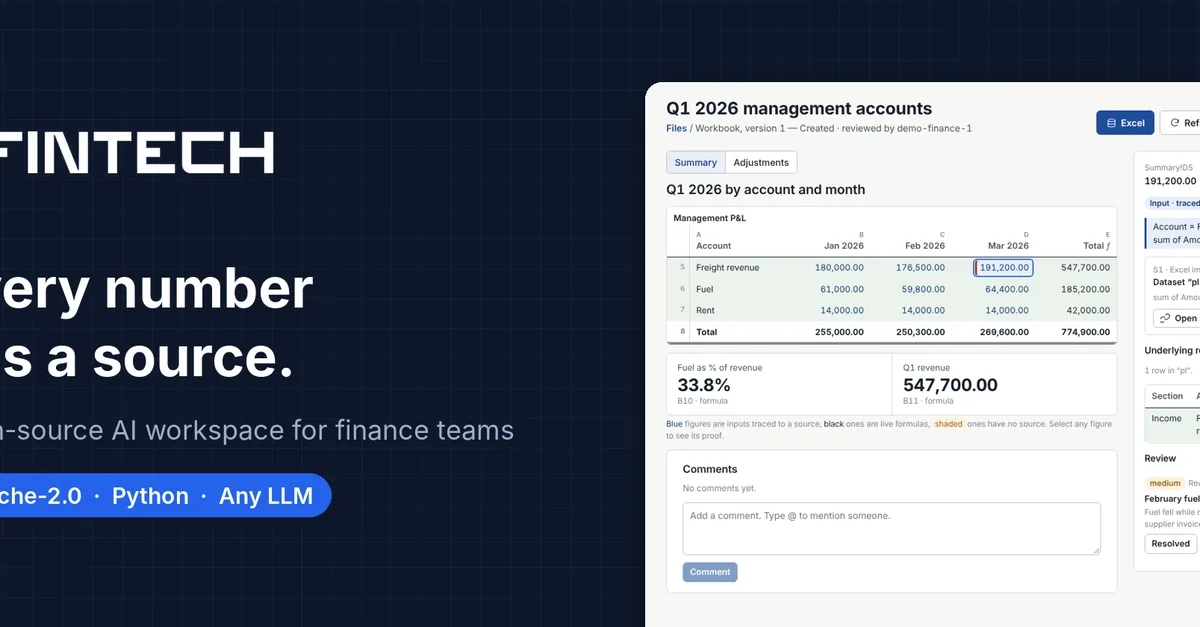
图示:来源页预览图(仅作编辑上下文;版权归属原发布方) · 来源引用:dev.to
1. What is OfinTech Desk, in one sentence?
A desktop AI workspace for finance that computes numbers in code and attaches a source to every figure it produces.
It's a local desktop application that reads your ledger, spreadsheets, documents and inbox; performs the arithmetic programmatically rather than letting a language model guess; and fills your own Excel and Word templates with results that carry a traceable provenance for each value. An optional self-hosted Team Server adds shared capability for teams, but the core product is a desktop app.
2. Is it genuinely open source?
Yes — v1.0.0 is fully open source under the Apache-2.0 license, published on GitHub.
Apache-2.0 is a permissive license: you can use it commercially, modify it, and distribute it, with patent protection included and attribution requirements that are relatively light. The repository is at OfinTech/ofinTech-Dask on GitHub. You can read the code, audit the arithmetic paths, fork it, or self-host the Team Server without asking permission.
3. What's the core problem it solves?
Unverifiable numbers. The typical failure of AI-for-finance tooling is a fluent narrative with no audit trail.
An LLM asked to "summarize the quarter" will happily produce a paragraph containing a revenue figure, a growth percentage, and a margin — some of which came from data it was given and some of which it reconstructed from statistical patterns. In finance, an unsourced number is worse than no number, because it looks like work product. OfinTech Desk's design constraint is that a figure without a provenance record is a bug, not a feature.
4. How does "every number has a source" actually work?
Each figure is produced by a computation that records which input values and which source documents it drew from.
In practice that means the pipeline separates two things that LLM-based tools usually blur together:
- Retrieval and interpretation — identifying which ledger rows, spreadsheet cells, or document passages are relevant to the question.
- Arithmetic — the actual aggregation, subtraction, ratio, or roll-up.
The second step runs as deterministic code against identified inputs. Because the inputs are pinned, the output carries a reference back to them. When you look at a filled-in Excel cell, you can trace the value to the ledger entries or documents that produced it, rather than trusting a generated sentence.
5. So the model doesn't do the math?
Correct. The model helps find, read and structure data; the arithmetic happens in code.
This is the single most important architectural choice in the project. Language models are unreliable calculators — they produce plausible-looking digits — but they are genuinely good at unstructured work: figuring out which sheet, which paragraph, which email thread matters. Splitting the responsibilities plays to each component's strength and makes the output reproducible. Re-run the same computation against the same inputs and you get the same number.
6. What data can it read?
Ledgers, spreadsheets, documents and inbox content.
That's the stated input surface: your accounting ledger, your Excel workbooks, your Word and PDF-style documents, and email. The intent is to cover the real spread of where finance data lives — not a clean single database, but a mess of exports, working files, contracts, and correspondence. The email side matters in particular because so many finance facts (approvals, confirmations, revised terms) arrive as messages rather than records.
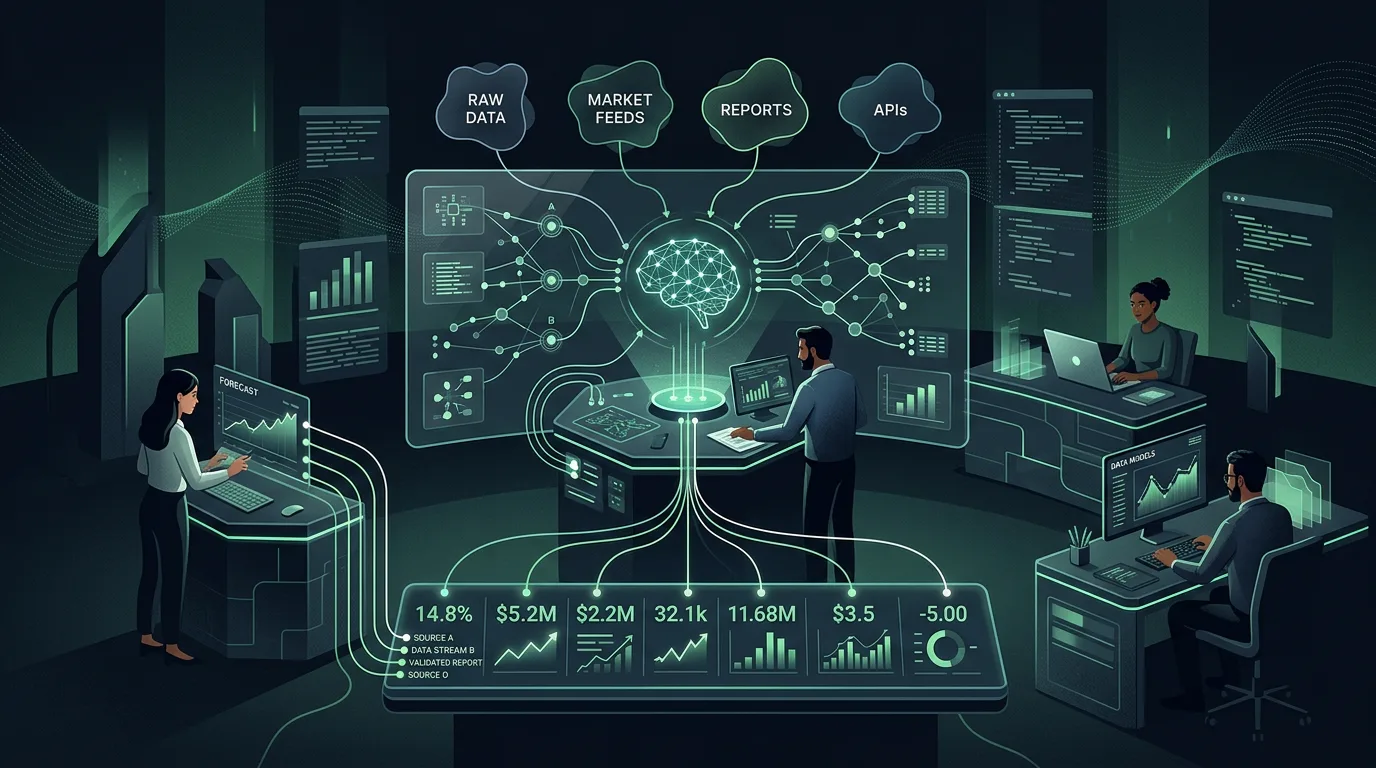
图示:HEXOPS 原创配图(受选题启发,非复制原文图片) · 来源引用:dev.to
7. Does it overwrite my Excel and Word files?
It writes into your own files — the templates and workbooks you already use — rather than generating separate output you have to paste in.
That's a deliberate ergonomic decision. Finance teams do not want a new document format; they want the model to fill in the model they already built. OfinTech Desk targets your existing Excel and Word artifacts and populates them, with each populated figure carrying its source. The alternative — generating a fresh report that someone then manually transcribes — introduces exactly the copy-paste error surface the tool exists to eliminate.
8. What is the Team Server, and do I need it?
It's an optional self-hosted component for sharing work across a team. The desktop app works without it.
You can run OfinTech Desk as a single-user local tool. If you want colleagues to share configurations, data access, or the outputs of the pipeline, you host the Team Server yourself. Self-hosting matters for finance specifically: ledger data and inbox contents are among the most sensitive material an organization holds, and "self-hosted" means the data path stays inside your own infrastructure rather than routing through a vendor's cloud.
9. Will it send emails or modify data on its own?
No. It asks a human before it sends or changes anything.
This is an explicit gate in the design: any action with external effect — dispatching a message, writing a change — requires human confirmation. The reasoning is straightforward. A model that is right about retrieval 95% of the time is still wrong often enough that unattended writes to a ledger or unattended outbound email are unacceptable. Human-in-the-loop is not a hedge here; it's the control that makes the rest of the automation usable in a regulated context.
10. Is this a hosted SaaS product?
No. It's a desktop application, with an optional self-hosted server.
There is no requirement to ship your ledger to a third party. That positioning is unusual in the current AI tooling market, where most finance assistants are cloud services by default. For teams with data residency constraints, procurement review, or a blanket prohibition on sending financial records to external APIs, an open-source desktop app with a self-hosted server option is often the only version of this capability that can be approved at all.
11. Does it replace an accountant or analyst?
No. It removes the manual assembly work around the numbers, not the judgment.
The tool's value is in the tedious middle layer: pulling figures from four places, doing the arithmetic consistently, and populating the reporting template. The things a professional adds — interpreting what the variance means, deciding which treatment applies, signing off on the result — remain human. What changes is that the professional reviews sourced figures instead of re-keying numbers to check someone else's work.
12. How do I evaluate it, and where do I start?
Read the source, run it on a small, boring dataset, and try to break the provenance chain.
Because it's Apache-2.0, you can inspect exactly how values are computed and how sources are attached before you trust it with anything. The practical test is adversarial: give it a ledger and an Excel template, ask for a figure, and then check whether the claimed source genuinely produces that value. A tool that survives that test is worth keeping. A tool that produces a confident number with a vague citation is the problem, not the solution.
The short version
OfinTech Desk is an open-source (Apache-2.0), desktop-first AI workspace for finance built around one constraint: every number must trace back to a source. It does arithmetic in code, writes into your existing Excel and Word files, gates outbound actions behind human approval, and offers a self-hosted Team Server for teams that cannot send financial data to a third party. The project is at v1.0.0 as of 27 October 2026, and the code is public.
Sources
- OfinTech Desk — announcement and engineering walkthrough (Dev.to): https://dev.to/rafmo20d/ofintech-desk-an-open-source-ai-workspace-for-finance-where-every-number-has-a-source-4066
- OfinTech Desk source code (GitHub, Apache-2.0): https://github.com/OfinTech/ofinTech-Dask
- Apache License 2.0 (SPDX): https://www.apache.org/licenses/LICENSE-2.0