
AI safety
An OpenAI-Compatible API for Language, Image, and Video: bblabu in a Real Stack
Figure: Editorial context image from the source page (preview only; rights remain with the publisher) · Credit / further reading: dev.to
Most teams don't pick an AI provider once. They pick it in the middle of a sprint, with an SDK already wired into three services, and the real question is never "which model is best" but "how much code changes if we're wrong." That's the niche an OpenAI-compatible endpoint is designed to fill, and it's the frame that makes bblabu worth a look — not as a model, but as a drop-in base URL.
This is a roundup-style evaluation: what bblabu actually is, where it fits alongside direct provider APIs and self-hosted inference, when the swap is smart, when it isn't, and which pricing details you should nail down before anyone ships to production.
What bblabu actually is
bblabu is an API station ("算力中心" — roughly, a compute center) that exposes multiple model families behind a single OpenAI-compatible surface. Per the announcement, the public site is https://api.bblabu.ai and the OpenAI-compatible base URL is:
https://api.bblabu.ai/v1
The homepage groups capabilities into three buckets:
- Language and reasoning — everyday chat, long-form analysis, coding, and agent workloads.
- Image creation — text-to-image, reference-image workflows, and image editing.
- Video generation — text-to-video and image-to-video, with duration as a selectable parameter.
That's the whole proposition. It is not a new model and doesn't claim to be. It's a routing layer with a familiar contract, and the contract is the product.
The compatibility trick, and why it matters
If your code already speaks the OpenAI REST shape, migration is mostly configuration:
from openai import OpenAI

client = OpenAI(
    base_url="https://api.bblabu.ai/v1",
    api_key=os.environ["BBLABU_API_KEY"],
)

resp = client.chat.completions.create(
    model="<model-id-from-the-dashboard>",
    messages=[{"role": "user", "content": "Summarize this changelog..."}],
)
Two caveats hide in that snippet. First, model is a string you must source from the provider's current model list — compatibility guarantees the envelope, not the contents. Second, "OpenAI-compatible" is a spectrum, not a boolean. Tool calling, structured outputs, streaming deltas, logprobs, and vision inputs are each independently implemented or skipped by every gateway on the market. Assume nothing.
Where bblabu differs from a pure text gateway is the breadth. Image and video generation usually live in separate SDKs and separate auth systems; here they're claimed under one key. For a product that generates a hero image, animates it, and writes the caption, collapsing three integrations into one is the actual selling point.
Where it fits in a stack
Think of the AI layer in three tiers, because your choice depends on which tier you're shopping in:
Tier 1 — direct provider APIs. Lowest latency ambiguity, fastest access to new features, cleanest compliance story. Cost: N integrations for N providers, and every model swap is a code change.
Tier 2 — compatibility gateways and routers (bblabu, and the same category as OpenRouter or a self-run LiteLLM proxy). One SDK, one key, many model families. Cost: an extra network hop, a second vendor in your data path, and a compatibility surface you don't control.
Tier 3 — self-hosted inference (vLLM, TGI, ComfyUI pipelines). Best unit economics at sustained volume, full data control. Cost: GPUs, ops, and a queueing story you now own.
bblabu is squarely Tier 2, with a wider modality spread than most text-only routers. That placement is the honest way to evaluate it — it competes with "we'll just call OpenAI and Anthropic directly and maintain two clients," not with a frontier lab.
When to use it
- Prototyping across modalities. You want a text model, an image model, and a video model behind one key before you've committed to vendors. This is the strongest use case.
- Provider-abstraction hedges. If your architecture is "one base URL, swap the
modelstring," a Tier 2 gateway is exactly the shape you designed for. Latency and pricing experiments become config changes. - Small teams without platform engineers. Maintaining three SDKs, three retry policies, and three rate-limit handlers is real work. One client is one thing to keep working.
- Bursty multimodal workflows. Idea → image → short video is a natural pipeline, and doing it under one credential removes a class of key-management bugs.
- Evaluation harnesses. If you're benchmarking prompt strategies across model families, a single endpoint makes the harness trivial to write.
When not to use it
- Regulated or data-residency-sensitive workloads. Every gateway is an additional processor in your data flow. If your DPA, subprocessor list, or residency requirements are settled, adding a hop requires a fresh review. Do that review before you write code, not after.
- You need a capability the wrapper doesn't pass through. If your system depends on prompt caching, specific structured-output schemas, fine-grained logprobs, or batch APIs, verify each one against the actual endpoint. "OpenAI-compatible" won't tell you.
- Latency is the product. An extra hop is usually small, but it is never zero, and video generation already has long tail latencies. If you're optimizing p95 for interactive UX, measure before and after.
- Volume is large and stable. Above a certain throughput, direct contracts or self-hosting beat any aggregator on unit cost. Gateways are most valuable when your needs are changing; they're least valuable when they've stopped changing.
- You need a contractual SLA tied to a specific model. When the abstraction is "some model in this family," you can't pin a guarantee to one of them.
Pricing caveats
The announcement page doesn't publish a rate card, so treat all of this as a checklist rather than a verdict. Before committing, get answers to these five:
- What's the billing unit for each modality? Text is usually tokens; images are usually per-image or per-megapixel; video is usually per-second of output, sometimes scaled by resolution and sometimes by input frames. Three different units mean three different budgets, and you can't compare a "cheap" plan without normalizing them.
- Is there a markup over upstream list price? Aggregators earn margin somewhere — either an explicit percentage, a credit spread, or a minimum commitment. Ask for the delta against calling the underlying provider directly; that number is your convenience fee.
- Credits vs. currency. Many stations sell prepaid credits. Credits expire, may not be refundable, and can be repriced. If procurement needs a predictable monthly line item, prepaid credits are an accounting problem even when they're a discount.
- Failure billing. Do you pay for a video job that times out at 90%? For a 429? For a stream that drops mid-response? Get this in writing — it's the most common surprise in multimodal billing.
- Rate limits and queue priority. Compatibility says nothing about throughput ceilings. A cheap per-token price with a low concurrency cap is an expensive price once you're queueing.
Also verify whether there's a free trial tier for smoke-testing before you fund an account — the announcement implies experimentation is expected, but don't assume the terms.
A migration checklist that takes an hour
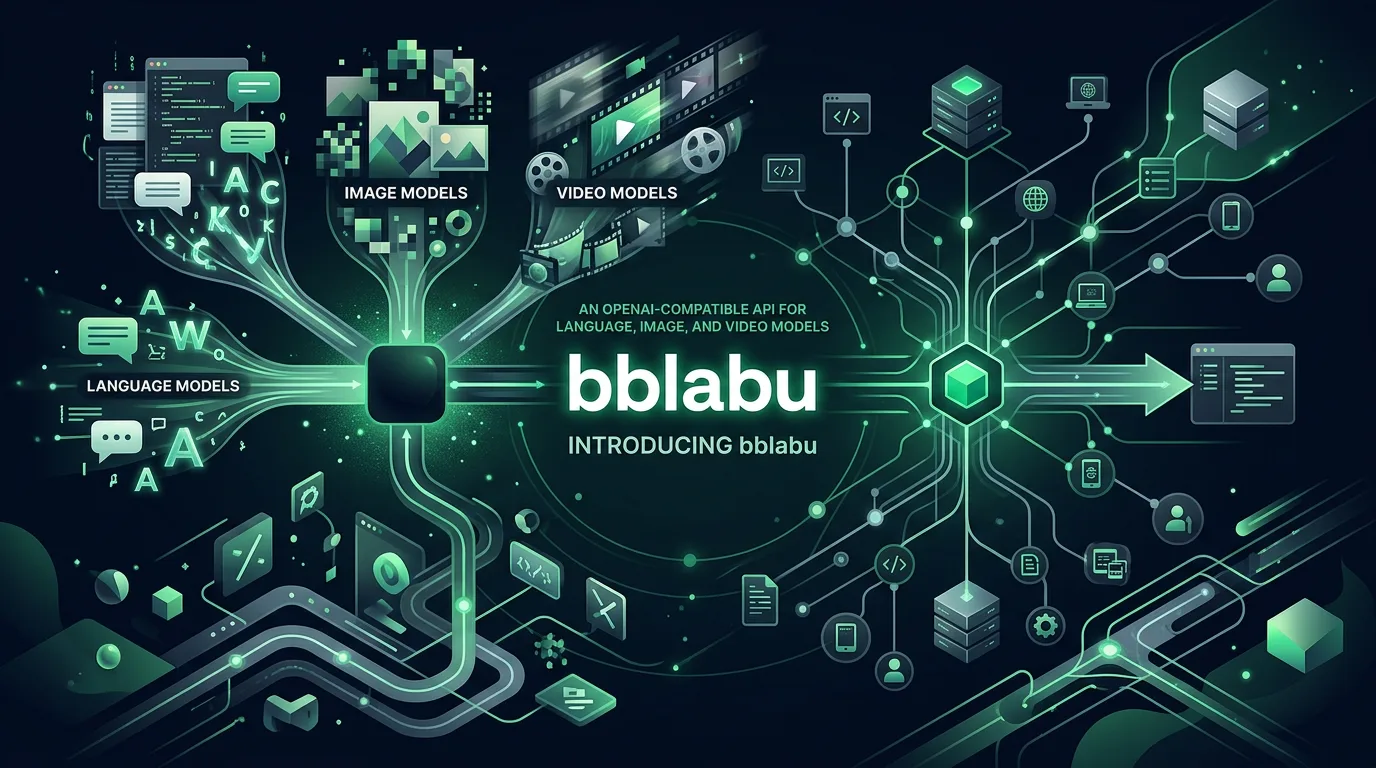
Figure: HEXOPS original illustration inspired by the topic (not a copy of the source article imagery) · Credit / further reading: dev.to
- Swap
base_urlandapi_keybehind an env var; never hardcode the endpoint. - Pin model IDs in config, not in application logic, so a deprecation is a config diff.
- Add a smoke test per modality: one chat completion, one image, one short video job.
- Wrap the client so you can route back to the original provider with a flag. This is your rollback.
- Log request ID, model string, latency, and billed units from day one. You will need them the first time an invoice looks wrong.
- Run a small A/B against your incumbent on quality, not just cost — a gateway changes the model, and that changes your output distribution.
Verdict
bblabu is a sensible Tier 2 bet if your problem is integration sprawl across modalities and your needs are still moving. The base-URL swap is genuinely cheap, the language/image/video coverage under one key is the differentiator, and the honest risks — compatibility gaps, an extra processor, opaque unit pricing — are all checkable in an afternoon. It's a poor fit if you're past the experimentation phase, need contractual model guarantees, or operate under strict data-residency rules.
The pragmatic move: keep the endpoint behind a single config value, prove it on one non-critical feature, and let the invoice and the p95 chart decide the rest.
Sources
- bblabu, "An OpenAI-compatible API for language, image, and video models: introducing bblabu" — https://dev.to/bblabu/an-openai-compatible-api-for-language-image-and-video-models-introducing-bblabu-1b7h
- bblabu public site — https://api.bblabu.ai