Engineering
The Download: the agentic web arrives and the drive for safer roads
Builder notes for website and software teams: architecture, ops, security, and delivery implications
Two signals in this edition of The Download are worth reading together. One is the arrival of the agentic web: the long-discussed idea, articulated by Tim Berners-Lee in 2001, of an internet navigated by autonomous software agents rather than only by humans clicking through pages. The other is the push to eliminate traffic deaths—a safety-critical automation problem with obvious lessons for any team building software that acts on the world.
For website and software teams, the practical takeaway is not “build a chatbot.” It is this: agents are becoming first-class clients of your systems, and systems that accept delegated action need explicit contracts, constrained permissions, auditability, cost controls, and fail-safe delivery. The safer-roads thread reinforces the same discipline: automation in consequential domains is not a demo; it is an engineering and operations program.

图示:来源页预览图(仅作编辑上下文;版权归属原发布方) · 来源引用:www.technologyreview.com
Architecture: treat agents as first-class clients
Most web architectures assume a human browser session: a login, a page view, a form post, a confirmation screen. Agents change the shape of traffic. They discover capabilities, call APIs, chain actions, retry, and sometimes act on behalf of a user without a human watching every step. That does not mean abandoning your web app. It means making the underlying capabilities explicit and safe to delegate.
Start with contract-first design. If an action matters, it should have a machine-readable contract: OpenAPI or JSON Schema, stable identifiers, versioning, error semantics, and clear preconditions. Agents should not have to scrape a UI or infer business rules from button labels. Keep human-facing pages, but expose the same capabilities through a governed API layer rather than a shadow “agent API” that drifts from the product.
Separate reads from writes, and writes from irreversible writes. A search or status check can be broad and cheap; a purchase, deletion, permission change, or external message needs stronger controls. Model consequential operations as explicit state machines with idempotency keys, async job handles, and webhooks or polling contracts. If an agent retries after a timeout, you need to know whether it created one order or three.
Put policy in one place. A policy layer should answer: which agent identity is calling, on whose behalf, with what scopes, against which budget, and with what approval threshold? Encode rate limits, spend caps, allowed domains, data classifications, and human-approval requirements as policy rather than scattering if statements across services. Agents are fast and persistent; policy must be centralized, testable, and observable.
Finally, publish operational metadata with your contracts: version, deprecation date, latency expectations, cost model, risk level, and required scopes. Agents—and the teams operating them—need to choose the right tool without reverse-engineering your production behavior.
Ops: run for delegated traffic
Agent traffic is not just more traffic. It is traffic that can loop, fan out, retry aggressively, and combine services in unexpected sequences. Your operations model needs agent-aware quotas, backpressure, and cost visibility.
Set quotas per agent identity and per delegated user, not only per IP address. Add budget alarms and spend caps for actions that cost money or consume third-party capacity. Use queues and async jobs for long-running work so agents cannot hold connections indefinitely or amplify load during incidents. Expose queue depth, job age, retry counts, and dead-letter rates as first-class metrics.
Tracing becomes more important, not less. A single delegated task may cross your API, an auth service, a policy engine, a job worker, and an external provider. Propagate a trace or task ID end to end, and write audit events that record the actor, the delegator, the action, the inputs that matter, the policy decision, and the outcome. Do not log secrets or unnecessary personal data. Audit logs should be useful for debugging, compliance, and after-action review—not just a compliance checkbox.
Build kill switches before you need them. You should be able to disable a risky action, revoke an agent identity, cap a scope, or force human approval without redeploying the entire product. Replay and dry-run modes are also valuable: let agents and operators test a plan against production-like state without committing the write.
Define SLOs by action class. A read-heavy discovery endpoint and a payment action have different failure costs. Track success rate, latency, retry rate, human-override rate, and cost per successful task. If an agent’s task success rate drops but your HTTP 200 rate stays high, your SLOs are measuring the wrong thing.
Security: assume tool misuse and prompt injection
Agentic systems expand the attack surface because they combine untrusted content with tools that can act. Treat agent input as untrusted, and never let model output directly execute privileged operations. Insert a deterministic policy and authorization layer between the agent’s intent and the action.
Use strong agent identity, short-lived credentials, delegated consent, and least-privilege scopes. Avoid long-lived shared API keys. Make consent receipts and permission changes visible to the human on whose behalf the agent acts. Defend against the confused-deputy problem: an agent with broad permissions should not be tricked by content from a low-trust source into acting on a high-trust resource.
Prompt injection is not only a model problem; it is an architecture problem. Sandbox tool calls, restrict egress, validate URLs and file paths, and protect against SSRF and data exfiltration. Keep secrets out of model context. Require human approval for irreversible or high-blast-radius actions, and make approvals specific: show the action, target, amount, and consequences.
Secure the supply chain too. If agents consume tool manifests or plugin descriptions, sign and verify them. Version and review changes. Red-team the agent paths, not just the web UI. Log policy denials and anomalies, and alert on unusual tool sequences, sudden scope use, or repeated approval requests. Security for the agentic web is mostly old security done more explicitly—identity, authorization, input validation, isolation, and audit—plus new attention to content-driven tool misuse.
Delivery: ship contracts, evals, and guardrails together
The delivery model changes when agents are clients. You need a sandbox where agents can discover and test capabilities without touching production data. You need contract tests and a conformance suite that check not only schemas but also error behavior, idempotency, rate-limit headers, and approval flows. You need documentation for humans and agents: examples, limits, deprecation policy, and a changelog.
Treat agent behavior as a product surface with evaluations. Measure task success, safety violations, cost per task, and human-override rates. Canary new actions or scopes to a small agent population before broad release. Use feature flags by action risk, and make rollback a first-class path. Run incident drills that include revoked credentials, disabled tools, and forced human approval.
The safer-roads thread is a useful discipline check. Safety-critical automation relies on safety cases, simulation, redundancy, staged deployment, telemetry, and fast incident response. Most website teams are not building vehicles, but the pattern applies to any agent that can spend money, change permissions, send external messages, or delete data. Write down the failure modes. Define what “fail safe” means for each action. Test the recovery path, not just the happy path.
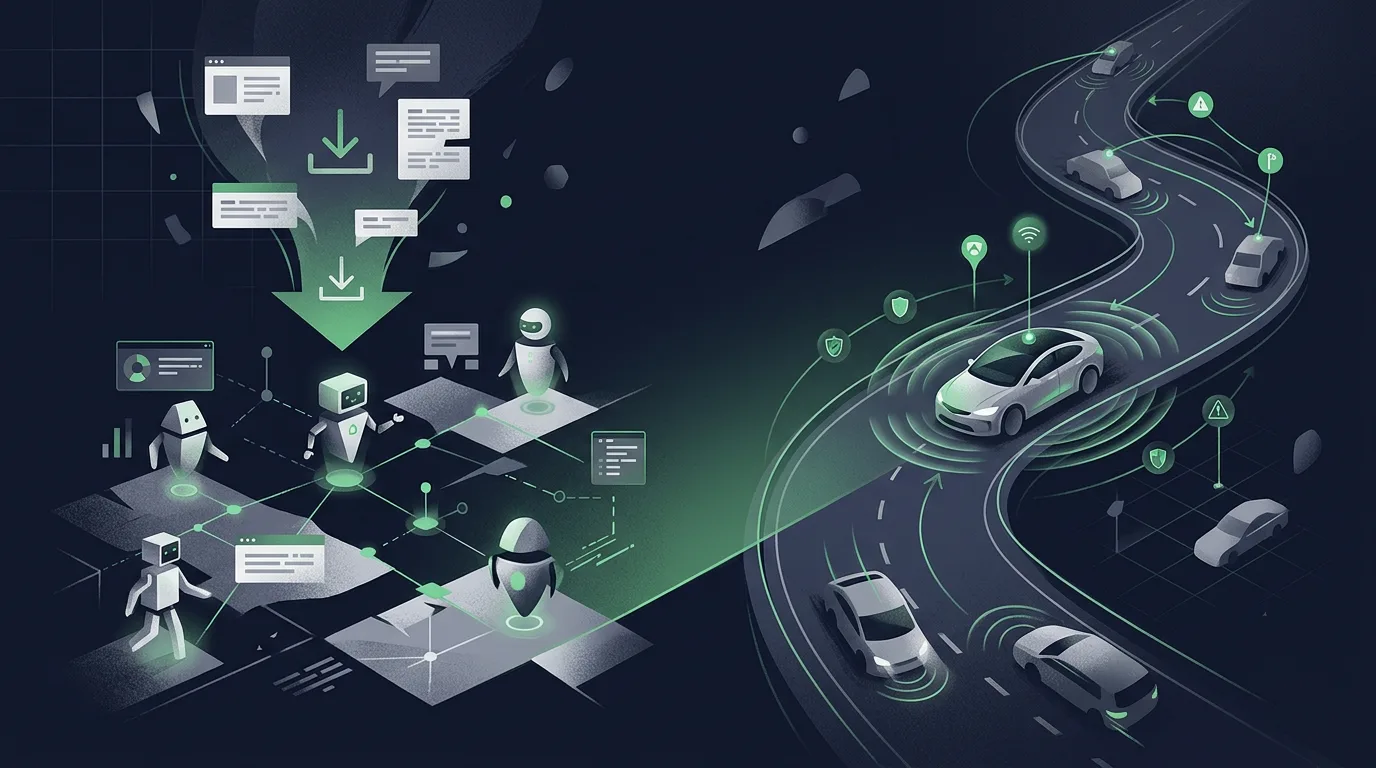
图示:HEXOPS 原创配图(受选题启发,非复制原文图片) · 来源引用:www.technologyreview.com
A practical 30/60/90-day plan
First 30 days: inventory consequential write actions; assign risk levels; require scoped agent identities; define an audit event schema; add per-agent quotas and budget alarms.
Next 60 days: expose a contract-first API for the highest-value actions; add idempotency and async job patterns; build a sandbox; centralize policy decisions; add dry-run and approval workflows; improve end-to-end tracing.
Next 90 days: add agent conformance tests and evals; canary by agent population; red-team prompt-injection and tool-misuse paths; run an incident drill with kill switches; publish versioning and deprecation policy; review data retention and consent receipts.
Bottom line
The agentic web does not require every team to rebuild around autonomous agents tomorrow. It does require teams to stop treating automation as a thin layer over human UI. Make delegation explicit, permissions narrow, actions auditable, costs bounded, and failure recoverable. The drive for safer roads is a reminder that the more software acts on the world, the more the boring engineering—contracts, verification, observability, and staged rollout—becomes the product.
Sources
- MIT Technology Review, The Download: the agentic web arrives and the drive for safer roads: https://www.technologyreview.com/2026/11/02/1147889/the-download-agentic-web-arrives-eliminating-traffic-deaths/