Engineering
Local AI on a PC: What Actually Works (Builder Notes)
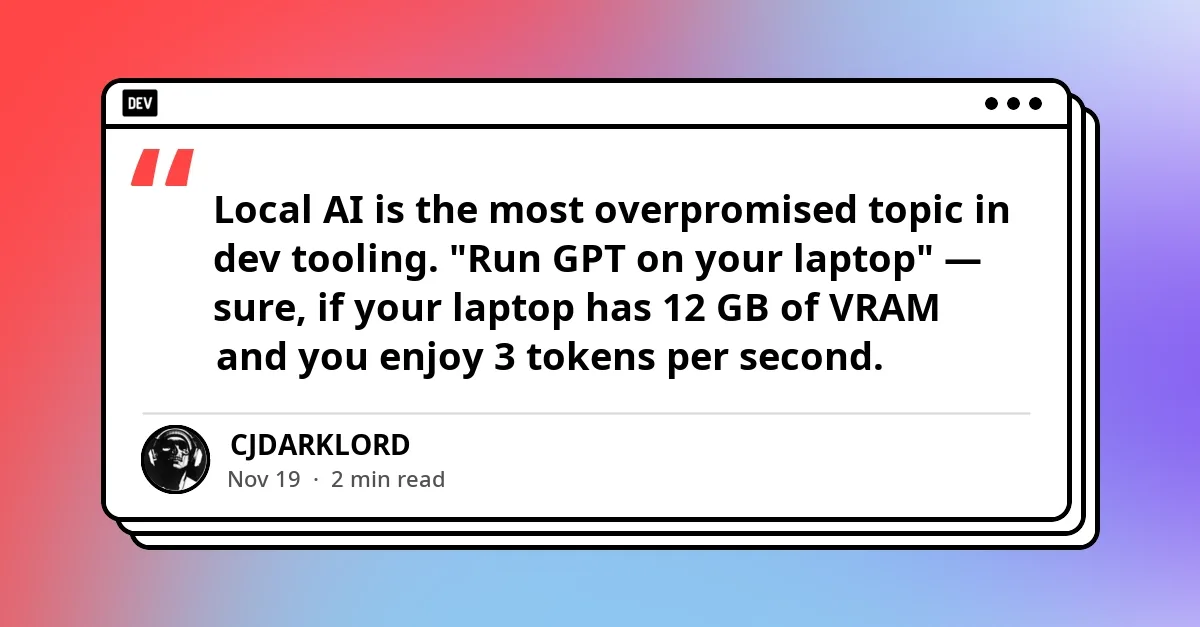
Local AI is the most overpromised topic in dev tooling. "Run GPT on your laptop" sells, but what you're actually buying is a deployment topology — a latency budget, a hardware contract, and an ops surface — not a product feature. Teams get burned because they evaluate local models with a chatbot demo and then ship them into a product where a 40-second wait is unacceptable, or where a hallucinated transcript becomes a support ticket.
The useful reframe: local AI works when it's a batch pipeline with a bounded job, and fails when it's an interactive assistant. Some workloads genuinely clear that bar today. Here's the honest breakdown, with the architecture, ops, security, and delivery implications each one drags in.
The three workloads, ranked by "actually works"
1. Speech recognition — the clear winner
faster-whisper (CTranslate2 backend, int8 quantization) is the best value-per-watt local model available to most teams. The source analysis reports medium int8 on an RTX 2070 using roughly 4.4 GB of VRAM and processing a 30-second fragment in 0.36–1.62 s depending on speech density. CPU inference works, several times slower — fine for overnight batch transcription, too slow for live subtitles.
That's a real capability, and it's the one to build on. But three operational realities:
- Hallucination on silence is a documented Whisper failure mode. Feed it music, dead air, or a noisy room and it will confidently invent sentences. Never ship raw output. Gate with a VAD pass, respect the no-speech probability, and add a repetition detector for the classic looped-output failure.
- RTF (real-time factor) is your SLA unit, not "latency." Promise "under 8 minutes per hour of audio," not "fast."
- Diarization is a separate problem. Whisper gives you text and timestamps; "who said this" needs another model and another failure mode.
2. LLMs — real, but only in the narrow lane
A 7–8B model at Q4_K_M lands around 4–5 GB and produces somewhere in the range of single-digit to low-teens tokens per second on consumer GPUs. That is not a chat product. It is a workable engine for batch extraction, classification, summarization, and structured rewriting where the job finishes while the user is doing something else.
The design rule that makes this safe: constrain the output shape. JSON schema, enum classification, fixed-field extraction. Free-form generation on a small model is where quality falls off a cliff and where you can't write a regression test. If your spec says "the model writes the email," you need a cloud model. If it says "the model tags this ticket with one of nine categories," local works and you can measure it.
3. Translation — split decision
Dedicated NMT models (Opus-MT per language pair at a few hundred MB, or NLLB-200 for breadth) are dramatically cheaper than asking an LLM to translate, and they're deterministic enough to test. LLM-based translation wins on tone, idiom, and context — but you pay for it in VRAM and in variance. Check the license before the model: NLLB-200 is CC-BY-NC, which quietly kills commercial use. This is the single most common licensing landmine in local-AI stacks.
图示:来源页预览图(仅作编辑上下文;版权归属原发布方) · 来源引用:dev.to
Architecture: model as a local service, not a library call
The mistake is importing the model into your web process. It serializes your concurrency, pins GPU memory for the life of the worker, and makes a model upgrade a full redeploy.
Instead:
- One process owns the GPU. Expose it over localhost HTTP or a Unix socket with a narrow schema (
audio → transcript,text → label). Your app talks to it like any other dependency. - Queue in front of it, with concurrency 1 per GPU. Batch by workload class. A transcription queue and an extraction queue should not compete for 4.4 GB.
- Two implementations behind one interface.
Transcriberhas a local backend and a cloud backend. Feature-flag the swap. This is your escape hatch when a customer's laptop has an 8-year-old driver, and it's also how you A/B quality. - Warm up on boot. The first inference pays CUDA kernel compilation. Health checks that fire a real 1-second job catch a broken install before a user does.
Ops: the parts that page you at 2am
VRAM budgeting is not optional. Model weights plus KV cache plus 500 MB–1 GB of CUDA context overhead. Don't co-locate two models on one card unless you've measured the sum under load. Run a preflight at install: query VRAM and driver version, and fail with a human-readable message rather than an OOM at first use.
Pin the driver matrix. CUDA, cuDNN, PyTorch, and CTranslate2 versions form a compatibility lattice that breaks silently. On Linux, containerize with the GPU runtime pinned. On Windows consumer machines — where you have no container — ship a pinned wheel set and refuse to run outside it. torch alone is multiple gigabytes; that's an installer-size decision, not an afterthought.
Watch the right metrics. Queue depth, real-time factor distribution, empty-output rate (a good hallucination proxy), and WER on a golden set of 20–50 audio files with known transcripts. Model upgrades ship behind that golden set or they don't ship. Laptops thermally throttle; a p95 RTF that doubles after 10 minutes of sustained load is a hardware fact, not a bug.
Treat model weights as build artifacts. Version them, hash them, store them, and pin the download revision. "Latest on the hub" is not reproducible.
Security: local isn't automatically safe
Four things teams get wrong.
- Model downloads are a supply chain. Hugging Face hosts pickle-based
.bin/.ptfiles that are code-execution vectors. Prefersafetensors, pin an explicit revision hash, and verify checksums. In an airgapped deployment, vendor the weights — that's the whole point of going local. - The document is untrusted input. If you feed a user-supplied PDF to an LLM, everything in that PDF is a prompt. The moment the model's output drives an action — a file write, an API call, a routing decision — a stranger has a control channel into your system. Keep model output on a short leash: schema validation, allowlists, and no tool calls from untrusted text.
- Data locality ≠ data safety. Going local removes egress, then adds new copies: temp WAV files, transcript caches, crash dumps, debug logs full of PII. Define retention explicitly. On shared GPUs, use process-per-tenant rather than trusting memory hygiene between requests.
- Licenses travel with weights. Whisper is MIT. Piper is MIT. NLLB is non-commercial. Llama's license carries user-count thresholds and naming requirements. A model license is a legal dependency in your
NOTICEfile, exactly like a code dependency.
图示:HEXOPS 原创配图(受选题启发,非复制原文图片) · 来源引用:dev.to
Delivery: what to promise, and how not to look stupid
Sell throughput, not latency. "Transcribes an hour of audio in a few minutes, on your machine, no upload" is a promise local Whisper keeps. "Instant" is a promise it breaks.
Ship a hardware preflight and a graceful fallback. Detect, inform, offer the cloud path. A user who sees "your GPU has 3 GB; local transcription will be slow — switch to cloud?" is a user who trusts you. A user who sees a stack trace is a churn event.
Put the model behind a versioned contract. {model, version, quantization, language} in the response metadata. When quality complaints arrive — and they will — you need to know which weights produced that output.
Write the acceptance tests before the feature. A golden set of audio, a labeled extraction set, a term-glossary translation set. Regression-test on every model swap. This is the difference between a demo and a product.
| Workload | Verdict | Notes |
|---|---|---|
| Speech-to-text (batch) | Ship it | faster-whisper int8, VAD-gated, RTF SLA |
| Speech-to-text (real-time) | Caution | CPU too slow; GPU-only feature |
| Structured extraction / classification | Ship it | Small model, schema-constrained, golden-set tested |
| Free-form generation / chat | Don't | Quality and latency both fail |
| Translation (dedicated NMT) | Ship it | Check license first |
| Translation (LLM) | Conditional | Better tone, higher VRAM, less testable |
| TTS (Piper-class) | Ship it | Small, CPU-viable, low drama |
The through-line: local AI is a cost and privacy play, not a capability play. It buys you zero marginal inference cost, no egress, and offline operation — in exchange for hardware variance, model-license homework, and a ban on interactive UX. Teams that price that trade honestly ship useful products. Teams that don't ship demos and then a migration.
Sources
- Local AI on a PC: what actually works (Whisper, translation, LLMs) — https://dev.to/cjdarklord/local-ai-on-a-pc-what-actually-works-whisper-translation-llms-1323
- faster-whisper (CTranslate2 backend) — https://github.com/SYSTRAN/faster-whisper
- Whisper model card and hallucination notes — https://github.com/openai/whisper
- CTranslate2 quantization and performance docs — https://opennmt.net/CTranslate2/
- NLLB-200 model card (license terms) — https://huggingface.co/facebook/nllb-200-distilled-600M
- Hugging Face safetensors and pickle security guidance — https://huggingface.co/docs/hub/security-pickle
- Piper TTS — https://github.com/rhasspy/piper