Comparison
Small-Team Feature Toggle Service Using Node.js: Detailed Pricing Trade-offs Explained
图示:来源页预览图(仅作编辑上下文;版权归属原发布方) · 来源引用:dev.to
Short answer: For a small team running Node.js services, pick Flagsmith when on-premise control and data residency matter, LaunchDarkly when real-time streaming and integration depth matter, and ConfigCat or GrowthBook when you want a simpler hosted rollout without a dedicated platform owner. But the pricing decision only becomes legible once every toggle is measured by three things: support-loop latency, outcome, and cost.
That framing matters more than it sounds. A feature flag is only useful in a support agent or similar Node.js workload if its evaluation can be tied to a real answer, a real latency figure, and a real cost number. The operational constraint changes the choice. Small teams need enough context to explain a slow or expensive loop, but not so much telemetry that every flag read becomes a new cardinality problem in your observability bill.
Why list pricing misleads small teams
Feature-flag vendors price in three incompatible currencies, and comparing them head-to-head is where most small teams go wrong:
- Per seat. You pay for humans who can edit flags. Cheap for a 4-person team, brutal once QA, support, and product all need read access.
- Per MAU / client-side evaluation. You pay for end users. This is fine for a marketing site and dangerous for a backend service that evaluates flags server-side for every request, because your "MAU" is really your request volume in disguise.
- Per evaluation / per streaming connection. You pay for read volume. This is the fairest model for Node.js backends but the easiest to blow through during an incident when retry storms multiply evaluations.
The hidden fourth cost is self-hosting labor. A free open-source license on a two-node Postgres-backed deployment is not free — it is roughly 4–8 hours a month of a senior engineer's attention, plus on-call exposure. Price that at your loaded hourly rate before declaring self-hosting the cheap option.
The four realistic options
Flagsmith — open source core, strong self-host story, straightforward Node SDK. Pricing is tiered by seat plus a monthly floor; the self-hosted path is genuinely production-viable rather than a demo. Trade-off: fewer built-in experimentation statistics than GrowthBook, and real-time updates require more configuration than LaunchDarkly.
LaunchDarkly — the most polished Node server SDK, excellent streaming (SSE) updates, and the richest integration surface. Pricing is seat-based with tiers that step up sharply as you add environments and projects. Trade-off: cost grows with organizational breadth, not usage; a small team with many microservices can hit tier boundaries uncomfortably fast.
ConfigCat — deliberately simple, flat-ish monthly pricing with a generous free tier, config propagated via CDN with polling. Node SDK is small and dependency-light. Trade-off: less sophisticated targeting and almost no experimentation layer; you are buying flag delivery, not a decision platform.
GrowthBook — open source, warehouses-native experimentation, free self-hosted tier, cloud priced per seat. Node SDK supports both feature flags and experiment assignment. Trade-off: the value proposition assumes you already have a data warehouse and someone who enjoys SQL.
Criteria table
| Criterion | Flagsmith | LaunchDarkly | ConfigCat | GrowthBook |
|---|---|---|---|---|
| Primary pricing axis | Seats + floor | Seats + tier limits | Flat monthly tier | Seats (cloud) / free self-host |
| Usable free tier | Yes, limited seats | Trial only | Yes, genuinely usable | Yes, self-hosted |
| Self-host option | Strong (open source) | No | No | Strong (open source) |
| Node.js SDK quality | Good | Excellent | Good, minimal | Good |
| Real-time updates | Polling / configurable | Streaming (SSE) | CDN polling | Polling / streaming |
| Experimentation stats | Basic | Good | Minimal | Best in class |
| Ops burden if self-hosted | Medium | N/A | N/A | Medium–high |
| Best small-team fit | Regulated / data-residency needs | Integration-heavy products | Simple hosted rollouts | Warehouse-backed teams |
Treat the pricing column as directional only — every vendor on this list has changed packaging within the last couple of years, and annual commitments routinely move the effective number by 20–40%. Verify current list prices before you build a budget around them.
The trade-off that actually bites: evaluation volume
Here is where Node.js specifically changes the math. Server-side flag evaluation happens per request, and a support-agent loop may evaluate several flags per turn. If your vendor meters evaluations, a single retry storm can multiply your monthly bill in an afternoon. If your vendor meters seats, that same storm costs nothing but burns your rate limit.
Three practical mitigations, all of which belong in your Node.js service regardless of vendor:
import { FlagEvaluator } from './flags.js';

// Cache evaluations for a short TTL — flags change far less often than requests arrive.
const cache = new Map();
const TTL_MS = 15_000;

export async function flag(key, context) {
  const cacheKey = `${key}:${context.userId ?? 'anon'}`;
  const hit = cache.get(cacheKey);
  if (hit && Date.now() - hit.at < TTL_MS) return hit.value;

  const value = await FlagEvaluator.evaluate(key, context);
  cache.set(cacheKey, { value, at: Date.now() });
  return value;
}
Bound the cache by user count, not by time alone — an unbounded Map keyed on user ID is a memory leak with extra steps. And keep the TTL short enough that a kill-switch flip still propagates within one support interaction.
Instrument at three boundaries, not everywhere
My default is to instrument the agent loop at exactly three points: flag evaluation, model call, and final support outcome. That gives you a defensible cost-per-outcome without turning every flag read into a metric with a user ID label attached.
Concretely: record evaluation count and latency at the flag boundary, token and dollar cost at the model boundary, and a resolved/escalated/abandoned label at the outcome boundary. Join them on a request ID, not a user ID. This keeps cardinality flat and lets you answer the only question that matters at renewal time — did the flags we shipped last quarter reduce cost per resolved ticket, or just add a config surface?
If a vendor's pricing model can't be reconciled against those three numbers within an afternoon of work, that is itself a signal. Either the metering is opaque or your instrumentation is, and both failures show up as budget surprises.
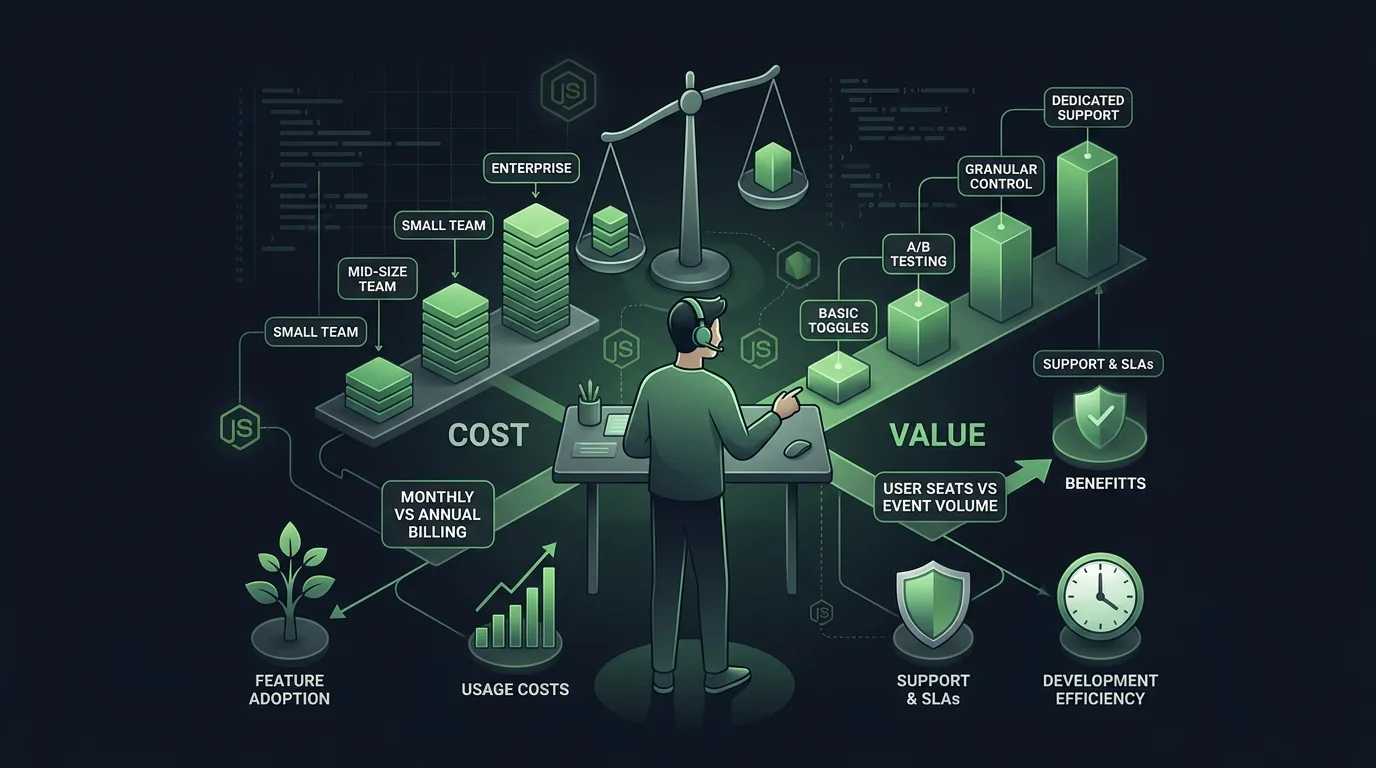
图示:HEXOPS 原创配图(受选题启发,非复制原文图片) · 来源引用:dev.to
Recommendation by scenario
You handle regulated data or need on-prem. Choose Flagsmith. The self-hosted deployment is real, the Node SDK is unremarkable in the good way, and you avoid the line item where a compliance review forces you into an enterprise tier anyway. Budget the ops time explicitly.
Real-time propagation is a product requirement. Choose LaunchDarkly. If a support agent must change behavior mid-conversation when a flag flips, streaming updates are not a nice-to-have and polling latency becomes a user-visible bug. Accept the seat pricing; you are buying the integration surface.
You have four engineers and no platform owner. Choose ConfigCat. Flat pricing, CDN delivery, and a Node SDK you can read in ten minutes. You will outgrow the targeting model, and that is a fine problem to have later.
You already run a warehouse and want experiments, not just toggles. Choose GrowthBook. Self-hosted is free, the stats engine is the differentiator, and the Node SDK covers flag evaluation cleanly.
You are genuinely unsure. Start on ConfigCat or self-hosted Flagsmith for one quarter, instrument the three boundaries, and let the measured cost-per-outcome pick your vendor at renewal. Choosing on price alone means optimizing the number you can see while ignoring the two you cannot.
Sources
- Original article: Small-Team Feature Toggle Service Using Node.js: Detailed Pricing Trade-offs Explained
- Flagsmith documentation and self-hosting guides — https://docs.flagsmith.com
- LaunchDarkly Node.js server SDK reference — https://docs.launchdarkly.com/sdk/server-side/node-js
- ConfigCat Node.js SDK and pricing pages — https://configcat.com/docs/sdk-reference/node
- GrowthBook feature flag and experimentation docs — https://docs.growthbook.io
Pricing structures and tiers cited here are directional and change frequently; confirm current list prices and contract terms with each vendor before committing.