Engineering
Google's Gemini 4 Argon, Connected Apps and Custom Skills Reshape AI Workflows
Builder notes for website and software teams — architecture, ops, security, and delivery implications.
Google is moving Gemini in three directions simultaneously: a new flagship model (Gemini 4 Argon), a broader set of connected apps, and demonstrated custom skills plus reusable prompt commands. Individually these are feature updates. Taken together they change what kind of integration you are actually building. You are no longer wiring a chat box to an API — you are handing an agent a toolbelt that reaches into your business systems, and you are letting end users extend that toolbelt themselves.
That shift has real consequences for how we design systems, gate access, meter spend, and ship changes. Below is a builder-focused read of what to plan for.
图示:来源页预览图(仅作编辑上下文;版权归属原发布方) · 来源引用:dev.to
What actually changed
According to the announcement, Google positions Argon as its flagship frontier model aimed at deep, long-horizon work across coding, finance, legal, cybersecurity, and science. Three practical threads matter for engineering teams:
- A stronger default model. Long-horizon work — multi-file refactors, document-heavy analysis, multi-step research — is where the model positioning focuses. If your product currently breaks tasks into many small calls because the model loses the thread, that assumption is worth re-testing.
- Connected apps. Gemini can reach into external business tools rather than only answering from its own context window. This is the biggest architectural change: data now flows from your SaaS estate into the model session.
- Custom skills and reusable prompt commands. Repeatable tasks can be packaged and invoked, which moves prompt engineering from a per-user craft to a versioned artifact your team owns.
The summary is explicit about the caveat that matters most to builders: access details, rollout specifics, and usage-based API costs need close verification. Treat the announcement as a directional signal, not a spec sheet. Regional availability, admin controls, and quota behaviour will decide whether your roadmap is a two-week task or a two-quarter one.
Architecture: build an adapter, not a dependency
The single highest-leverage decision is to keep the model behind an internal interface. If Argon turns out to be excellent for your long-horizon workloads, you want to switch a config value — not rewrite prompt plumbing.
Concretely:
- Model adapter layer. One module owns model selection, system prompt assembly, retry policy, and response normalisation. Everything upstream speaks your domain types, not provider types.
- Separate the three capabilities. Model quality, connected-app data access, and skill/prompt reuse fail in different ways. Instrument and roll them out independently. A degraded connector should not take down your summarisation endpoint.
- Treat connected apps as an ingestion boundary. Data pulled from external tools should land in your own normalised shape before it touches prompts. This gives you a place to redact, truncate, and cache — and a place to audit.
- Design for long-running sessions. Long-horizon work implies multi-minute tasks. That means async job patterns, resumable state, and a UI that shows progress rather than a spinner. Synchronous request/response will not survive contact with a 90-second agent run.
For custom skills, the mental model that holds up is skills as code. They need a repository, review, semantic versioning, and a changelog. If your organisation lets non-engineers author reusable prompts, those prompts are production artefacts and should be treated as such — with an owner, a test set, and a rollback path.
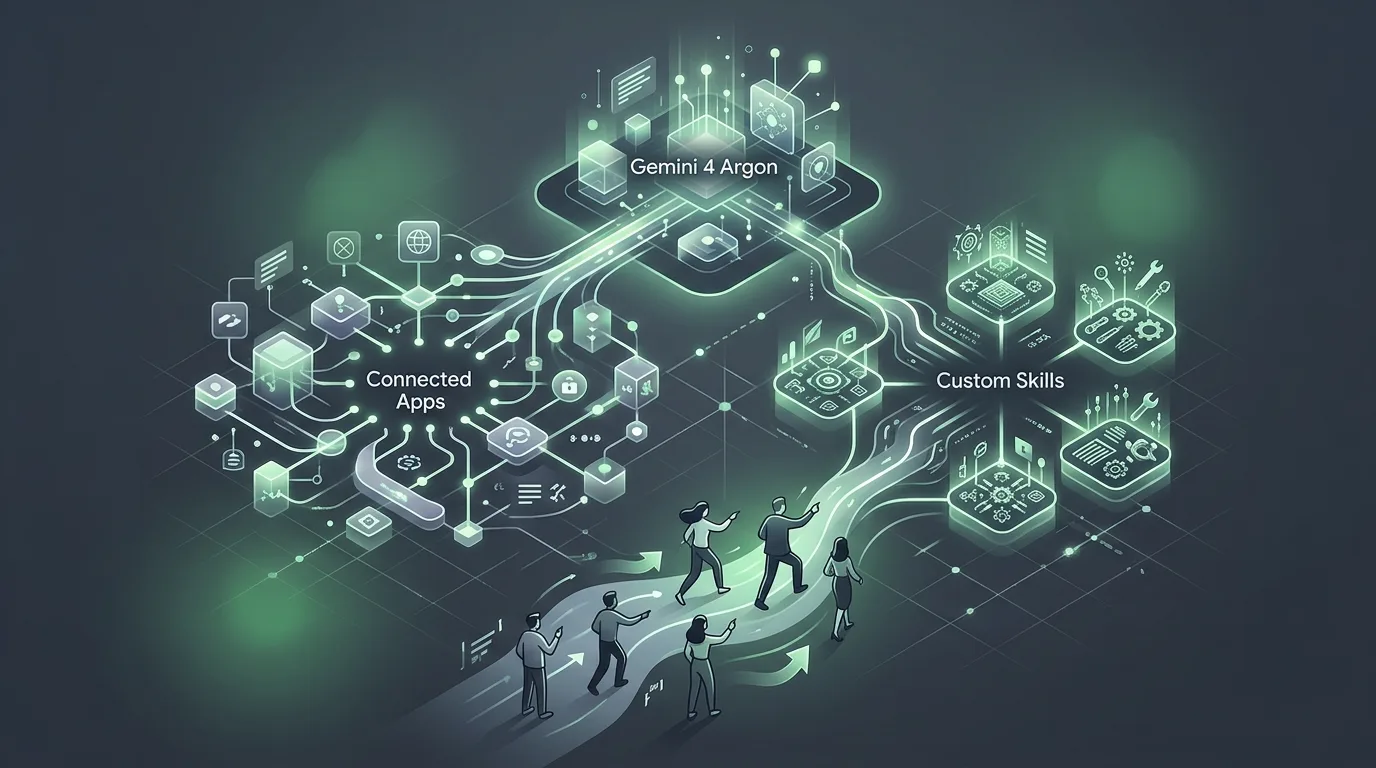
图示:HEXOPS 原创配图(受选题启发,非复制原文图片) · 来源引用:dev.to
Ops: cost, quota, and the observability gap
Usage-based API pricing plus agentic, multi-step tasks is a combination that produces surprising invoices. A single user-visible action can fan out into dozens of model calls, connector fetches, and retries.
Practical controls:
- Per-tenant token and spend budgets, enforced in your gateway, not in the client. Fail closed with a clear user-facing message rather than silently truncating.
- Cost attribution by feature. Tag every request with feature, tenant, and skill version. You cannot price a feature you cannot measure.
- Cache aggressively at the boundary. Connected-app reads are often repeatable within a session. Cache normalised results with short TTLs and deduplicate identical fetches across steps in one agent run.
- Cap the loop. Every agent loop needs a maximum step count, a wall-clock deadline, and a token ceiling. Unbounded loops are how you discover your provider's rate limits at 3 a.m.
- Golden-set evaluation in CI. A model swap is a behaviour change. Keep a curated set of representative tasks with expected outcomes and run it on every prompt or model change. Track pass rate, latency, and cost per task — not just quality.
- Prompt and skill versioning in traces. Log the exact skill version and system prompt hash with each response. When a user reports a bad answer three days later, you need to reconstruct what actually ran.
The rollout question is the one most teams under-plan: if Argon is available in some regions and not others, your feature flag strategy needs to be regional from day one, with a graceful fallback model path.
Security: connected apps are the new attack surface
Connecting business tools to a model is a data-flow decision with a security budget attached. Three risks deserve explicit design time.
Scope creep. Connected apps invite broad OAuth grants — "read all documents" is easy to click and hard to unwind. Request the narrowest scope that satisfies the feature, and make disconnection a first-class, one-click action that actually revokes rather than hides.
Prompt injection via retrieved content. The moment external documents, tickets, or emails enter the context, you have untrusted input in an instruction-following channel. A document can contain text that tells the model to do something. Mitigations: never let retrieved content grant new tool permissions, keep tool authorisation decisions in deterministic code, and mark untrusted content clearly in the prompt structure. Treat every connector as an untrusted source.
Data residency and retention. Data flowing into a model session may leave your region and may be retained depending on tier and admin settings. For regulated workloads, confirm enterprise data controls before enabling connectors — and write down the answer, because "someone checked" is not an audit trail.
Also consider: custom skills are a shared-code surface. A skill authored by one team but usable org-wide can leak data it was never scoped for. Apply the same review gate to skills as to internal APIs.
Delivery: ship it in slices
The temptation is to ship "Gemini integration" as one release. Resist it. Sequence it:
- Model swap behind the adapter. No new features, just measure quality, latency, and cost against your golden set. Decide with data.
- Custom skills for internal, low-risk tasks. Reusable prompts for summarisation, ticket triage, changelog drafting. Prove the authoring and review workflow before exposing it.
- One connected app, read-only, one team. Instrument every fetch. Watch for injection attempts and anomalous call volume.
- Expand scope and write access last. Every added capability needs a revocation story and a kill switch.
Keep a per-capability kill switch. If a connector starts leaking or a skill misbehaves, you want to disable that slice without redeploying the product.
What to do this week
- Put the model behind an adapter interface if it isn't already.
- Add per-tenant token budgets and feature-tagged cost logging.
- Build a 30-task golden set from real user requests and wire it into CI.
- Inventory which connected apps you would actually enable, with the minimum scope for each.
- Draft a skill-review process: owner, version, test set, rollback.
The strategic point of the announcement is not the model. It is that AI work, business tooling, and repeatable tasks are converging into one surface. The teams that win will be the ones whose architecture already treats models as swappable, connectors as untrusted, and prompts as versioned code.
Sources
- Google's Gemini 4 Argon, Connected Apps and Custom Skills Reshape AI Workflows — the source article this analysis is based on.
- Introducing Gemini 4 Argon — Google — vendor announcement referenced in the source; verify current model availability, connected-app access, and pricing before committing to a roadmap.