GEO
Ignite 2026 Turns Azure Into an Agent Platform: The Search and GEO Consequences
Ignite weeks are always a firehose. Fifty announcements, a dozen "GA" badges, and a keynote that treats every feature as equally revolutionary. Strip the gloss and this year's Azure Weekly summary lands on a single thesis: Azure is rebuilding itself around agents as the primary workload. Models, gateways, Kubernetes, and observability all moved this week with that assumption baked in — not as a sidecar for humans clicking through the portal, but as the thing the platform is for.
图示:来源页预览图(仅作编辑上下文;版权归属原发布方) · 来源引用:dev.to
That has an under-discussed second-order effect. If agents are the workload, agents are also the audience. The documentation, changelogs, and launch posts describing Azure are increasingly read by retrieval systems and autonomous buyers rather than by a person with three browser tabs open. Which means the Ignite announcement cycle is now a generative engine optimization problem as much as a marketing one.
What shipped
| Area | Announcement | Status |
|---|---|---|
| Models | GPT-6.2 Astra and GPT-6.2 Sol in Foundry | GA |
| Governance | Azure AI Gateway (standalone service) | GA |
| Kubernetes | Managed GPU node pools, CVM node pools on Azure Container Linux | GA |
| Kubernetes | AKS AI Manager for Foundry, Agent… | (announcement truncated in source) |
Read the table as a stack rather than a list. Models at the top, a gateway in the middle that governs and routes traffic, Kubernetes underneath providing the compute substrate, and an AI Manager that binds Foundry workloads to the cluster. Each row is a different layer of the same bet: inference is commoditizing, so the durable value moves to the control plane around it.
The Azure AI Gateway going standalone is the tell. A gateway implies many models, many consumers, quota, policy, and audit — the concerns you have when agents, not applications, are calling. Managed GPU node pools and CVM node pools on Azure Container Linux say the same thing from the infrastructure side: agent workloads need accelerators and confidential compute, and they need them scheduled like normal pods. AKS AI Manager for Foundry closes the loop by treating an agent runtime as a first-class Kubernetes object.
Why this matters beyond the launch post
Three things follow from "agents are the primary workload," and none of them are in the keynote.
First, the buyer changes. An agent evaluating whether to use Azure AI Gateway does not read your blog post top to bottom. It retrieves a chunk, checks it against two other chunks, and either cites you or doesn't. Your document is competing at the passage level, not the page level.
Second, the versioning surface explodes. Ignite ships GA, preview, and "coming soon" in the same breath. GPT-6.2 Astra versus Sol, standalone gateway versus the gateway embedded in Foundry, GPU node pools versus CVM node pools — every one of those is a distinct entity with a distinct lifecycle. Ambiguity here is expensive, because a retrieval system that can't tell preview from GA will confidently tell a user the wrong thing.
Third, the docs become an API. When an agent is provisioning infrastructure, your reference page is functionally a schema. Broken headings, missing parameter tables, and prose-only examples are no longer UX debt — they're integration failures.
Indexing: fix the fragmentation before you optimize anything
The Ignite announcement itself is a good case study in what goes wrong. The canonical detail lives on Microsoft Learn; the narrative lives on the Azure blog; the community reaction lives on dev.to. Search engines handle that reasonably well with canonicals. Retrieval systems handle it less well, because they often index the derivative post and cite it — which is fine for the derivative author and bad for the platform that wants to be the source of truth.
Practical fixes:
- One canonical URL per concept, with
dateModifiedmaintained. A GA date is a fact. Publish it as one, in one place, and link to it everywhere else. - Keep versioned docs crawlable but explicitly labeled.
/preview/in the path plus a visible status line in the first paragraph beats a banner rendered by JavaScript. - Don't hide critical facts behind client-side rendering. If "GA" only appears after hydration, assume some crawlers never see it.
Structured content that survives extraction
Retrieval favors self-contained passages. That has concrete implications for how you write about a platform like this:
- Make every H2 section answer a question on its own. Assume the reader arrives mid-page with no context.
- Repeat the entity name. "Azure AI Gateway," not "the gateway," at least once per section. Coreference resolution across chunks is unreliable.
- Use tables for lifecycle matrices. GA/preview/retired is tabular data; prose obscures it.
- Quantify. "Standalone GA service" is extractable. "Significantly improved" is not.
- Add a TL;DR at the top. Three bullets that a model can lift verbatim without misrepresenting you.
For schema, TechArticle with datePublished, dateModified, and about pointing at the product entities is low-effort and unambiguous. It won't win you citations on its own, but it removes a class of errors.
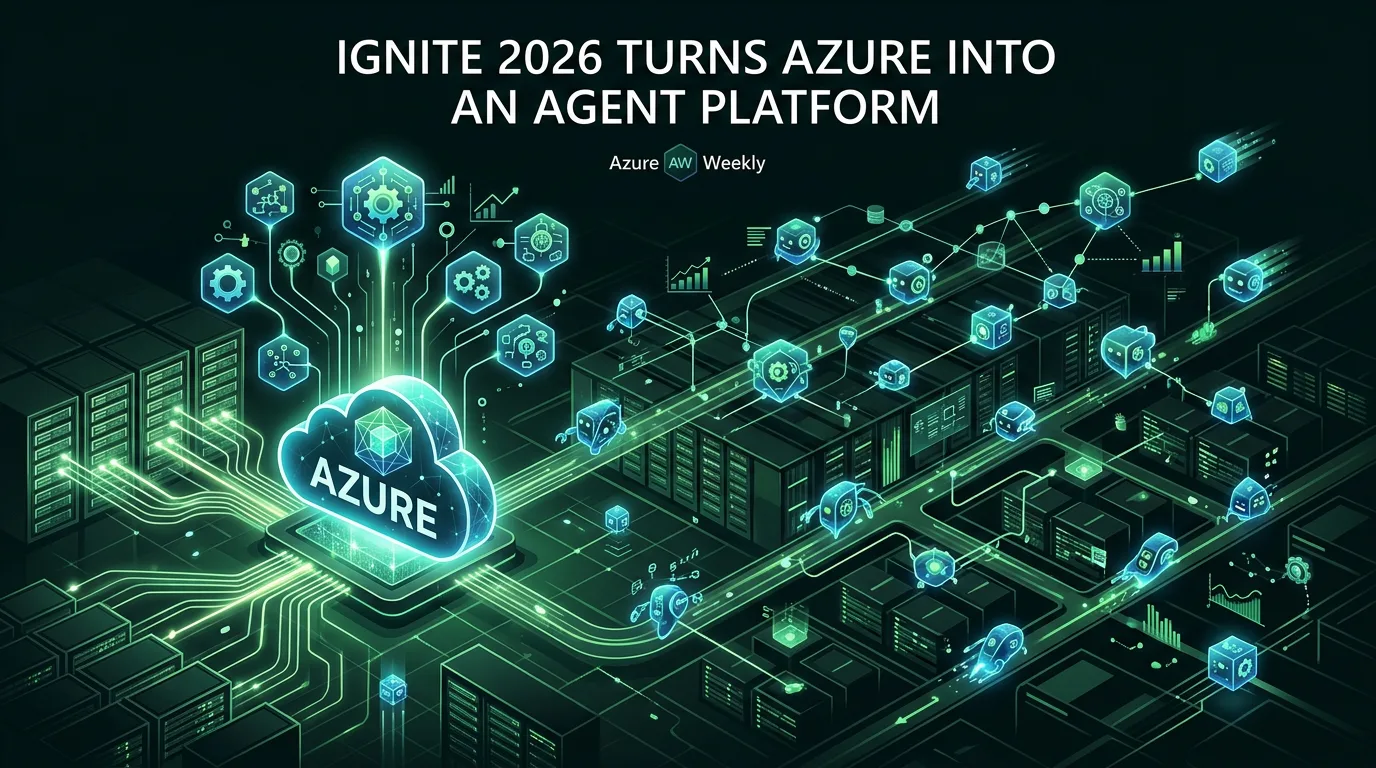
图示:HEXOPS 原创配图(受选题启发,非复制原文图片) · 来源引用:dev.to
Where llms.txt actually fits
llms.txt is a proposed convention — a Markdown file at the site root that gives language models a curated map of your content, with an optional llms-full.txt carrying the whole corpus. The pitch is that your sitemap is optimized for crawlers and your HTML is optimized for browsers, so neither is great for a model trying to find the right page.
Be honest about the state of play: major model providers do not officially consume llms.txt as a ranking or retrieval signal today, and adoption is inconsistent. Treating it as an SEO lever is a mistake. Treating it as inexpensive hygiene is not.
For a platform shipping at Ignite cadence, it's genuinely useful as a machine-readable changelog index:
- A short intro stating what the site covers and the date of last review.
- Links grouped by lifecycle — GA first, preview second, deprecated last.
- One-line descriptions that name the product and the status, not marketing copy.
- A separate file for the deep reference material.
That structure helps human readers, internal search, and any retrieval system that does pick it up. It also forces you to confront the fragmentation problem.
Getting cited by AI answers
Citations are earned at the claim level. Three things correlate with being the source an answer engine quotes:
Specificity. "GPT-6.2 Astra and GPT-6.2 Sol are GA in Foundry" can only come from a source that named both. Generic coverage gets aggregated; specific coverage gets cited.
Stability. Pages that move, rename, or silently rewrite their claims get down-weighted over time. Pin your URLs.
Attribution discipline. If you cite the Ignite keynote, link it. Sources that cite sources are easier to trust and easier to verify, and verification is what an answer engine is doing when it decides between two candidate passages.
One more: write the question. Agents decompose multi-hop queries — "how do I attach a GPU node pool to a Foundry agent" splits into the node pool, the agent runtime, and the binding between them. If your content only covers each piece in isolation and never states the connection, you'll be cited for the parts and lose the answer.
The takeaway
Ignite 2026 is a platform pivot, and platform pivots always outrun their documentation. The gap between what shipped this week and what is clearly, structuredly, verifiably documented is where the next six months of confusion lives — for humans and for the agents Azure is now built to run. Closing that gap is not a marketing task. It's infrastructure.
Sources
- Azure Weekly: Ignite 2026 Turns Azure Into an Agent Platform — https://dev.to/htekdev/azure-weekly-ignite-2026-turns-azure-into-an-agent-platform-1i7
llms.txtproposal and specification — https://llmstxt.org