AI agents
Most AI coding agents do not commit their work. They edit files, run tests, and iterate in a loop, but the final state is often the only artifact a developer sees. When something breaks three turns later, the team has no commit history to inspect, no diff to bisect, and no reliable way to reproduce the agent’s path. That is the reproducibility gap — and it is becoming the next bottleneck in AI-assisted software delivery.
The reproducibility gap in agentic coding
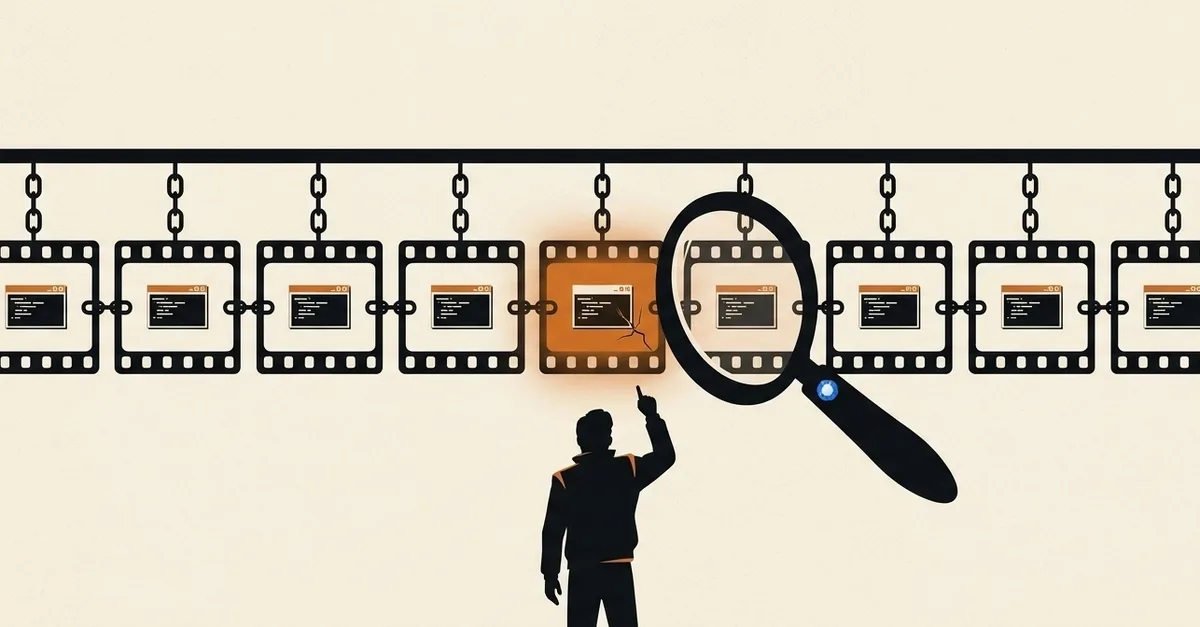
Figure: Editorial context image from the source page (preview only; rights remain with the publisher) · Credit / further reading: dev.to
Agentic tools are built for speed. A model receives a task, proposes a patch, executes commands, observes results, and repeats. Each turn can change multiple files. But unless the harness explicitly commits, those intermediate states vanish. Traditional version control assumes a human decides when to commit; agents rarely do. Even when they do, commit messages are sparse and the granularity is wrong for debugging. If a test starts failing after turn 17, you want to know what changed at turn 13, not just the final diff.
The source tip describes a pattern: snapshot every agent turn to a git ref, then use git bisect to find the turn that introduced a regression. The idea is simple and powerful. Git refs are cheap, content-addressed, and already understood by every engineering team. A ref like refs/agent/run-123/turn-17 points to a tree that captures the working directory at that moment. You can diff refs, check out old states, and bisect across them. It turns an opaque agent loop into a series of testable checkpoints.
Why git refs are a natural fit
Git is a content-addressable filesystem with a graph on top. Committing every turn is not the only way to snapshot; you can create tree objects and refs without polluting the main branch history. That matters because agent turns are noisy. You do not want hundreds of WIP commits in your pull request. You want a separate namespace — refs/agent/... — that can be garbage-collected on a schedule. The bisect workflow then becomes mechanical: mark the last known good ref, mark the first known bad ref, and let git find the boundary.
This is not just a debugging trick. It is an observability primitive. Logs tell you what the agent said; traces tell you which tools it called; refs tell you what the code actually looked like. Together, they close the loop between intent and outcome. For teams running agents in CI, snapshots also provide an audit trail for compliance and incident review.
The counterpoint: not every turn deserves a ref
Figure: HEXOPS original illustration inspired by the topic (not a copy of the source article imagery) · Credit / further reading: dev.to
The pattern has real costs. Git repositories are not designed for high-frequency snapshots of large working trees. If every turn creates a full tree object, storage grows quickly, especially with binaries, node_modules, or generated assets. Refs accumulate and slow down tooling if not pruned. There is also a privacy risk: snapshots may capture secrets, customer data, or proprietary code that should not persist. And bisecting across turns can be misleading if the agent’s environment changed — different dependencies, model versions, or external services.
So the opinion here is not ‘snapshot everything forever.’ It is ‘snapshot deliberately.’ Treat turn-level refs as ephemeral observability data, not as permanent history. Set retention windows, exclude sensitive paths, and run snapshots in a dedicated ref namespace. For most teams, a 7–30 day retention is enough to debug a regression, while long-term artifacts should be explicit commits or release tags.
A 30-day action plan
Week 1: Instrument the agent loop. Identify where a turn begins and ends. Capture the working tree hash, the tool calls, and the model version. Start with a single repository and a single agent workflow.
Week 2: Add a snapshot policy. Create refs under refs/agent/
The trend is clear: as agents take on more autonomous work, reproducibility becomes a first-class requirement. The teams that treat agent state as versioned data will debug faster, ship safer, and learn more from failures. The teams that do not will keep asking the same question: ‘What did the agent actually change?’
Key takeaways
- AI agents often skip commits, leaving no reliable history for debugging.
- Snapshotting each turn to a git ref creates checkpoints that can be diffed and bisected.
- Use a separate ref namespace and a retention policy to avoid repo bloat.
- Exclude secrets and large generated files; treat snapshots as ephemeral observability data.
- A 30-day plan: instrument, snapshot, bisect, then harden privacy and retention.
Next steps
- Audit one agent workflow this week and identify the turn boundary.
- Prototype a snapshot script that writes to refs/agent/ and prunes after 14 days.
- Run a tabletop bisect exercise with a known regression.
- Share the workflow with your platform team and document the privacy rules.