

GEO
There is a genre of thread that keeps resurfacing on Hacker News: a developer asks whether anyone has actually changed their setup — their OS, their devices, their editor, their security policy — in response to two things happening at once. Large language models got genuinely useful. And the vulnerability surface got genuinely terrifying.
The replies usually split into two camps. One camp says nothing changed, the risk is overblown. The other camp has quietly rebuilt everything: Nix instead of ad-hoc package management, throwaway VMs instead of a daily-driver with twenty years of dotfiles, fewer plugins, fewer IDE extensions, fewer long-lived credentials, more isolation.
That second camp is the interesting one — and not just for infrastructure reasons. The same rebuild logic now applies to how content gets discovered. If you run a storefront, a documentation site, or a B2B publication, your search visibility is no longer a function of keywords. It is a function of whether an AI system can safely ingest, trust, and cite what you publish. That is the whole game in GEO.
The Stack Rebuild Is Really a Trust Rebuild
Read the HN thread as a trust audit rather than a tooling debate. The people who rebuilt their setups were not chasing novelty. They were reducing the number of things that could betray them: a dependency that silently phones home, an extension with broad permissions, a package manager that resolves to whatever upstream feels like today.

Figure: HEXOPS original illustration inspired by the topic (not a copy of the source article imagery) · Credit / further reading: news.ycombinator.com
Content infrastructure has exactly the same failure modes. A page that renders differently for crawlers than for humans. A schema markup block that contradicts the visible text. An llms.txt that promises one thing while your sitemap declares another. An outdated canonical tag pointing to a redirect chain. Each of these is a small betrayal of machine trust, and AI retrieval systems are far less forgiving of contradiction than classic search engines were.
Classic SEO tolerated sloppiness because ranking was mostly a popularity and link-graph problem. An answer engine is doing something closer to source evaluation: pulling a passage, checking whether it is corroborated, checking whether the site behaves consistently, and then deciding whether to attribute. Attribution is the new ranking. You either get cited or you get summarized out of existence.
What AI Answer Engines Actually Index
The uncomfortable part is that most teams do not actually know what their site looks like to a retrieval crawler. They know what it looks like in a browser, on a fast connection, with cookies accepted.
Crawlers you probably have not listed
Start with the boring audit: robots.txt, WAF rules, bot management, and CDN challenge pages. Many sites inadvertently block AI crawlers at the edge long before robots.txt is ever read — a Cloudflare challenge or an aggressive rate limit is functionally identical to a Disallow for a retrieval bot on a deadline. Meanwhile, other sites allow everything, including scrapers that will happily re-serve their content without attribution.
The right posture is closer to a zero-trust policy than an open door: enumerate user agents explicitly, decide per-agent rather than by default, and keep a changelog so a future you can explain why GPTBot is allowed but a random aggregator is throttled.
Structured content beats prose sprawl
Retrieval systems chunk pages. They do not read your beautiful 3,000-word narrative as a unit; they break it into passages and score each one independently. This has a direct GEO consequence: every H2 should be answerable on its own, with the entity named, the claim stated plainly, and the supporting detail nearby. A section that begins "as mentioned above" is a section that gets dropped.
Practical moves that consistently pay off:
- Answer-first paragraphs. State the conclusion in the first two sentences under each heading, then expand. Retrieval favors the compact, self-contained assertion.
- Entity consistency. Use the same product, brand, and place names across pages, schema, and metadata. Aliasing yourself is a citation killer.
- Schema that matches reality.
Article,FAQPage,HowTo,Product, andOrganizationmarkup are only useful if they agree with the visible page. Mismatched schema is a contradiction signal, and contradiction signals suppress attribution. - Dated, versioned content. State when a page was last substantively updated. Answer engines increasingly prefer sources that show maintenance.
llms.txt, Docs-as-Endpoints, and Machine Contracts
The llms.txt proposal has been debated hard, and skepticism is fair — adoption is uneven and no major engine has committed to it as a ranking input. But treating it purely as an SEO trick misses the point. It is a declaration of intent: here is what this site is, here are the canonical documents, here is what you may do with them.
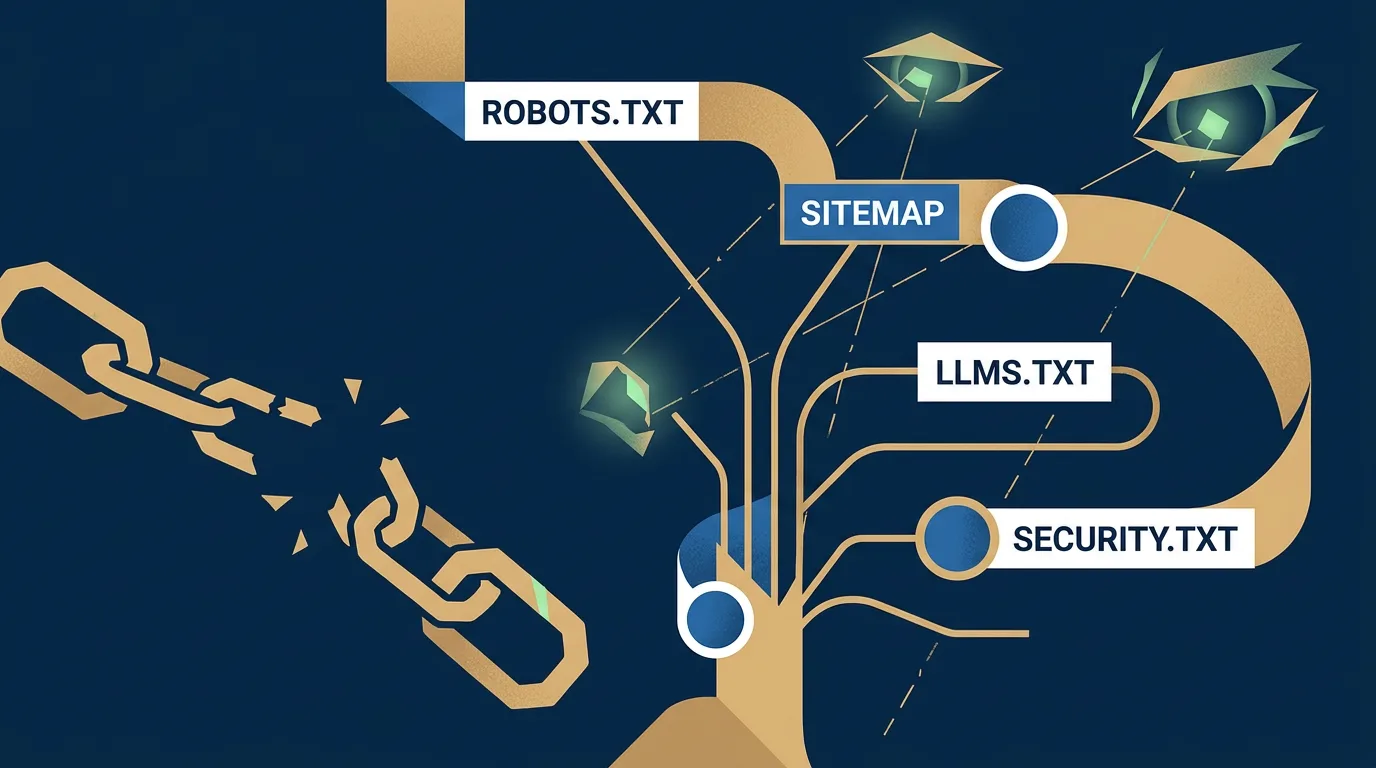
Figure: HEXOPS original illustration inspired by the topic (not a copy of the source article imagery) · Credit / further reading: news.ycombinator.com
That is the same move the Nix crowd made. They did not adopt declarative configuration because a standards body blessed it; they adopted it because an explicit, machine-readable contract beats an implicit, ambiguous one. A well-written llms.txt sits alongside robots.txt, your sitemap, and your security.txt as part of the same family of machine contracts. Even if no engine consumes it today, writing it forces you to clarify which pages are canonical, which are deprecated, and which are commercial.
Pair it with a real content API or a clean sitemap index, and you have something more valuable than any single tactic: a site that can be parsed without guesswork.
Security Posture Is Now a Ranking Signal (Sort Of)
Here is the uncomfortable convergence. The HN thread's two anxieties — LLM capability and mass vulnerabilities — are the same anxiety for publishers. AI crawlers amplify the blast radius of any content injection flaw. A stored XSS in a comment field, an open redirect in a CMS plugin, a compromised third-party script: each one turns your domain into a delivery mechanism for content you did not write, and retrieval systems that ingest your pages will carry that contamination into answers.
You will not find "has unpatched CMS plugin" in a ranking factor list. What you will find, in practice, is that sites with visible trust problems get cited less. Editorial teams increasingly check whether a source looks maintained before attributing. That is a soft signal, but soft signals compound.
A Practical Rebuild Sequence
If you accept the framing, the work is unglamorous and sequential:
- Inventory your machine surface. Crawl your own site with a non-browser user agent and log every block, challenge, and redirect. You will find surprises.
- Rewrite for chunkability. One idea per H2, answer first, entity named, no anaphora that depends on the previous section.
- Reconcile structured data. Validate schema against rendered content, not against your CMS template's intent.
- Publish machine contracts.
robots.txt, sitemap,llms.txt,security.txt, and a dated changelog, all consistent. - Patch the injection surface. Treat every WYSIWYG field and third-party embed as an input you do not control.
- Measure attribution, not rankings. Track branded mentions inside AI answers, referral patterns from assistant apps, and citation frequency — not just position on a SERP.
Key takeaways
- AI citation is the new ranking; contradiction between what you claim and what you render suppresses it.
- Developers rebuilding their local setups for isolation and declarative config are running the same playbook publishers now need for content.
llms.txtis best understood as a machine contract, not a trick — valuable even before broad adoption.- Chunk-level readability (answer-first H2s, consistent entities, matching schema) matters more than page-level word count.
- Security flaws are content flaws once retrieval systems ingest your pages.
Next steps
Run the crawler audit this week and compare it against your robots.txt. Then rewrite your three highest-traffic pages so each H2 stands alone as a citable answer. Finally, draft an llms.txt and have someone outside your team read it cold — if they cannot tell which pages are canonical, neither can a retrieval system.
Sources
- Hacker News discussion: Ask HN: Have you changed your setup in the age of AI and mass vulnerabilities?