Deep dive
How Cisco Defends at Machine Speed with OpenAI
Security operations have a throughput problem. Defenders must ingest enormous volumes of telemetry, correlate weak signals across network and identity systems, decide what matters, and act before an attacker pivots. Cisco’s collaboration with OpenAI, as summarized in OpenAI’s Cisco cyber case study, pairs Cisco’s network intelligence with OpenAI models to build more adaptive enterprise defenses. The important question is not whether a language model can summarize an alert. It is whether Cisco can turn telemetry, context, and model output into bounded action faster than an adversary can exploit the gap between detection and response.
This analysis examines the likely mechanism behind that approach, the trade-offs Cisco and its customers must manage, who benefits, and where the risks concentrate. The public description is high-level, so the architecture below is an analytical model of how such a system has to work—not a claim about every implementation detail.
The core thesis: machine speed is an architecture, not a chatbot
“Machine speed” in security does not mean letting a model run unchecked across the enterprise. It means compressing the loop from signal to context to decision to containment. A chatbot bolted onto a firewall does not do that. An architecture does.
Cisco’s advantage is not only model access. It is proximity to network intelligence: DNS, email, identity, endpoint, cloud, firewall, proxy, VPN, and threat-intelligence signals. OpenAI models add a layer of semantic reasoning over messy, unstructured, and semi-structured data—alert text, incident notes, logs, policies, and analyst intent. The combination can make defenses more adaptive if, and only if, the model’s output is grounded in evidence and constrained by deterministic controls.
How the mechanism likely works
1. Collect and normalize network intelligence
The first layer is data. Cisco’s security and networking portfolio can observe traffic patterns, identity behavior, DNS requests, email content, endpoint events, and cloud activity. Raw telemetry is noisy. Before any model sees it, the system must normalize events, resolve entities—user, device, application, IP, asset—and build a timeline. This is where network intelligence becomes context rather than volume.
A useful system also attaches business context: asset criticality, user privilege, exposure, geography, and prior incidents. Without that, a model can produce a technically accurate but operationally wrong recommendation.
2. Add semantic context with OpenAI models
OpenAI models are strongest where language and ambiguity are involved. In a security workflow, that could include summarizing an incident, explaining why an alert fired, translating a natural-language query into a search or policy request, correlating disparate signals, or drafting a response plan. The model can help an analyst ask, “What changed on this identity before the lateral movement?” rather than manually stitching together dashboards.
But the model should not be the system of record. A robust design uses retrieval and grounding: the model receives relevant telemetry and policy context, cites evidence, and returns a structured output. High-volume, low-ambiguity classification should stay with deterministic rules, signatures, or smaller specialized models. The large model is reserved for ambiguity, investigation, and communication.
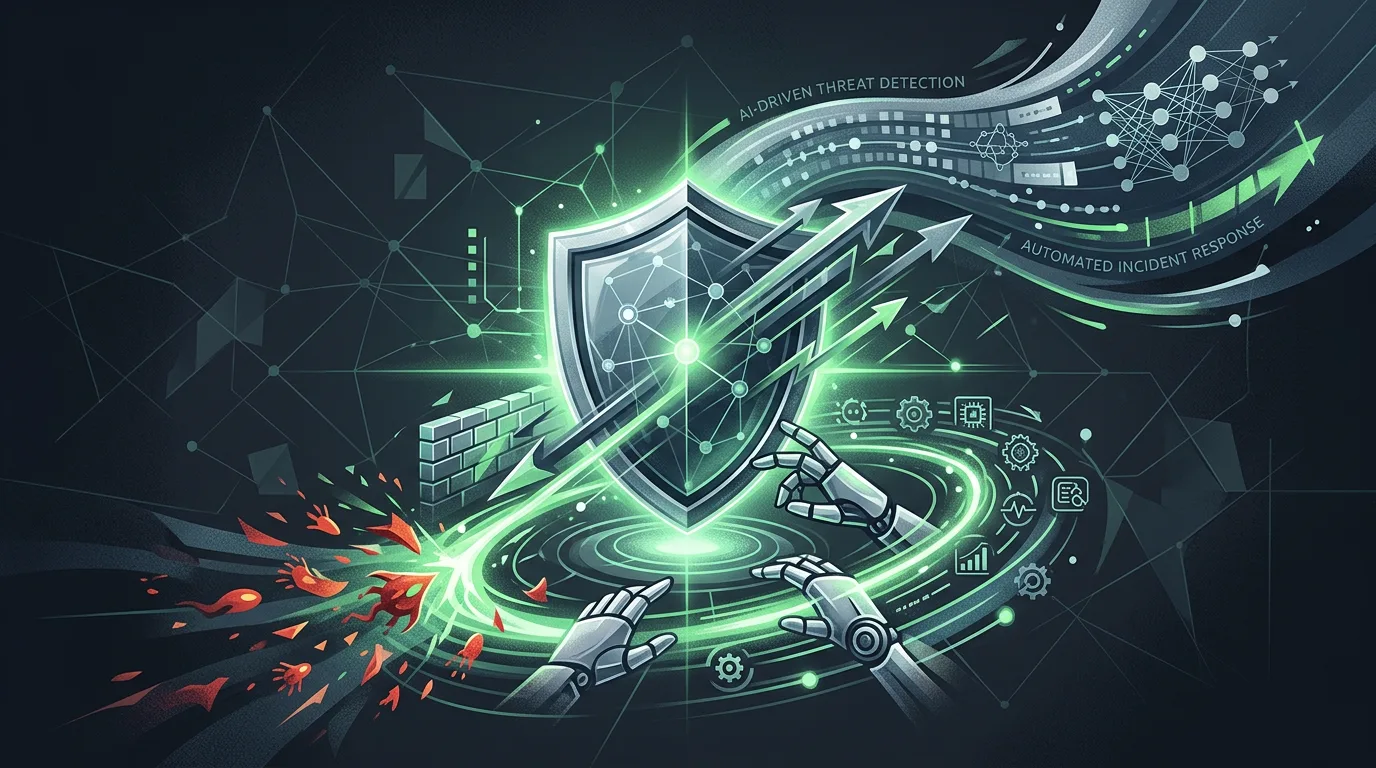
Figure: HEXOPS original illustration inspired by the topic (not a copy of the source article imagery) · Credit / further reading: openai.com
3. Turn analysis into bounded action
The action layer is where “machine speed” becomes real—and where danger rises. Model output must map to concrete, permissioned actions: block a domain, isolate an endpoint, revoke a session, adjust a policy, open a ticket, or escalate to a human. Mature designs use confidence thresholds, action tiers, and blast-radius controls. Low-risk actions can be automated. High-impact actions require approval or a rollback plan.
This is the central trade-off: speed versus authority. A system that can contain an incident in seconds can also disrupt a business process in seconds. The answer is not to remove automation; it is to make automation bounded, auditable, and reversible.
4. Close the feedback loop
Adaptive defense requires learning from outcomes. Analyst dispositions, incident results, false positives, and containment effects should feed evaluation and tuning. That does not necessarily mean training the foundation model on customer data. It can mean improving prompts, retrieval, routing, playbooks, and guardrails. The loop must also include adversarial testing: can a crafted log line, email, or alert influence the model’s recommendation?
Trade-offs: why machine speed is not free
Latency and cost
Not every packet can go through a large model. That would be too slow and too expensive. Practical systems prefilter with rules and classifiers, then invoke models only when ambiguity or risk justifies the cost. “Machine speed” may mean seconds to minutes for an incident workflow, not milliseconds for every packet. Cisco must be clear about which loop it is accelerating.
False positives and hallucination risk
Language models can produce plausible but wrong explanations. In security, a confident wrong answer is worse than no answer. The system needs evidence links, confidence signals, and deterministic validation. It also needs to manage automation bias: analysts may accept a model’s summary because it is fluent. Fluency is not accuracy.
Data governance and tenant isolation
Security telemetry can contain personal data, credentials, internal hostnames, and sensitive business context. Enterprises will ask where data is processed, how long it is retained, whether it is used for model training, and how tenants are isolated. Cisco’s brand trust helps, but the answers must be contractual and technical, not just architectural.
Security of the AI layer itself
The model is part of the attack surface. Observed content—emails, logs, web pages, alerts—can carry prompt-injection attempts. An attacker may try to make the model ignore policy, leak context, or recommend a harmful action. The system must treat all model inputs as untrusted, constrain tool use, and log every action.
Vendor concentration and lock-in
Cisco plus OpenAI creates a powerful integration story: network context, security workflows, and frontier models in one stack. It also creates concentration risk. Customers may worry about pricing, roadmap dependence, and switching costs. The stronger the integration, the more valuable the ecosystem—and the harder it is to leave.

Figure: HEXOPS original illustration inspired by the topic (not a copy of the source article imagery) · Credit / further reading: openai.com
Who benefits
SOC teams benefit most directly if the system reduces triage time, summarizes incidents, and automates low-risk containment. But the benefit is uneven: analysts gain leverage, while the role shifts toward verification, policy design, and adversarial testing.
Network and security operations teams benefit from convergence. Network telemetry becomes security context, and security decisions become network-aware. That can reduce the friction between teams that often see the same incident through different dashboards.
CISOs get a clearer story for the board: faster mean time to respond, more consistent playbooks, and better analyst productivity. The risk is that vanity metrics replace real risk reduction. A faster alert queue is not the same as fewer successful compromises.
Cisco and OpenAI benefit commercially. Cisco differentiates its security portfolio and increases stickiness; OpenAI gains distribution into enterprise security workflows. That does not make the partnership wrong, but buyers should evaluate it like any concentrated dependency.
Lean security teams may benefit disproportionately if the system genuinely lowers the skill floor for investigation. But smaller organizations may also face integration and pricing barriers, so the biggest early gains may go to large enterprises with mature telemetry.
Risks and failure modes
The first risk is adversarial adaptation. Attackers can use AI too. They can craft inputs to evade detection, poison signals, or manipulate model-assisted workflows. Defenders must assume the model will be probed and attacked.
The second is model drift. Attack techniques change, networks change, and business context changes. A system tuned for last quarter’s incidents may silently degrade. Continuous evaluation, red teaming, and rollback are not optional.
The third is over-automation. Machine-speed response without clear authority can cause outages, block critical business traffic, or revoke the wrong session. The safest design reserves destructive actions for human approval until precision is proven.
The fourth is regulatory and liability exposure. Automated containment can affect privacy, availability, and contractual obligations. Audit trails must show what happened, why, which model or rule was involved, and who approved it.
The fifth is trust erosion. If the system produces too many confident-but-wrong explanations, analysts will stop using it. Trust is built through evidence, transparency, and measurable precision—not through model fluency.
A practical evaluation checklist
For enterprises considering this class of defense, the questions should be concrete:
- Which actions are automated, which are recommended, and which require approval?
- Is model output grounded in cited telemetry and policy?
- How are prompt injection and malicious inputs tested?
- Where is data processed, retained, and isolated?
- What is the false-positive rate, and how is it measured?
- Can every automated action be rolled back?
- How does the system perform against adversarial evasion and model drift?
- What happens when the model is unavailable or wrong?
Bottom line
Cisco’s approach with OpenAI is directionally right: use network intelligence as the context layer, use models for ambiguity and communication, and constrain action with deterministic controls. That is how defense becomes adaptive rather than merely automated. But machine speed is not a product feature; it is an operating model. The winners will be organizations that automate the low-risk loop, keep humans accountable for high-impact decisions, and measure real risk reduction rather than the speed of the queue. Cisco can build the architecture. Customers still have to govern it.
Sources
- OpenAI, “Cisco cyber” case study: https://openai.com/index/cisco-cyber