Deep dive
The Y2K Vibes Are Back: How AI Agents Are Stress-Testing the Internet’s Plumbing
The recent wave of outages across airline booking systems, banking platforms, and productivity tools is easy to dismiss as bad luck. A queue backs up here, an API gateway times out there, a login service wobbles, and suddenly thousands of people cannot check in, move money, or open a document. But the pattern is too familiar to be coincidental. It has the same smell as Y2K: not a single dramatic bug, but a decade of hidden dependencies, untested assumptions, and brittle integration points all arriving at the same moment.
The difference is that the pressure is no longer coming only from humans clicking buttons. It is coming from AI agents operating at machine speed.
Figure: Editorial context image from the source page (preview only; rights remain with the publisher) · Credit / further reading: techcrunch.com
According to TechCrunch’s reporting, cybersecurity experts see something deeper than a run of isolated incidents. The outages are a symptom of how modern systems are being stressed by agentic workloads: software that can plan, call tools, retry, browse, authenticate, and execute multi-step workflows without a human in the loop. That is a powerful productivity story. It is also a new class of operational risk.
What “Y2K, AI agent style” actually means
Y2K was remembered as a date-format problem, but the real lesson was about dependency mapping. Banks, airlines, utilities, and supply chains had spent years assuming that two-digit dates would never roll over. The bug was small; the blast radius was enormous because so many systems depended on the same untested assumptions.
The AI-agent equivalent is not a calendar rollover. It is the assumption that digital infrastructure designed for human-paced traffic can absorb autonomous, high-concurrency, stateful, retry-heavy workloads. Agents do not behave like people. They do not get tired, they do not notice a slow page and wait, and they do not stop after one failed attempt. They loop. They parallelize. They call the same endpoint from many orchestrated workers. They hold sessions open, refresh tokens, retry writes, and chain together third-party services in ways the original architects never modeled.
When that behavior hits legacy booking engines, core banking adapters, or productivity suites with shared authentication and API gateways, small faults can become systemic outages. The common thread is not necessarily that an AI agent caused every incident. It is that agentic traffic is exposing the same class of systemic fragility that Y2K exposed: hidden coupling between systems that were never designed to fail gracefully together.
The mechanism: how agents turn small faults into systemic outages
From human-paced to machine-paced traffic
A human user might refresh a page three times. An agent fleet can generate thousands of retries in minutes. That is not necessarily a denial-of-service attack in the traditional sense. It can look like authorized traffic from legitimate credentials. But the shape of the load is different: higher concurrency, longer workflows, more state transitions, and more cross-service calls per “user” action.
Legacy rate limiters often count requests per IP or per API key. Agents can spread across keys, tenants, and regions, or simply stay within the limit while multiplying the number of concurrent workflows. The result is a system that appears to be operating within policy while its queues, connection pools, and downstream dependencies are saturated.
Retry amplification and thundering herds
Retries are supposed to improve reliability. At agent scale, they can become an amplifier. If many agents share the same retry policy, they retry in sync. If they lack exponential backoff and jitter, they create a thundering herd against an already degraded service. If they retry non-idempotent writes, they can duplicate bookings, payments, or ticket updates.
This is where the airline and banking examples matter. A booking engine or payment platform may tolerate a human double-click. It may not tolerate an orchestrated agent workflow that retries a seat hold or a transfer because a downstream confirmation timed out. The failure is not just availability. It is correctness.
Stateful workflows against stateless assumptions
Agents are often stateful in ways APIs are not. They maintain context, hold tokens, track carts, remember partial results, and resume workflows after delays. But many backend systems assume short-lived, stateless requests. When an agent holds a session open while waiting for a slow third-party response, it can pin resources, exhaust connection pools, or create stale locks.
The productivity-platform outages fit this pattern well. A suite that supports human collaboration may have been designed for a certain number of active sessions, document locks, and sync events. Agentic automation can multiply those events dramatically: reading, writing, summarizing, indexing, and cross-linking documents at machine speed. The system may not fail at the first agent. It fails when enough agents behave like power users with infinite patience and no social cues.
Shared dependencies and hidden coupling
Most modern outages are not caused by one system failing in isolation. They are caused by a shared dependency degrading: an authentication service, an API gateway, a rate limiter, a cache, a queue, or a third-party provider. Agents make those dependencies more visible because they chain them together aggressively.
A banking platform may depend on an identity provider, a fraud-scoring API, a core ledger, and a notification service. An airline booking system may depend on inventory, pricing, payment, and departure control. A productivity platform may depend on auth, storage, search, and real-time sync. When one link slows down, agents do what agents do: retry, reroute, or pile up. The outage then looks like a mysterious cross-platform coincidence. In reality, it is a dependency graph lighting up under a new workload.
The observability gap
Traditional monitoring is built around human traffic patterns: request volume, error rate, latency, saturation. Agent traffic breaks those baselines. An agent loop may look like normal user activity until it suddenly is not. Logs may show thousands of legitimate requests, each individually valid, that together create a cascade.
Without agent-aware observability — trace IDs tied to agent identities, workflow-level metrics, retry counts, queue depth by tenant, and decision logs — operators are diagnosing a storm they cannot see. That is one reason these incidents feel Y2K-ish: the systems are working as designed, but the design assumptions are wrong.
Why now? The economics of agentic automation
The timing is not accidental. Inference is cheaper, browser automation is more capable, tool-calling frameworks are more mature, and vendors are pushing agents into every workflow. Companies see labor savings, faster processing, and the promise of “autonomous operations.” The incentive is to deploy agents quickly and measure them by task completion, not by systemic load.
At the same time, years of cost optimization have removed slack from many production systems. Headroom is expensive. Redundancy is expensive. Chaos engineering is expensive. So organizations scale for expected human traffic, then introduce a workload that can multiply concurrency overnight. The result is a gap between the speed of agent deployment and the speed of resilience engineering.
Trade-offs: what we gain and what we put at risk
Efficiency versus headroom
Agents reduce manual work, but they also consume capacity. Every automated workflow still hits APIs, databases, queues, and third-party services. If the business case assumes existing infrastructure can absorb that load for free, the trade-off is hidden until peak demand. Efficiency gains can become outage costs.
Autonomy versus control
The more autonomy an agent has, the more useful it is — and the more damage it can do when it loops or misinterprets a failure. Human approval gates, spend limits, and kill switches reduce speed. But without them, a single bad tool call can cascade across systems. The trade-off is not whether to have autonomy, but where to place bounded autonomy.
Centralization versus redundancy
API gateways, identity providers, and cloud regions concentrate operational convenience. They also concentrate risk. Agents amplify that concentration because they tend to use the same shared endpoints and credentials. Redundancy and bulkheads cost money, but they prevent one slow dependency from taking down every workflow.
Speed versus correctness
Agents are optimized to complete tasks. Distributed systems are optimized to handle ambiguity. The mismatch shows up in retries, duplicate writes, stale state, and partial completions. Idempotency keys, transactional boundaries, and explicit compensation logic slow development down, but they are the difference between a retry and a duplicate payment.
Convenience versus lock-in
Agent platforms abstract away infrastructure, which makes deployment easy. They also hide failure modes and create new dependencies. When the platform’s orchestration layer, model provider, or tool integration has a bad day, every agent workflow depending on it has a bad day too.
Who benefits from the outage narrative?
There is no conspiracy here, but there are clear incentives. Cloud providers, observability vendors, and cybersecurity companies benefit from demand for agent-aware monitoring, AI security, rate limiting, and resilience tooling. AI agent platform vendors benefit from selling “guardrails” as a premium layer. Enterprises that invest early in operational discipline can differentiate on reliability.
Attackers also benefit. Outages create confusion, degraded monitoring, and support overload — useful cover for credential stuffing, fraud, or exploitation of retry logic. Regulators gain urgency, too, as operational resilience rules increasingly treat third-party and automated dependencies as board-level risks.
The losers are the users who cannot check in, transfer money, or access work documents, and the businesses that discover too late that their automation strategy outran their operational maturity.
Risks that deserve board-level attention
The biggest risk is cascading failure across critical infrastructure. Airline booking, banking, and productivity platforms are not isolated apps; they are part of broader economic and social workflows. A retry storm in one layer can become a settlement error, a missed flight, or a lost workday in another.
There is also liability ambiguity. When an agent causes an outage, who is responsible: the enterprise that deployed it, the model provider, the orchestration vendor, or the API owner? Most contracts and incident-response playbooks are not written for that question.
Then there is security. Agents need credentials and tool access. That creates identity sprawl, privilege creep, and new surfaces for prompt injection or tool abuse. An agent that can read email, call APIs, and execute workflows is a high-value target. If it can be manipulated into retrying a failed payment or exporting data, the outage may be the least of the problems.
How to make agentic systems boring again
The fix is not to stop using agents. It is to treat them as a new class of high-volume, semi-trusted clients.
Give agents distinct identities and least-privilege access. Enforce idempotency keys for writes. Add per-agent, per-tenant, and per-workflow rate limits with adaptive backpressure. Use circuit breakers, bulkheads, and queue caps. Run canary agents and synthetic monitoring that mimic real agent loops. Chaos-test retry storms before production does. Instrument traces with agent IDs and workflow context. Put kill switches and human approval gates around high-risk actions. Contract-test third-party APIs for failure behavior, not just happy paths.
Most importantly, capacity-plan for agent concurrency, not human concurrency. The question is not “how many users will click this button?” It is “how many autonomous workflows will retry this dependency at 2 a.m. if it slows down?”
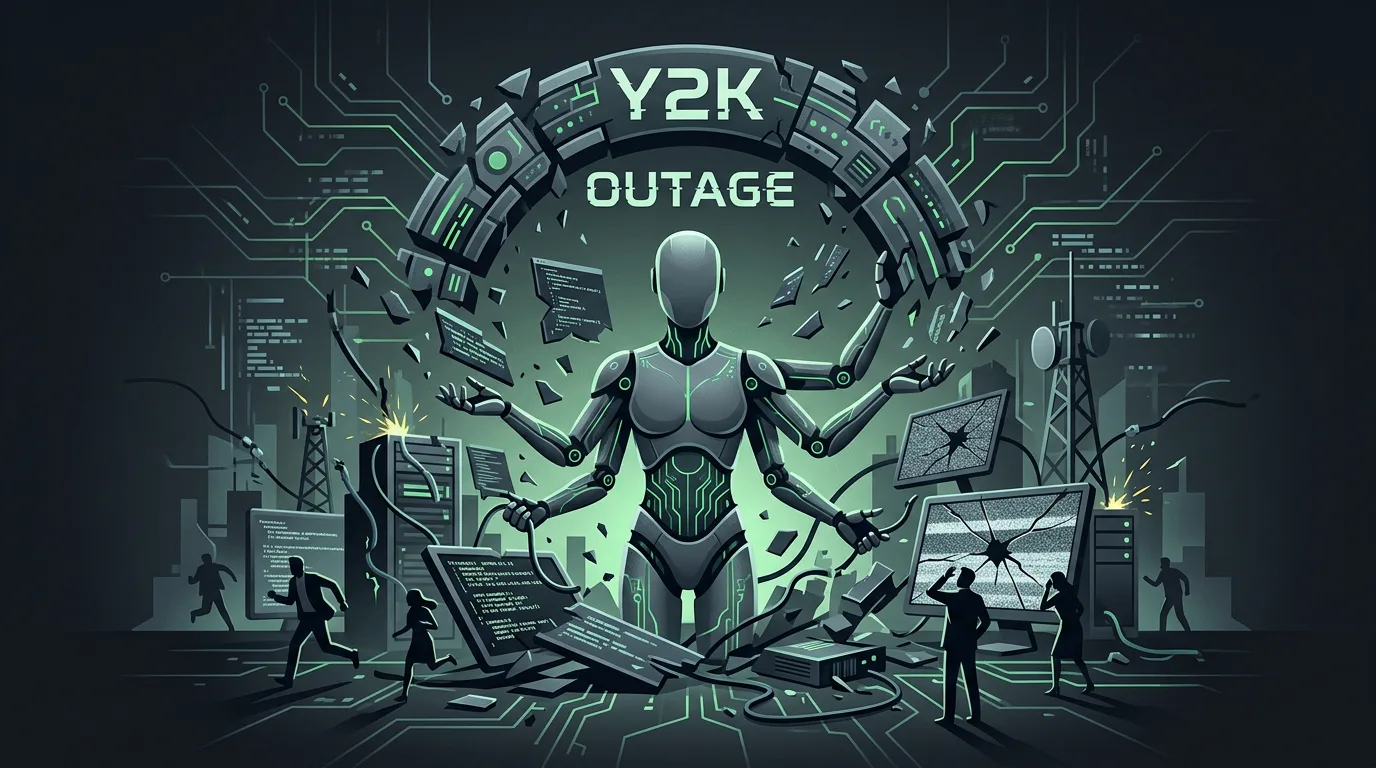
Figure: HEXOPS original illustration inspired by the topic (not a copy of the source article imagery) · Credit / further reading: techcrunch.com
Y2K was not solved by one heroic fix. It was solved by years of inventory, testing, and disciplined remediation. The AI-agent outage wave will be similar. The organizations that win will not be the ones with the most autonomous agents. They will be the ones that make those agents boring: bounded, observable, idempotent, and designed to fail without taking the whole system with them.
Sources
- TechCrunch: “These tech outages are giving Y2K, AI agent style” — https://techcrunch.com/2026/11/19/these-tech-outages-are-giving-y2k-ai-agent-style/