AI 安全
Aligned Cyber Agents: A Roundup of AI Vulnerability-Finding Stacks
The arrival of a cybersecurity-tuned frontier model — one trained to both surface exploitable vulnerabilities and draft the fixes, while staying inside an authorized scope — is less interesting as a benchmark story than as a signal about where security tooling is heading. The binding constraint in AppSec was never raw detection. It was trust: can a team point a machine at their own systems, let it act, and still defend every action it took?
This roundup maps the categories worth buying, the ones worth building, and the questions that separate a demo from a deployment.
Why "authorized scope" is the real product line
Figure: HEXOPS original illustration inspired by the topic (not a copy of the source article imagery) · Credit / further reading: openai.com
A detector that produces more findings than a team can triage makes an organization less safe, not more — it buries the real signal and burns the credibility of the tooling budget. What actually changes the economics is an agent that can be pointed at a defined target, demonstrate that it stayed inside the boundary, and hand back a reproducible fix in the same breath.
That reframes the buying criteria. Scope manifests, per-action audit logs, and reversibility matter more than leaderboard scores. For distributed and cross-border engineering orgs this is doubly true: the agent's log trail becomes the compliance artifact you show an auditor or a customer's security questionnaire. If a vendor cannot export a record of what the agent touched and why, you are purchasing a liability with a nice UI.
The stack, layer by layer
Model-native security agents
The newest layer, and the one driving the current wave of interest. These are general reasoning models with security-specific training: they read code, configuration, dependency graphs, and HTTP traffic together, chain observations into an exploit path, and write a patch. Their genuine advantage is explanation — a narrative a mid-level developer can follow at 2am.
Their failure modes are equally distinctive. They hallucinate reachability, assuming a vulnerable function is called when it is dead code. They over-probe when left unsupervised on live systems. And they are confidently wrong about business logic, because business logic is not a pattern.
Use them where you control the environment: staging mirrors, repositories with a clear owner, and a reviewer who can actually read the proposed diff.
Static analysis engines
Rule-based engines such as CodeQL and Semgrep remain the cheapest route to deterministic, reproducible, explainable results. They do not hallucinate. They also do not think — someone must author and maintain the rules, and that maintenance is the hidden line item.
The productive pattern is pairing, not replacing: the engine produces high-confidence candidates at scale, the agent contextualizes and drafts the fix, the human approves.
Reachability and application security posture layers
This is the most under-bought category in the stack. Tools that answer "is this CVE actually reachable in our build?" eliminate more work than any detector adds. Most security backlogs are dominated by findings that were never exploitable in that specific deployment.
An agentic layer on top can reason about call paths and runtime configuration, but validate its claims against a deterministic reachability engine before you deprioritize anything.
Fuzzing and dynamic harnesses
Coverage-guided fuzzing is still unmatched for memory-safety defect classes, and it is the layer agents assist rather than replace. The useful contribution is harness generation and crash triage: writing the driver code that nobody wants to write, then clustering thousands of crashes into a handful of root causes.
Human-led assessment and bounty programs
Agent output should feed scoping and hypothesis generation for human testers, not substitute for their judgment. Keep humans on the authorization decision itself — that is the one call you never delegate to a model.
When to use it — and when not to
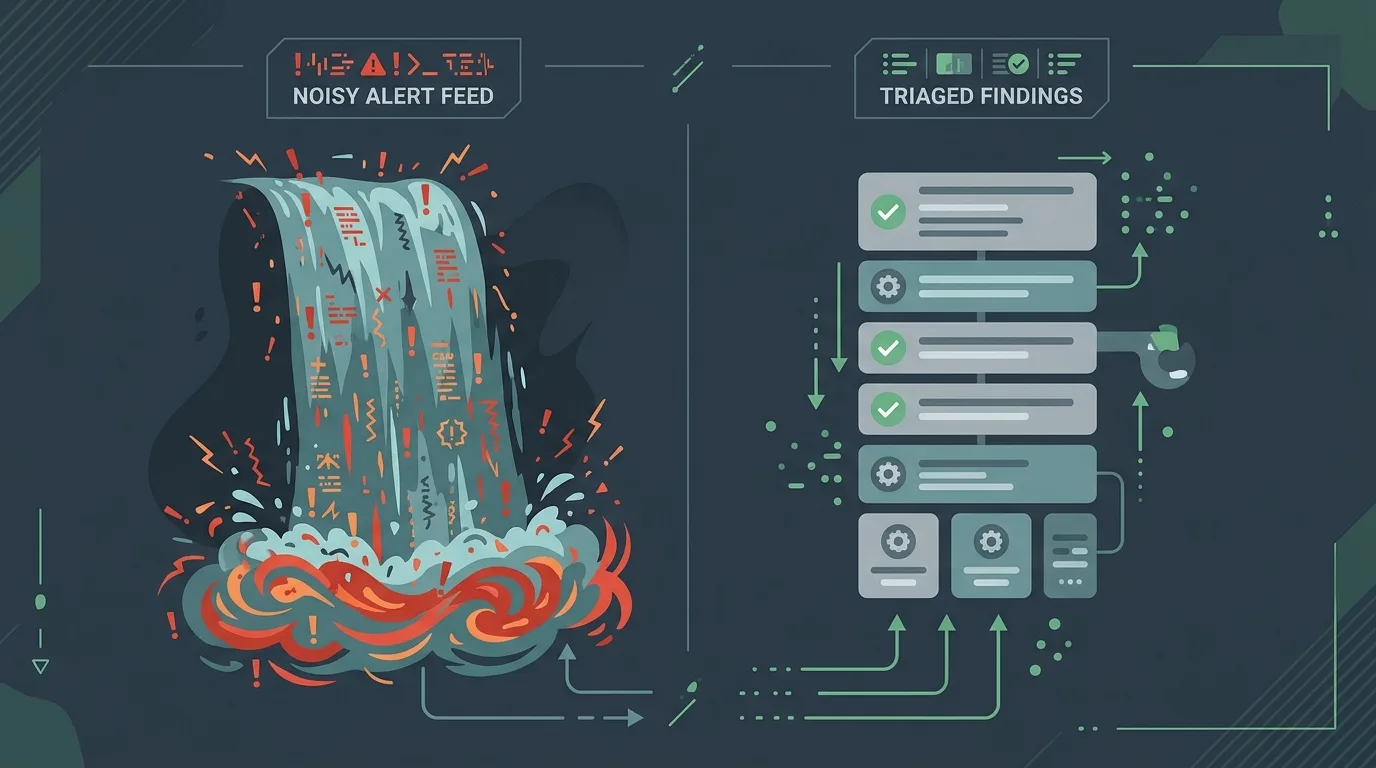
Figure: HEXOPS original illustration inspired by the topic (not a copy of the source article imagery) · Credit / further reading: openai.com
Reasonable fits: large, aging codebases with thin test coverage; pre-acquisition and pre-audit sweeps on code you own outright; patch generation for well-understood defect classes such as injection, deserialization, and path traversal; and triage compression, where the agent's job is to collapse ten thousand alerts into two hundred that a human should read.
Poor fits: any system you do not own or lack written authorization to test — this is precisely what scope training exists to protect, and violating it is a legal event, not a bug. Regulated production environments where an agent with network egress becomes a new attack surface in its own right. Threat modeling, which requires knowing what the business cannot afford to lose, not what looks pattern-shaped. And codebases dominated by generated or vendored code without aggressive filtering, where signal-to-noise collapses and the agent starts reporting the framework back to you.
Pricing caveats
- Enterprise security models are quoted, not listed. Expect annual contracts with per-seat or per-scan structures and a floor that assumes a security team already exists. Ask explicitly what happens at renewal.
- Agentic scanning consumes compute proportional to repository size and reasoning depth. A tier that caps reasoning steps will look impressive in a demo and thin in production. Model cost per full-repository sweep, not cost per month.
- Static engines price per developer seat or per lines of code and look cheap — until you count the engineer hours spent maintaining custom rules. That is the real bill.
- Bundled credits from cloud or CI vendors obscure the year-two step change. Always model the renewal number, not the introductory discount.
- Open-source engines plus your own orchestration is the lowest-cash, highest-labour path. Be honest about which resource you actually have more of.
- Free tiers exist for a reason. They are acquisition funnels. Check whether audit logs, scope controls, and export — the features that make the tool defensible — are gated behind the paid tier. Usually they are.
Guardrails to demand before deployment
- A written scope manifest: target list, time windows, explicitly excluded hosts.
- Per-action authorization logs, exportable in a format your auditor accepts.
- A dry-run mode that produces findings without active probing.
- Patch proposals delivered as diffs, never auto-merged into a protected branch.
- A kill switch and an egress allowlist.
- One named human approver per engagement, with authority to stop it.
Key takeaways
- Scope discipline and auditability, not detection volume, are the features that make AI security agents deployable.
- Pair model-native agents with deterministic static and reachability engines; the agent explains and fixes, the engine proves.
- Never point an autonomous agent at infrastructure you lack written authorization to test.
- Budget for year two, per full-repository sweep, and include the engineer hours that rule maintenance quietly consumes.
- Keep the authorization decision — and the merge button — with a human.
Next steps
Pick one owned repository with a staging mirror and run a time-boxed pilot: static scan first for a baseline, then an agent pass in dry-run mode, then a single approved patch cycle. Record how many findings survived human review. That ratio, not the vendor's benchmark, is your business case.
Sources
Further reading: OpenAI News — introducing a cybersecurity model for authorized vulnerability discovery and remediation