
How-to
Trajectory's $45M Raise Is a Signal, Not a Strategy: A Practical Playbook for Cross-Border, SaaS, and Store Teams
Trajectory, a one-year-old startup, has raised $45 million at a $300 million valuation on a single promise: letting nontechnical domain experts train AI models themselves. For a team running a Shopify storefront, a subscription SaaS product, or a cross-border operation with listings in six languages, the headline reads like good news — cheaper, closer-to-the-business AI without hiring an ML team.
It is good news, but not in the way most teams will interpret it. The real shift is not that models got easier to train. It's that the bottleneck moved from engineering to data curation and evaluation — work that your merchandisers, support leads, and category managers are already doing informally, just without the discipline that makes it usable. This playbook turns the announcement into something you can act on this quarter.

图示:来源页预览图(仅作编辑上下文;版权归属原发布方) · 来源引用:techcrunch.com
Why this matters more for operators than for engineers
When training requires a specialist, the specialist decides what "good" means, often by proxy. When training is accessible to the person who actually handles the customs classification dispute or the German returns email, the definition of quality gets sharper — and the failure modes get more obvious.
That is the entire value proposition, and it is also the entire risk. A platform that lets a nontechnical expert train a model will happily let that expert train a bad model on 40 inconsistent examples. Accessibility without evaluation discipline is just faster ways to be wrong.
So the practical question is not "which vendor?" It is "do we have a repeatable way to define, measure, and maintain quality?" Build that first; the vendor choice becomes easy.
The nine-step playbook
Step 1 — Select use cases by judgment density, not novelty
Score every candidate on four axes: monthly volume, cost per error, whether historical human decisions exist, and tolerance for latency. High volume plus high error cost plus an existing decision log is the sweet spot.
| Use case | Volume | Error cost | Decision log exists? |
|---|---|---|---|
| HTS / customs code classification | High | High | Yes — broker records |
| Multilingual listing QA (DE/JP/BR) | High | Medium | Partially |
| Returns reason coding | Medium | Medium | Yes — support tags |
| Supplier email triage | High | Low | Yes — inboxes |
| Product Q&A on PDP | High | Medium | No — needs new collection |
Avoid, in the first wave, anything where a wrong answer is a legal or safety matter without a human gate. Start where a mistake costs money, not a compliance filing.
Step 2 — Build the decision log before you shop for a platform
Pull 12 months of human decisions where the input and the final answer both exist. Target 500–2,000 examples in one table with columns for input, human decision, confidence, and outcome. If you cannot assemble this in two weeks, you are not ready to train — and you have just learned the most valuable thing this project will tell you.
Step 3 — Run a prompting baseline first
Do not train what a well-engineered prompt plus retrieval can already do. Measure the general model on your task. Only move to fine-tuning when the baseline plateaus below your business threshold — usually because of domain vocabulary, house style, or edge-case rules the model cannot infer from instructions.
Step 4 — Write acceptance criteria as numbers, before you evaluate anything
"Better" is not a criterion. Write: top-1 accuracy ≥ 92% on 300 held-out customs codes; abstain and escalate when confidence < 0.80; p95 latency under 2 seconds; cost per 1,000 predictions under a stated ceiling; zero price or PII leakage in 50 adversarial prompts.
Step 5 — Shortlist vendors against six criteria
Trajectory is one entrant in a young category. Evaluate any platform — including this one — on the same grid:
- Data portability. Can you export your examples, labels, and outputs in an open format in one click?
- Evaluation tooling. Does it version a frozen test set and show per-segment results, or only one aggregate score?
- Human-in-the-loop. Can reviewers correct outputs and feed corrections back into the next training run?
- Deployment and residency. Can the model run in the region your customers and contracts require?
- Model ownership and exit. Do you get weights, a distilled model, or only API access? What happens on termination?
- Pricing model. Per seat, per prediction, or per training run — and which one punishes you as usage grows?
Step 6 — Name an owner and give them hours
This is the organizational change nobody budgets for. Assign one accountable expert per use case and block four to six hours a week for labeling and review. Make it a KPI, not a favor. If the expert's time is invisible on the roadmap, the model will quietly rot.
Step 7 — Freeze a golden evaluation set
Build 200–500 examples stratified by market, language, and edge case, with a written rubric for ambiguous cases. Version it. Freeze it. Never train on it. Re-run it for every candidate model and every retraining cycle. This single artifact is worth more than any platform subscription.
Step 8 — Pilot in shadow mode, one market, one language
Run the model alongside humans for two to four weeks. Humans answer first; the model's output is logged but not shown to customers. Compare on the golden set and on live data. Shadow mode catches the embarrassing failures before your Brazilian customers do.
Step 9 — Ship behind thresholds, then watch for drift
Put confidence gates and escalation paths in place on day one. Audit a random weekly sample by hand. Set an explicit retraining trigger — a drop of more than three points on the golden set, or a spike in escalations — and a named person who owns that trigger.
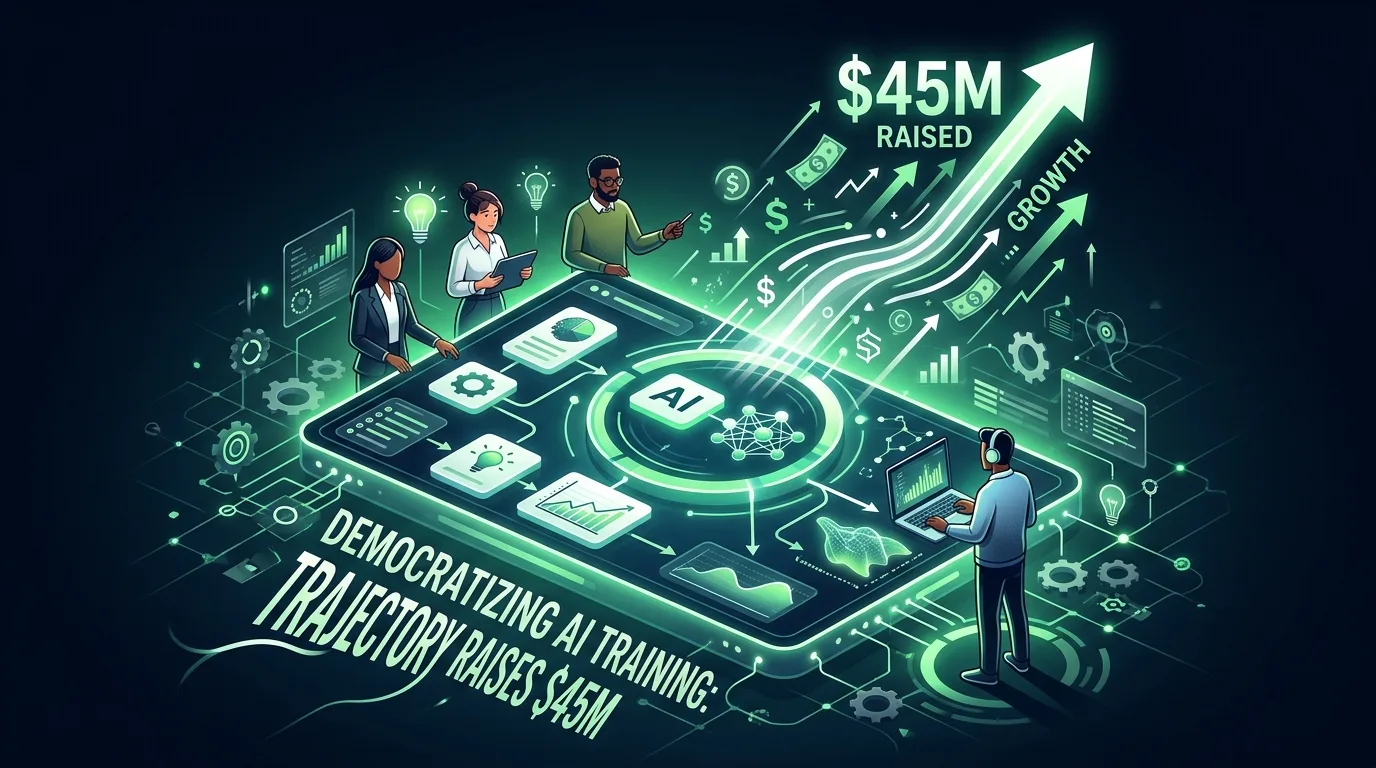
图示:HEXOPS 原创配图(受选题启发,非复制原文图片) · 来源引用:techcrunch.com
The checklist
Data
- 500+ historical decisions with input and final answer captured
- PII stripped or tokenized before upload
- Labeling rubric written and agreed by two reviewers
- Golden set frozen, versioned, and stored outside the vendor's UI
Evaluation
- Prompting baseline measured on the same golden set
- Acceptance criteria written as numbers
- Per-segment results reviewed (per market, per language, per category)
- Adversarial and leakage tests run
Vendor
- One-click export of data, labels, and model artifacts confirmed
- Contract covers termination, deletion, and price protection
- Your data excluded from vendor training by contract
- Deployment region matches customer and regulatory requirements
Organization
- One accountable expert per use case, with blocked hours
- Review time reflected in the roadmap and headcount plan
- Escalation path documented for customer-facing deployments
Operations
- Confidence thresholds and abstain behavior defined
- Weekly sampled audit scheduled
- Retraining trigger and owner named
Risk notes specific to a young, well-funded vendor
A one-year-old company at a $300 million valuation is a bet on a category, not a guarantee of a decade of support. That is not a reason to avoid the category; it is a reason to contract carefully. Insist on open-format data export, clarity about whether you receive weights or only API access, deletion guarantees, and price protection for at least 24 months. Keep your own copy of every labeled example and every evaluation result — outside their product. If the platform disappears, your decision log and golden set should let you rebuild on a different stack in weeks, not quarters.
Also budget honestly. The training run is the cheapest part of the project. Labeling, evaluation design, weekly audits, and retraining will likely cost three to five times the compute in human hours during year one. Teams that skip this line item are the ones whose "AI initiative" quietly ends after the demo.
Bottom line
Trajectory's raise confirms that model training is becoming an operator's tool rather than an engineer's specialty — but the tool only works for teams that arrive with clean decision logs, a frozen evaluation set, and a named human who owns quality. Pick one high-volume, high-error-cost workflow, run the prompting baseline first, pilot in shadow mode in a single market, and contract for exit before you contract for access. Do that, and the next platform announcement is an opportunity instead of a distraction.
Sources
- TechCrunch, "Trajectory raises $45M to make AI model training accessible to nontechnical experts," November 2, 2026 — https://techcrunch.com/2026/11/02/trajectory-raises-45m-to-make-ai-model-training-accessible-to-nontechnical-experts/