
How-to
AI Agent Marketplace Integration: A Practical AIGB × aiagentstore.io Guide for Cross-Border, SaaS, and Store Teams
Agent marketplaces are the new app stores. Instead of shipping every capability yourself — translation, copywriting, image generation, refund triage, review summarization — you rent it from a marketplace and orchestrate it from your own backend. The AIGB + aiagentstore.io pattern is a concrete version of that: a marketplace account issues you an API key, and your AIGB backend routes store/SaaS workloads to whichever agents you enable.
This guide turns that three-line recipe into something a cross-border ops team can actually ship: prerequisites, numbered steps, governance, a QA pass, and a go-live checklist.
图示:来源页预览图(仅作编辑上下文;版权归属原发布方) · 来源引用:dev.to
Why this integration is worth the afternoon
For cross-border and store teams, the value isn't "we have AI now." It's elastic capability without headcount. Three practical wins:
- Unlimited functional expansion. Adding a new language, a new channel (TikTok Shop, Amazon, Shopify, a Telegram bot), or a new task type stops being an engineering project. You enable an agent, wire it into a workflow, and measure it.
- Multilingual by default. Cross-border stores live or die on localized product copy, CS replies, and returns policy. Routing those through marketplace agents lets you A/B different vendors per locale without re-platforming.
- Stablecoin / red-packet style incentives. The marketplace ecosystem advertises crypto-native engagement mechanics (stablecoin payouts, "red packet" airdrop-style coupons). Treat this as an optional growth lever, not core infrastructure — and read the compliance section below before you enable it.
The catch, as always, is that "it works in the dashboard" and "it works in production under load with a payment flow attached" are different claims.
Prerequisites checklist
Before you touch a config panel, confirm you have:
- A decision on which workloads go to the marketplace (pick 2, not 12, for phase one)
- An owner: one engineer for wiring, one ops person for prompt/agent evaluation
- A staging store or tenant where a bad agent response can't reach customers
- Secret storage (Vault, AWS Secrets Manager, Doppler — not a
.envin a repo) - Observability: request logs with tenant ID, agent ID, latency, token/spend
- A written data-handling note: what PII is allowed to leave your systems
- For payment/stablecoin features: a review with whoever owns compliance in your jurisdiction
Step-by-step integration
Step 1 — Register the aiagentstore.io account as an organization
Register at aiagentstore.io using a shared team mailbox, not a personal address. Personal-account ownership is the single most common cause of "we can't rotate the key because the person left."
Set up at least two seats: one admin (billing/keys) and one operator (agent selection). Keep the admin seat out of day-to-day work.
Step 2 — Provision the API key (and a second one)
From the account's developer/API section, generate a key. Immediately create two keys:
aigb_prod_primary— used by the AIGB runtimeaigb_prod_standby— stored, unused, ready for rotation
Record in your secret manager: key ID, creation date, owner, rotation date (90 days). If the marketplace supports scoped keys or per-agent keys, use them — a key that can only call your three enabled agents is worth far more than one that can call everything.
Step 3 — Map your workloads to agents before configuring anything
Don't browse the marketplace first. Write the mapping first, because it determines what you configure.
| Workload | Trigger | Latency budget | Failure fallback |
|---|---|---|---|
| Product copy localization (5 locales) | New SKU published | < 60s async | Queue + human translator |
| CS first-response drafting | Ticket created | < 8s | Template reply |
| Review sentiment summary | Nightly batch | no SLA | Skip and retry |
| Checkout-page microcopy | Manual, ops-initiated | < 15s | Keep current copy |
The latency column matters: an agent marketplace call is a network hop to a third party. Anything on a customer-facing synchronous path (checkout, payment confirmation) should either have a hard fallback or not be there at all in phase one.
Step 4 — Configure the agent in the AIGB backend
In the AIGB admin, open the AI agent configuration panel and create one entry per workload from Step 3. For each entry set:
- Agent/endpoint reference from the marketplace
- Credentials reference — point at your secret manager key name, never paste the raw key
- System prompt / persona: scope it tightly. "You localize Shopify product titles for the German market; output only the localized title, no commentary" beats "You are a helpful assistant."
- Model parameters: temperature low (0.2–0.4) for anything customer-visible; higher only for ideation
- Timeouts and retries: 10s timeout, 1 retry with jittered backoff, then fallback
- Max tokens / spend cap per request
- Fallback behavior: what the store does when the call fails
Give every agent a stable internal agent ID you control (e.g. store-cs-draft-de), independent of the vendor's ID. When you swap vendors later, your logs stay comparable.
Step 5 — Wire secrets into the runtime properly
Load the key at process start from the secret manager. Never log it, never echo it in error responses, and scrub it from stack traces. If AIGB supports a "connection/credential" object, create it once and reference it by name across agents — rotating one credential should not require editing twelve agent records.
Step 6 — Route by tenant and locale, not by guesswork
This is where cross-border teams get leverage. In your AIGB routing layer:
- Inject locale and market into every prompt (
market=DE,currency=EUR,formality=formal) - Inject tenant/store ID so a multi-store SaaS doesn't cross-contaminate prompts or logs
- Keep a per-agent, per-locale evaluation set of ~20 golden examples. When you switch a vendor or bump a prompt, run the set before rollout.
Step 7 — Enable multilingual behavior deliberately
Marketplace agents handle multiple languages, but "supports" ≠ "is good at." Pick your top three revenue locales, run the golden set, and score on: terminology consistency (brand terms, size charts), locale-specific compliance language (EU withdrawal rights, Korean e-commerce disclosures), and tone. Keep a glossary per locale in the system prompt — brand names that must not be translated, forbidden claims, measurement units.
Step 8 — Treat stablecoin / red-packet features as an isolated experiment
If you enable crypto-native incentives (stablecoin payouts, red-packet coupons), isolate them:
- Separate feature flag, separate budget, separate tracking
- Legal review: is the mechanic a discount, a lottery, a security, or a payment service in your target markets? Rules differ sharply across the EU, US, and APAC
- KYC/AML posture for anything that pays out value
- Never let an agent-generated message promise a reward amount you haven't verified in code
Most teams should finish Steps 1–7, prove ROI, and only then open this file.
Step 9 — Instrument cost and quality from day one
Log per request: tenant, agent ID, locale, prompt version, latency, tokens, cost, success/fallback. Without this you will not be able to answer "did enabling that agent help?" Build one dashboard with: fallback rate (< 3% target), p95 latency, cost per order/ticket, and human-edit rate on generated copy (the most honest quality metric there is).
Step 10 — Document the runbook and hand it over
Write a one-pager: how to rotate the key, how to disable an agent in an incident, who to call at the marketplace, and what the fallback is for each workload. Test the "disable an agent" path in staging. It should take under five minutes.
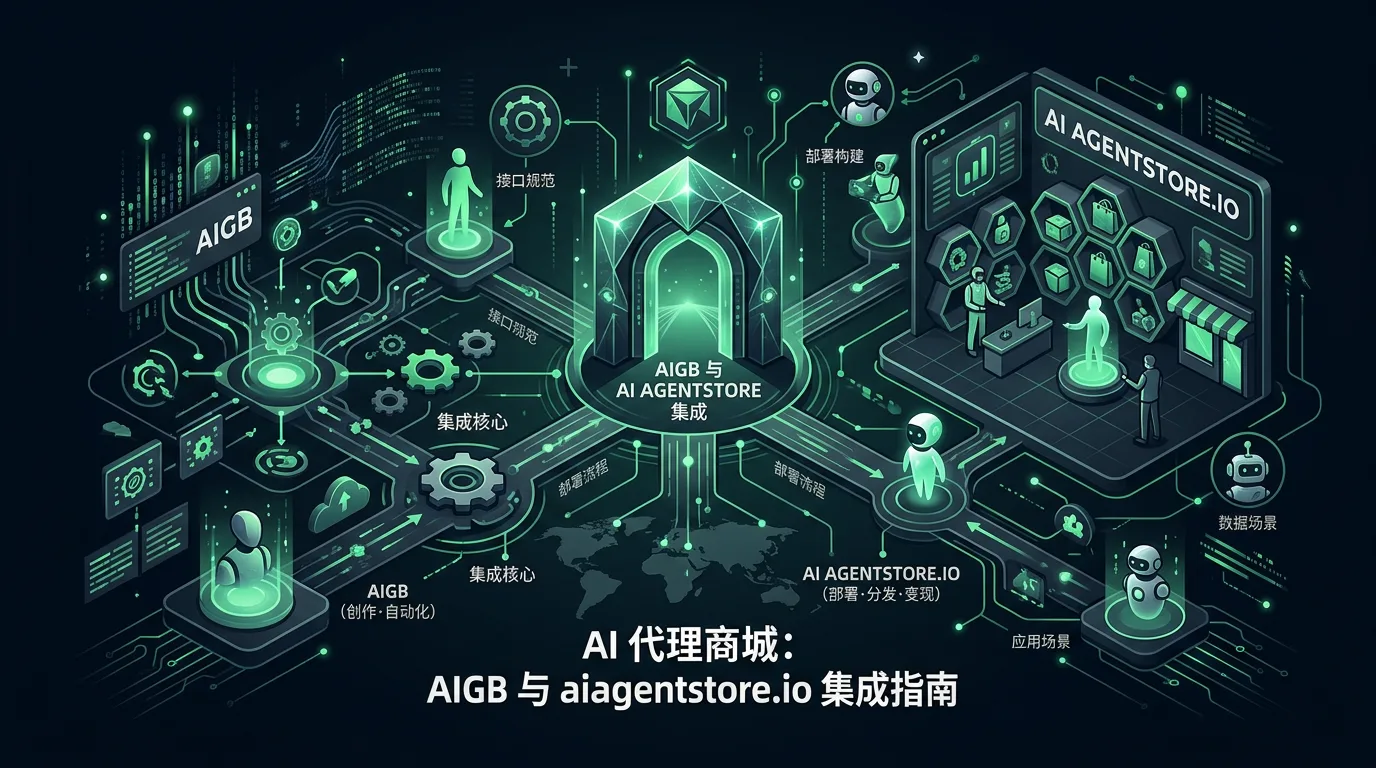
图示:HEXOPS 原创配图(受选题启发,非复制原文图片) · 来源引用:dev.to
Go-live checklist
- Two API keys exist; both stored in a secret manager; rotation date calendared
- No key material in git, logs, or client-side bundles
- Every agent has an owner, a fallback, a timeout, and a spend cap
- Workload mapping table is filled in and reviewed by ops
- Golden-example eval set exists for top 3 locales; last run recorded
- Staging end-to-end test passed for each workload, including forced failure
- Rate limits and 429 handling verified under a synthetic burst
- PII review signed off; logs redact customer data
- Dashboard live: fallback rate, p95 latency, cost per unit, human-edit rate
- Stablecoin/red-packet features either disabled or behind flag + legal sign-off
- Incident runbook written and tested
- Rollback: one toggle disables the integration and restores template behavior
Common failure modes
| Symptom | Likely cause | Fix |
|---|---|---|
| Sudden 401s in production | Key expired or rotated by a teammate | Standby key + rotation calendar |
| Latency spikes at peak | Synchronous call on checkout path | Move to async queue, add fallback |
| German copy drifts between SKUs | No glossary, temperature too high | Glossary in system prompt, temp ≤ 0.3 |
| Bill higher than expected | No per-agent spend cap, retries looping | Token caps, cap retries at 1 |
| Can't tell if it's helping | No human-edit tracking | Log edits, not just generations |
Bottom line
The AIGB + aiagentstore.io integration is a three-object setup — account, key, agent config. The engineering is a day. The value comes from the boring parts around it: a workload map, per-locale eval sets, hard fallbacks, spend caps, and a rotation runbook. Teams that treat the marketplace as a pluggable vendor layer behind their own routing and observability get compounding leverage; teams that paste a key into a prompt box get an outage and a surprise invoice.
Start with two workloads. Measure. Then expand.
Sources
- Original guide: AI 代理商城:AIGB 与 aiagentstore.io 集成指南
- aiagentstore.io — marketplace entry point: https://aiagentstore.io
Note: marketplace-specific UI labels, key scopes, and crypto-incentive availability change frequently. Verify current names and limits in your own dashboard before writing them into runbooks; the workflow above is vendor-agnostic by design.