AI
Fixed-deadline builds are the cheapest way to find out how your team actually makes decisions. GitHub's Game Off is now in its 14th year, and the 2026 theme is SHIFT — a nudge toward changing gears, swapping perspectives, bending the rules (announcement). The theme is fun; the structure is the useful part. A public, calendar-bound, roughly four-week window forces every decision a normal roadmap defers indefinitely: what are we not building?
This checklist converts that structure into a repeatable sprint protocol for engineering and growth teams. Every item has a binary gate. If you fail a gate, you do not "push through" — you cut scope and re-run the gate. Use it for a game jam, a conference demo, a seasonal launch, or v1 of an internal tool.
Why a hard deadline changes engineering behavior
A jam compresses the full product lifecycle — ideation, scoping, building, cutting, shipping, feedback — into about 30 days. Teams that treat the date as real ship something small and finished. Teams that treat it as aspirational ship a half-integrated subsystem and a demo that crashes under a live audience. The gap is almost never raw talent. It is whether scope was locked in writing before the first commit, and whether anyone had the authority to say no.

Figure: Editorial context image from the source page (preview only; rights remain with the publisher) · Credit / further reading: github.blog
The gates below assume four weeks and a small team (2–8 people). Shrink or stretch the day ranges to your calendar; keep the order and keep the gates binary.
Phase 0 — Scope lock (days 1–3)
- One-sentence pitch, written down. — Pass: anyone on the team can recite the pitch verbatim, including the one thing it is not. Fail: the pitch requires a slide, a diagram, or the word "and" more than once.
- Explicit non-goals list. — Pass: at least five named features you are deliberately not building, visible in the repo README. Fail: non-goals exist only in conversation.
- Single decision owner. — Pass: one named person can break ties on scope within 24 hours. Fail: decisions require a meeting, or the tie-breaker is "whoever cares most."
- Demo surface defined. — Pass: you can describe the exact 90 seconds a stranger will experience on ship day. Fail: you describe capabilities instead of a sequence.
Phase 1 — Vertical slice (days 4–10)
- End-to-end path exists, however ugly. — Pass: one real user can go from entry point to a visible outcome with no manual intervention, even with placeholder art, copy, or data. Fail: every subsystem is 70% done and nothing connects.
- Build and deploy are automated. — Pass: a clean machine can produce a shippable artifact with one command or one click, and the last three builds succeeded. Fail: only one person can build it, or the last build is "the good one on my laptop."
- Instrumentation before content. — Pass: you can already answer "how many people got past step one?" Fail: analytics is a post-launch task.
- Scope re-check against the clock. — Pass: remaining work fits in the remaining days with a 30% buffer. Fail: the plan requires zero bugs and no interruptions. Cut now, not in week three.
Phase 2 — Content and systems (days 11–20)
- Feature freeze scheduled, not hoped for. — Pass: a calendar date for freeze exists and is communicated outside the team. Fail: freeze is "when it's ready."
- Cut list ranked in advance. — Pass: a written list of features in the order they will be dropped, agreed before emotions are attached. Fail: cutting happens live, in an argument, under pressure.
- Quality bar defined per surface. — Pass: you can state which surfaces must be flawless and which may be merely acceptable. Fail: everything is implicitly "must be perfect," which means nothing is.
- Weekly external review. — Pass: someone outside the team has used the build and given written feedback each week. Fail: feedback arrives only at the end, when nothing can change.
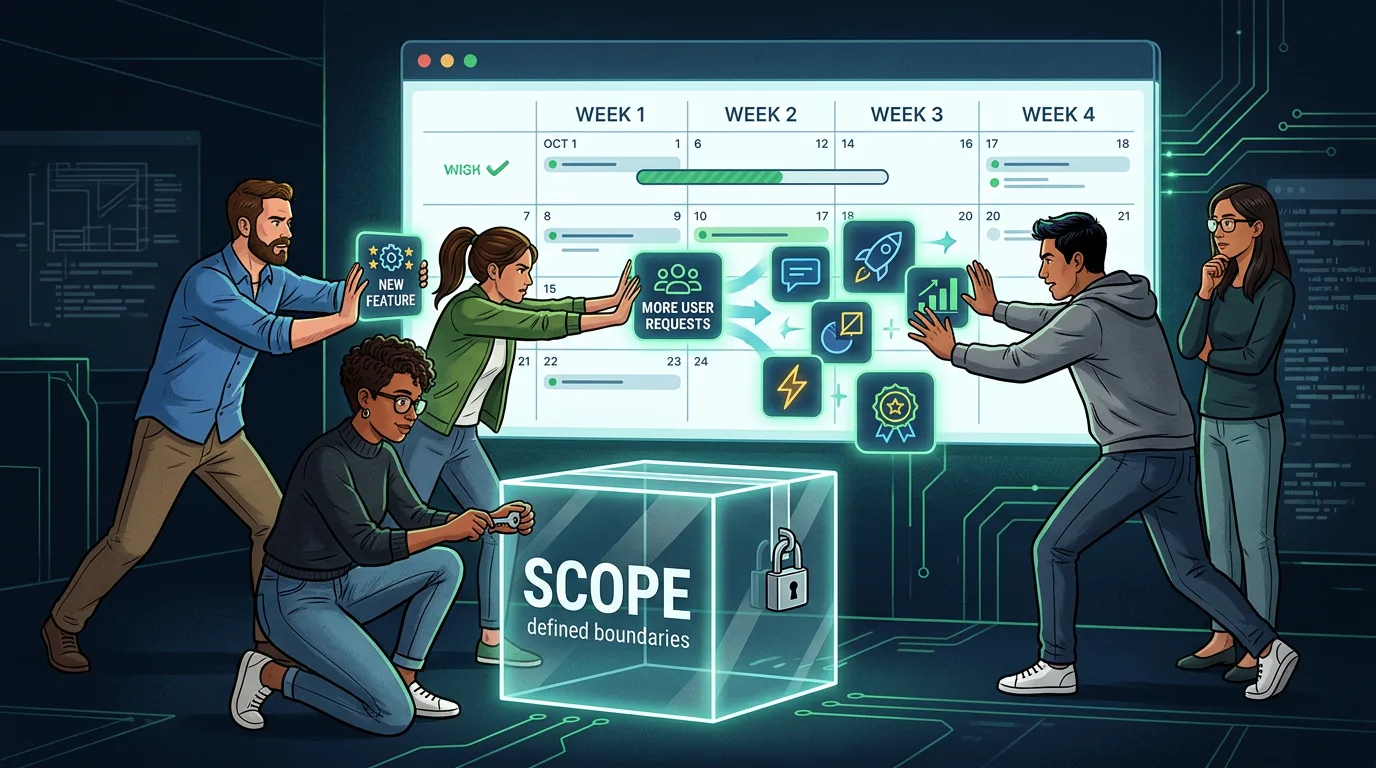
Figure: HEXOPS original illustration inspired by the topic (not a copy of the source article imagery) · Credit / further reading: github.blog
Phase 3 — Polish and cut (days 21–27)
- Freeze actually enforced. — Pass: any post-freeze addition requires deleting something of equal size — no net-new scope. Fail: "small additions" are merging daily.
- Failure paths tested. — Pass: you have deliberately triggered the error states, slow network, empty data, and first-run experience. Fail: you have only tested the happy path, on your machine, on fast Wi-Fi.
- Onboarding read by a stranger. — Pass: three people unfamiliar with the project completed the first-run flow without help. Fail: you explained it to them.
- Ship checklist rehearsed once. — Pass: you have done one full dry run of the release process, including rollback. Fail: ship day is also the first time the process runs.
Phase 4 — Ship and learn (days 28–30)
- Shipped publicly, on the date. — Pass: it is live and reachable by anyone with the link. Fail: it is "basically done" and waiting for a final polish pass that has no date.
- Post-mortem within 72 hours. — Pass: a written retro with three keep / three change items, shared outside the team. Fail: the retro is scheduled for "sometime next month."
- Reusable assets extracted. — Pass: at least one component, template, or process from the sprint is now in your default toolkit. Fail: everything built is throwaway.
The growth-side checklist
- Landing surface live before the build is finished. — Pass: a page exists with a clear promise and an email capture. Fail: marketing starts after launch.
- One metric, chosen up front. — Pass: a single number defines success, plus one guardrail metric. Fail: success is described qualitatively.
- Feedback loop owned by a person. — Pass: one named owner triages inbound feedback within 48 hours. Fail: feedback lands in a channel nobody reads.
- Distribution plan written in week one. — Pass: three specific places and the exact copy for each. Fail: "we'll post it around."
Key takeaways
- A hard deadline doesn't create quality; scope discipline does. Lock the non-goals in writing before the first commit.
- Binary gates beat optimistic status updates. If a gate fails, cut and re-run it — don't negotiate with the calendar.
- The cut list must be ranked before anyone is emotionally attached to a feature.
- Instrumentation and a landing surface belong in week one, not week four.
- Extract reusable assets at the end, or the sprint teaches you nothing you can repeat.
Next steps
- Pick your fixed date and count backwards to place the four phases.
- Run Phase 0 this week: write the pitch, the five non-goals, and name the single decision owner.
- Copy this checklist into your repo README so every gate is visible and checkable.
- Schedule the feature freeze and the post-mortem on the calendar today — both, before any code is written.
Sources
- GitHub Blog: Game Off 2026: The theme is SHIFT