
FAQ
LLMBrake FAQ: Per-Customer Dollar Caps for OpenAI and Anthropic API Calls
A "Show HN" post with two points and zero comments is not a signal of traction — it's a signal of a problem people recognize but haven't yet argued about publicly. LLMBrake proposes per-customer dollar caps for OpenAI and Anthropic API calls, which is one of those ideas that sounds trivial until you've shipped a multi-tenant LLM feature and watched a single account burn through a month of margin in an afternoon.
Below is a practical FAQ on the concept, the design questions it forces, and what to verify before you adopt any tool in this category. Where I describe LLMBrake's internals, treat it as the design a tool like this must solve — check the repo README for the exact implementation.
Figure: Editorial context image from the source page (preview only; rights remain with the publisher) · Credit / further reading: github.com
Q1. What is LLMBrake, in one sentence?
A spend-control layer that caps how many dollars each individual customer can consume in OpenAI or Anthropic API calls.
The framing matters: this is not a rate limiter (requests per second) and not a token quota (tokens per day). It's an accounting boundary denominated in money, applied per tenant. That's a meaningfully different primitive, because token counts and request counts don't map cleanly to the thing you actually care about — your bill.
Q2. Why dollar caps instead of token limits?
Because tokens aren't the unit your finance team sees, and model prices move.
A token limit forces you to pick a model assumption at design time. If a customer's traffic shifts from a cheap model to a frontier model — or you re-route traffic for quality reasons — a fixed token ceiling quietly changes the dollar exposure by 10x or more. Dollar caps stay stable across model changes, prompt-length drift, and retries.
The second reason is product legibility. "You have $5 of usage left this month" is something a customer understands and can act on. "You have 340,000 tokens remaining, weighted by model tier" is not.
Q3. Doesn't OpenAI or Anthropic already provide usage limits?
They provide limits for your organization, not for your customers.
Provider-side limits protect you from catastrophic spend at the account level. They don't know that customer A is on a $20 plan and customer B is on a $2,000 enterprise contract. Multi-tenancy is entirely your problem, which is exactly the gap a per-customer cap fills.
You can approximate it with project-scoped API keys per customer, but that strategy degrades fast: key sprawl, rotation burden, awkward model access management, and no way to express a cap that spans multiple providers.
Q4. Where does enforcement actually happen?
Three realistic architectures: a proxy in front of the provider, a wrapper in your SDK path, or inline checks in your application code.
- Proxy / gateway: all provider traffic routes through one service that prices each request, writes spend to a ledger, and rejects over-budget calls. Provider-agnostic, centralized, and hard to bypass — but it's another hop in the latency path and another service to operate.
- SDK wrapper: a thin client layer that meters before and after each call. Easier to adopt, easy to forget in one code path.
- Inline checks: application code asks a budget service for permission before calling the model. Maximum flexibility, maximum chance of a bypass bug.
The proxy approach is the only one that's structurally hard to circumvent. If you're capping real money, prefer enforcement that a tired engineer can't accidentally skip at 2 a.m.
Q5. How do you price a request when you don't know the cost until it finishes?
Reserve an estimate up front, then reconcile against actual usage.
This is the central technical problem. You need two numbers: input tokens (known before the call) and output tokens (unknown). A workable pattern:
- Count input tokens, multiply by the model's input price.
- Reserve a worst-case output estimate (
max_tokens× output price) against the customer's budget. - Make the call, read actual usage from the response.
- Release the difference back to the budget.
Without step 2, a customer with $0.10 left can fire a request that costs $3.00 and blow past the cap by 30x. Reservation-based accounting is what makes the cap a cap rather than a suggestion.
Q6. What about streaming responses?
Streaming breaks the "know the cost after the call" model, so you must meter incrementally or cut off mid-stream.
Two viable approaches: terminate the stream when the customer's remaining budget is exhausted (clean, but the customer sees a truncated answer), or reserve conservatively at stream start and refuse to begin if the full max_tokens budget isn't available (predictable, but harsh on near-limit accounts).
Most products should do the second and reserve the full worst case. A truncated answer mid-sentence is a worse experience than a clean "you've hit your limit" message.
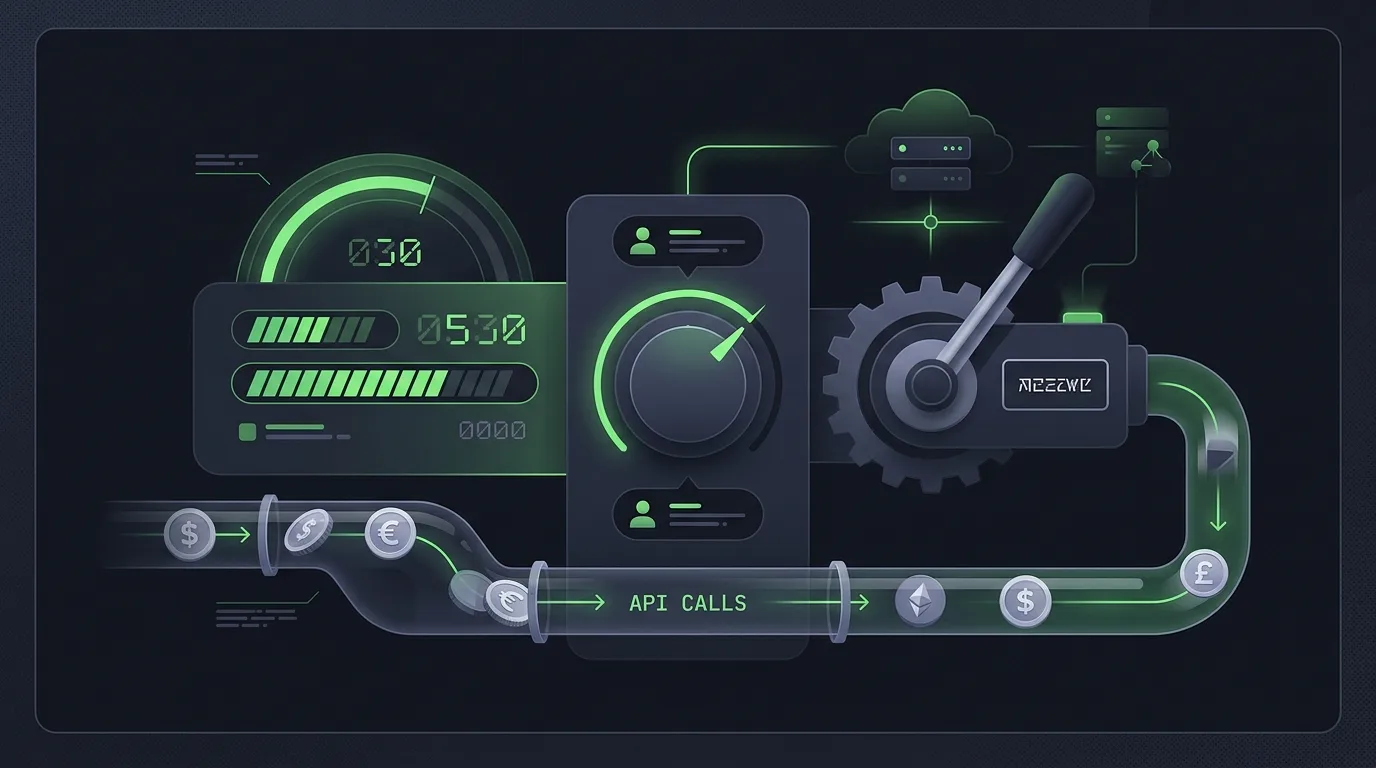
Figure: HEXOPS original illustration inspired by the topic (not a copy of the source article imagery) · Credit / further reading: github.com
Q7. How do you avoid race conditions when a customer fires parallel requests?
Atomic decrement against a shared ledger, or the cap is fiction.
Ten concurrent requests each seeing "$1.00 remaining" and each spending $0.60 will overshoot the cap to $6.00. Whether the ledger lives in Redis with DECRBY-style atomicity, a Postgres row with SELECT ... FOR UPDATE, or a dedicated accounting service, the check-and-reserve must be a single atomic operation. This is the single most common way homegrown caps fail.
Q8. What should happen when a customer hits the cap?
Fail closed, fast, and legibly — with a path to raise the limit.
The response should be a distinct, non-ambiguous error (402 Payment Required or a typed quota error), not a generic 500 or, worse, a silent fallback to a cheaper model. Silent degradation teaches customers that quality is inconsistent without telling them why.
The cap should also be a conversion surface, not a wall. Surface remaining balance, when it resets, and a one-click way to top up or upgrade. A hard ceiling that's discoverable is a monetization feature; a hard ceiling that appears as a mystery outage is a churn event.
Q9. Does a hard cap hurt the product experience?
It can, which is why the cap should be a tier, a warning, and a throttle — in that order.
The mature version of this pattern is graduated: soft warnings at 70% and 90%, a degraded-but-functional tier at 100% (cheaper model, shorter context, slower queue), and a hard stop only at a defined overage ceiling. Absolute cutoffs are appropriate for free tiers and trial accounts; paid accounts usually want a throttle-then-notify behavior before an outright block.
Q10. How is this different from an API gateway rate limiter?
Rate limiters count requests; this counts money.
Kong, Envoy, or a homegrown token bucket can stop a request flood. They cannot stop a slow trickle of expensive, long-context, frontier-model calls that never trips a per-second threshold but produces a four-figure invoice. Dollar-based metering is a different control plane, and most teams need both.
Q11. What should you verify before adopting a tool like LLMBrake?
Five things, in roughly this order of importance:
- Atomicity of the ledger. Is reservation/commit/rollback atomic under concurrency? Ask for the failure mode under parallel requests.
- Price table freshness. Pricing changes; a hardcoded table silently drifts from reality. Is there a documented update path?
- Streaming semantics. Does it reserve worst-case, or does it count after the fact and allow overshoot?
- Bypass surface. Can application code call the provider directly and skip metering? If yes, the cap is advisory.
- Latency and availability cost. A budget service in the request path is a single point of failure for every model call in your product. What's the fail-open/fail-closed policy when the ledger is unreachable?
Plus the boring operational questions: where does spend data live, how long is it retained, and can you export it to reconcile against your provider invoice?
Q12. If I don't adopt a tool, what's the minimum viable version?
A single table, a single atomic operation, and a nightly reconciliation job.
Store (customer_id, period, budget_cents, spent_cents). Before each call, atomically reserve worst-case cost. After each call, reconcile to actual. Nightly, compare your ledger to provider-reported usage and alert on drift above a few percent. That's maybe 200 lines and it captures 90% of the value — the remaining 10% is the multi-provider pricing table and the operational tooling, which is precisely what a project like LLMBrake is trying to package.
The honest takeaway from a two-point Show HN: the problem is real and universally felt, the solution space is crowded with half-built internal tools, and the differentiator will be whether the enforcement is actually airtight. Verify the atomicity before you trust the cap.
Sources
- LLMBrake repository — https://github.com/llmbrake/llmbrake
- Hacker News discussion thread — https://news.ycombinator.com/item?id=50386174
- OpenAI API pricing (for building a price table) — https://openai.com/api/pricing/
- Anthropic API pricing — https://www.anthropic.com/pricing
- OpenAI rate limits documentation — https://platform.openai.com/docs/guides/rate-limits
- Anthropic rate limits documentation — https://docs.anthropic.com/en/api/rate-limits