
AI news
{"type":"json_object","markdown":"# SFXMint vs Freesound vs Kenney: Free SFX Is Becoming an Agent-Integration Problem\n\nTL;DR — A new dev.to write-up pits SFXMint against Freesound and Kenney, and the interesting axis isn't sound quality. It's whether a coding agent can fetch a licensed WAV into assets/ without a human driving a browser. SFXMint's pitch: whole-library CC0, self-produced (not scraped) audio, a keyless JSON API, and an MCP server at https://sfxmint.com/mcp. Freesound has the catalog. Kenney has the trust. Nobody has both plus an agent-native surface — yet.\n\n
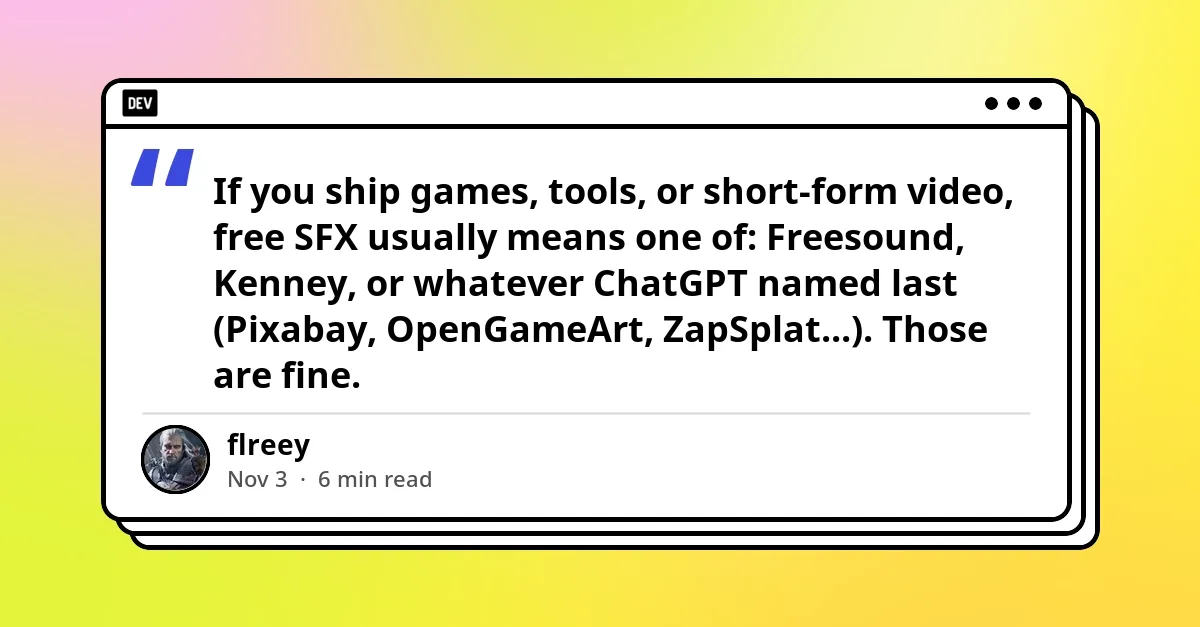
Figure: Editorial context image from the source page (preview only; rights remain with the publisher) · Credit / further reading: dev.to
\n\n## What happened\n\nThe post (authored by someone with an obvious stake in SFXMint — read it as a pitch, not a review) frames the free-SFX landscape as two buckets. Bucket one: the names everyone already knows — Freesound, Kenney. Bucket two: whatever an LLM hallucinated last time you asked — Pixabay, OpenGameArt, ZapSplat. All of them work, the author concedes. The friction is elsewhere.\n\nTwo frictions, specifically:\n\n1. License filtering before you freeze a build. Knowing a file is CC0 versus CC-BY versus CC-BY-NC is the difference between shipping and a takedown email. Doing that audit by hand across a few dozen clips is tedious; doing it across a library is a legal project.\n2. Agent accessibility. If you're running Cursor, Claude Code, or Codex and you want a click track, a UI blip, or a footstep set, the ideal is a tool call that lands a file on disk. Right now the typical path is: agent suggests a URL → you open a browser → you click through a license page → you download → you rename → you move it.\n\nSFXMint's answer is the second bucket, sharpened: a catalog it says is 100% CC0, generated in-house via AI/synthesis rather than scraped from user uploads, with a keyless JSON API (no signup gate on the request path) and an MCP endpoint so agents can enumerate and pull assets as a tool. The dev.to post trails off mid-sentence in the summary, so treat the specifics of rate limits, catalog size, and audio quality as unverified.\n\n## The three-way comparison, honestly\n\n| | Freesound | Kenney | SFXMint |\n|---|---|---|---|\n| License model | Mixed: CC0, CC-BY, CC-BY-NC, Sampling+ | Uniform CC0 | Claims uniform CC0 |\n| Provenance | User uploads, community-moderated | Hand-authored by one studio | Self-produced AI/synth |\n| Catalog depth | Very large, patchy quality | Curated, game-focused, deep in UI/impact | Unknown |\n| Programmatic access | API, but key + OAuth, attribution tracking | Manual ZIP downloads, no API | Keyless JSON API + MCP |\n| Agent-native | No | No | Yes, by design |\n\nThat table is the whole story. Freesound wins on volume and variety and loses on license uniformity — its CC-BY and CC-BY-NC entries mean every asset you pull carries an obligation you must record somewhere. Kenney wins on trust and craft: a decade of CC0 game packs, zero ambiguity, and nobody has ever been sued over a Kenney blip. But Kenney is a download site, not an interface. An agent cannot subscribe to it.\n\n
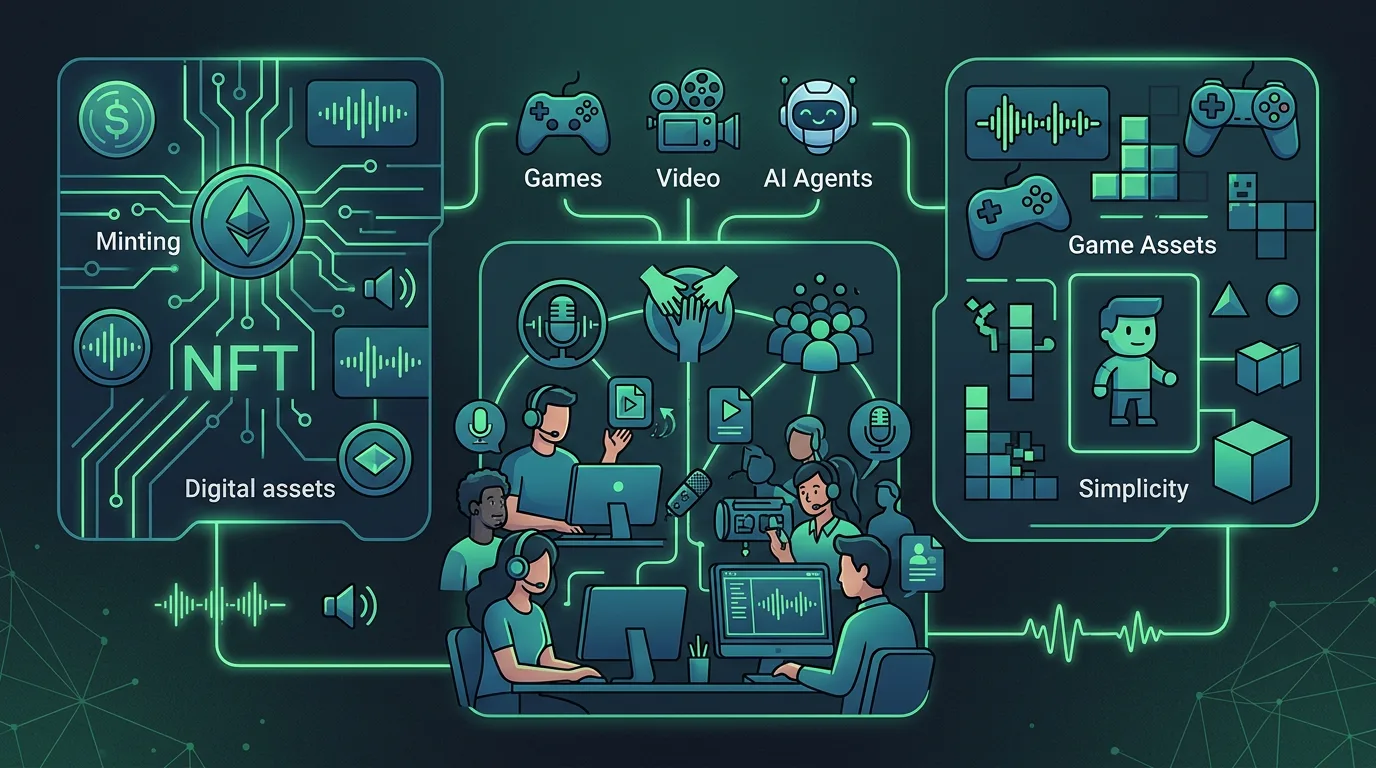
Figure: HEXOPS original illustration inspired by the topic (not a copy of the source article imagery) · Credit / further reading: dev.to
\n\n## Why it matters for builders\n\nThree things, in ascending order of how much they should worry you.\n\nMCP is becoming the distribution channel for asset libraries. We spent a decade moving from FTP to CDNs to package registries. MCP is the next layer: a standard tool surface an agent can call without bespoke glue. Whichever SFX, sprite, or font library ships a clean MCP server first gets defaulted into every agent's toolkit, and defaults are sticky. SFXMint being early here matters more than its audio quality does today.\n\nLicense metadata is now a build artifact. If your CI doesn't produce a manifest of every asset's license and source, you don't actually know what's in your binary. "CC0 across the whole library" is a genuinely attractive property because it collapses the audit to a single boolean. That's worth real money in engineering time, even if the sounds are mediocre.\n\n**"Not scraped" is a claim, not a guarantee.** AI-generated audio has its own unsettled provenance story — model training data, output copyrightability, and the fact that AI audio is not currently registrable for copyright in the US. Swapping one set of unknowns for another is a lateral move unless you can inspect it.\n\n## What to watch next\n\n- Catalog depth and quality. A keyless API is worthless if the library has 400 sounds. Count the assets, listen to a sample, check whether there's a coherent footstep set or just one.\n- Rate limits and the pricing cliff. "Keyless" usually means "free until it isn't." Find the ceiling before you bake it into a pipeline.\n- Whether Freesound or Kenney respond. Freesound has an API and could wrap it. Kenney has the cleanest license story in the industry and could ship an MCP server in a weekend. If either does, SFXMint's differentiation narrows to AI-generated audio — a weaker moat.\n- Verification of the CC0 claim. Independent audit, not marketing copy.\n\nFor now: if you need volume and can stomach attribution bookkeeping, Freesound. If you need dependable game-ready packs and never want to think about licenses again, Kenney. If you want an agent to fetch a sound without you touching a browser, SFXMint is the only one trying — and that's the axis the whole category is about to be judged on.\n\n## Sources\n\n- SFXMint vs Freesound vs Kenney: Free SFX for Games, Video, and AI Agents — https://dev.to/flreey/sfxmint-vs-freesound-vs-kenney-free-sfx-for-games-video-and-ai-agents-4lpb\n- SFXMint — https://sfxmint.com/\n- Freesound licensing overview — https://freesound.org/help/faq/\n- Kenney assets (CC0) — https://kenney.nl/assets\n\n*Disclosure: the source article is written by a party with a stated interest in SFXMint. Claims about its license uniformity and catalog provenance are reported, not verified.*\n"}