Engineering
Builder Notes: Anthropic’s Scion Migration and the New Source-Control Contract for AI Development
Anthropic’s migration of its monorepo from Git to Scion is easy to read as an internal infrastructure story. For website and software teams, it is more useful as a design brief. The published details describe a source-control system that moves repository operations to the server side, uses content-addressed storage, and adds tiered caches for agent and CI workloads. It also makes an explicit trade: less local data and shared infrastructure in exchange for weaker offline independence.
That is a meaningful shift in the contract between developers, automation, and the repository. Git’s default posture is distributed: clones are local, many operations work offline, and CI usually pays for its own copies or cache workarounds. Scion points toward a repo control plane optimized for many parallel, machine-driven readers and writers. Whether or not your team ever uses Scion, the builder implications are worth working through.
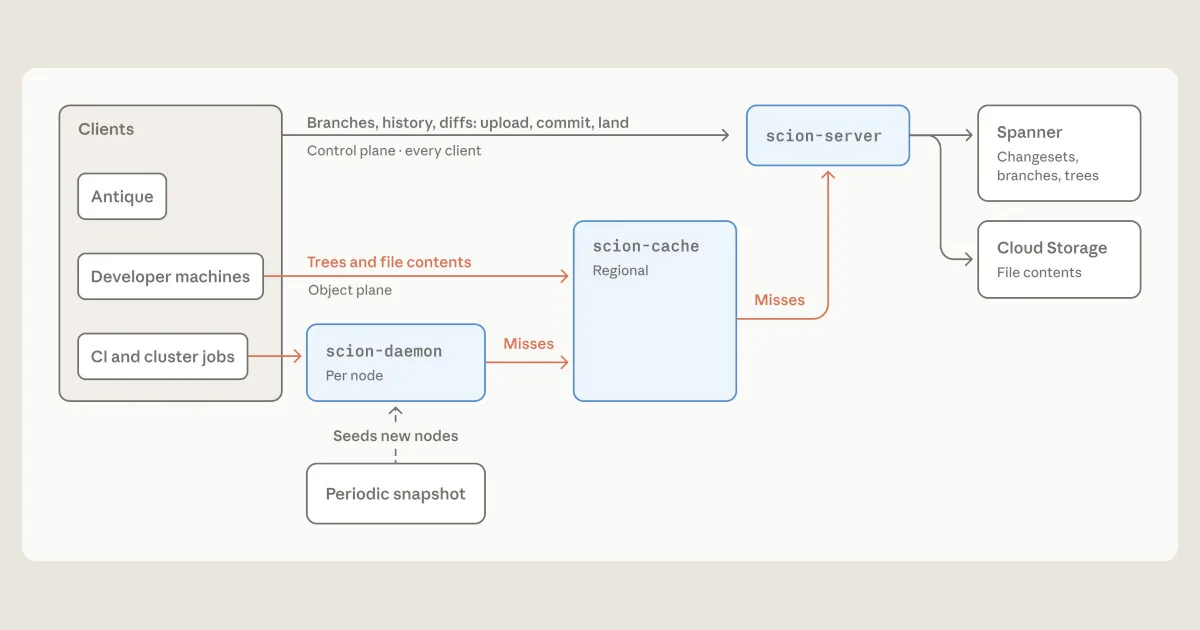
Figure: Editorial context image from the source page (preview only; rights remain with the publisher) · Credit / further reading: www.infoq.com
Architecture: source control becomes a service boundary
The first architectural change is where repository operations execute. In a Git-centric workflow, merge, diff, history traversal, and object reads often happen on the developer’s machine or CI runner. Moving those operations server-side turns the repository into a service with an API contract, capacity model, and failure modes. Clients become coordinators: they present intent, render results, and manage local state, but the server owns more of the object graph and operation execution.
For teams designing similar systems, the first decision is which operations move. Read-heavy history and object access are natural candidates because they benefit from shared caches. Write-heavy operations need more care: server-side merges and rebases can centralize consistency, but they also centralize conflict UX, audit, and rollback. A server-side merge API without a strong conflict-resolution experience will just move pain from laptops to a shared outage.
Content-addressed storage is the second architectural pillar. CAS gives immutable objects, integrity by hash, and deduplication opportunities. It also separates object storage from mutable references and metadata. Builders should treat that split as a product boundary: objects need retention, garbage collection, replication, and encryption; refs need compare-and-swap semantics, authorization, and audit. Deduplication is attractive for monorepos, but it changes cost and security models. A deduplicated object store can save capacity while making cross-tenant existence leaks a concern if tenancy boundaries are not designed explicitly.
Tiered caches are the third pillar, and they are clearly aimed at agent and CI workloads. Agents are bursty, parallel, and often read far more than they write. CI has similar patterns but different priority and isolation needs. Tiered caching can absorb repeated object reads and make clone-equivalent operations cheaper, but caches introduce invalidation, stampedes, stale reads, and poisoning risks. The builder note is to define cache scope before cache technology: per-repository, per-tenant, per-workload, or per-agent-session. Then define what may be cached, for how long, and how a cache hit is validated against a content hash.
The offline tradeoff deserves architecture-level honesty. If the server is the source of truth for operations, an outage blocks work in ways a distributed VCS does not. A pragmatic design keeps a read-only local object cache and a break-glass path for emergency reads. That is not the same as offline independence, but it prevents a network partition from becoming a full stop.
Ops: capacity planning for agents, not just developers
Server-side source control changes the operations model from “developer laptop performance” to “shared service SLOs.” Agents and CI create bursty, highly parallel demand. A single agent may fetch many objects; a fleet of agents may do it at once. Tiered caches help, but cold starts and cache misses can create thundering herds against the origin store.
Teams should separate workload classes. Interactive developer traffic, CI traffic, and agent traffic have different latency tolerances and failure semantics. A slow history query annoys a developer; a slow object fetch can stall hundreds of agent jobs or block a release pipeline. Use separate pools, quotas, and priority classes so one workload cannot starve another. Admission control and backpressure are not optional when the repository is shared infrastructure.
Observability needs to be operation-centric: latency and error rates per repository operation, cache hit ratios by tier, CAS dedupe ratios, queue depth, and saturation of the object store. Track agent and CI workloads separately. Also track version skew. In a server-side model, clients, IDE plugins, CI runners, and agent tools may deploy at different cadences. A server change can break older clients unless protocol compatibility windows and feature flags are explicit.
Disaster recovery is another sharp edge. Content-addressed storage gives integrity, not backup. Replication, restore drills, and retention policies still need to be designed. Garbage collection is especially risky in a CAS system: a misconfigured GC can delete objects still referenced by an in-flight agent session or a delayed CI job. Treat GC as a production change with canaries and audit logs.
Finally, cost allocation becomes visible. Shared caches and server-side compute can reduce total storage and clone churn, but they concentrate cost. Chargeback by team, workload, or repository helps prevent “free” agent traffic from becoming an unbounded platform expense.
Security: the repository becomes a crown jewel
Centralizing source control raises the value of the repository service. Every operation needs authentication and authorization, not just clone. Scoped, short-lived credentials for CI and agents are table stakes. Long-lived personal access tokens copied into agent environments are exactly the wrong pattern.
Agents should be treated as untrusted automation. Give them the minimum repository scope, sandbox their execution, restrict egress, and audit object-level access. A read-only agent that can fetch source is still a potential exfiltration path. A write-capable agent needs stronger controls: signed commits or objects, provenance metadata, review gates, and the ability to revoke a session quickly.
Content-addressed storage changes the security conversation in subtle ways. Hashing provides integrity and tamper evidence, but it does not provide confidentiality. Encrypt at rest, separate tenant keys where multi-tenancy exists, and be careful with cross-tenant deduplication. Cache poisoning is also a real risk: a tiered cache must validate content hashes and enforce scope so one agent’s cached object cannot contaminate another team’s build.
The offline tradeoff has a security dimension too. If teams lose local independence, they may be tempted to keep informal mirrors or copied credentials as resilience. That creates shadow repositories. Provide an approved read-only cache and an emergency access path instead of letting workarounds grow.
Figure: HEXOPS original illustration inspired by the topic (not a copy of the source article imagery) · Credit / further reading: www.infoq.com
Delivery: cache-aware workflows and a staged migration
For delivery teams, the biggest practical change is that caching becomes a first-class part of the workflow. CI and agent jobs should be designed around deterministic inputs, content-addressed outputs, and stable cache keys. A repository platform that offers tiered caches is only useful if build and agent tooling can exploit it without serving stale or poisoned content. That means cache-aware build scripts, explicit invalidation rules, and tests that exercise cold-cache behavior.
Tooling and training matter as much as infrastructure. Server-side operations may change command behavior, IDE integrations, and agent instructions. If a merge or history operation is no longer local, developers need clear feedback, retries, and conflict resolution. Measure developer experience with operation latency, conflict resolution time, and failure recovery, not just storage savings.
Migration should be staged. A dual-run period with a read-only Git mirror, shadow reads, and result comparison reduces risk. Migrate read-heavy workflows first, keep write paths controlled, and define rollback criteria before cutover. Do not big-bang a monorepo migration on the strength of an architecture diagram. Also preserve export paths: a source-control platform without data portability is a lock-in decision, not just an infrastructure choice.
For smaller teams, the lesson is not “build Scion.” It is to adopt the underlying principles selectively: remote build caches, scoped agent identities, server-side CI caching, audit logs, and explicit workload isolation. Git can remain the developer-facing interface while shared infrastructure absorbs the machine-driven load.
Bottom line
Scion is a bet that AI-driven development changes repository access patterns enough to justify a server-side, cache-heavy, content-addressed control plane. The tradeoff is real: less local independence, more shared-infrastructure dependency, and a higher security bar. Builders should separate Git compatibility from source-control architecture. Treat the repository as a product with SLOs, tenant boundaries, migration paths, and a break-glass plan. The teams that get this right will not just move faster with agents; they will keep delivery predictable when the agents, and the repository service, misbehave.
Sources
- InfoQ: “How Anthropic Redesigned Source Control for AI-Driven Development,” by Eran Stiller — https://www.infoq.com/news/2026/10/anthropic-source-control/