FAQ
Google's AQuA, Explained: An FAQ on the Open-Sourced Ambient Quality Agent
Short version: AQuA (Ambient Quality Agent) is a reference implementation Google has open-sourced for diagnosing why AI agents fail in production. Instead of guessing from stack traces, it analyzes real agent sessions, verifies which failure patterns actually recur, and traces them back to the exact source snapshot that was deployed when the session ran. In Google's reported 32-session replay, prompt changes cut seat-selection bypasses from 15 sessions to two and dietary-preference omissions from seven to zero.
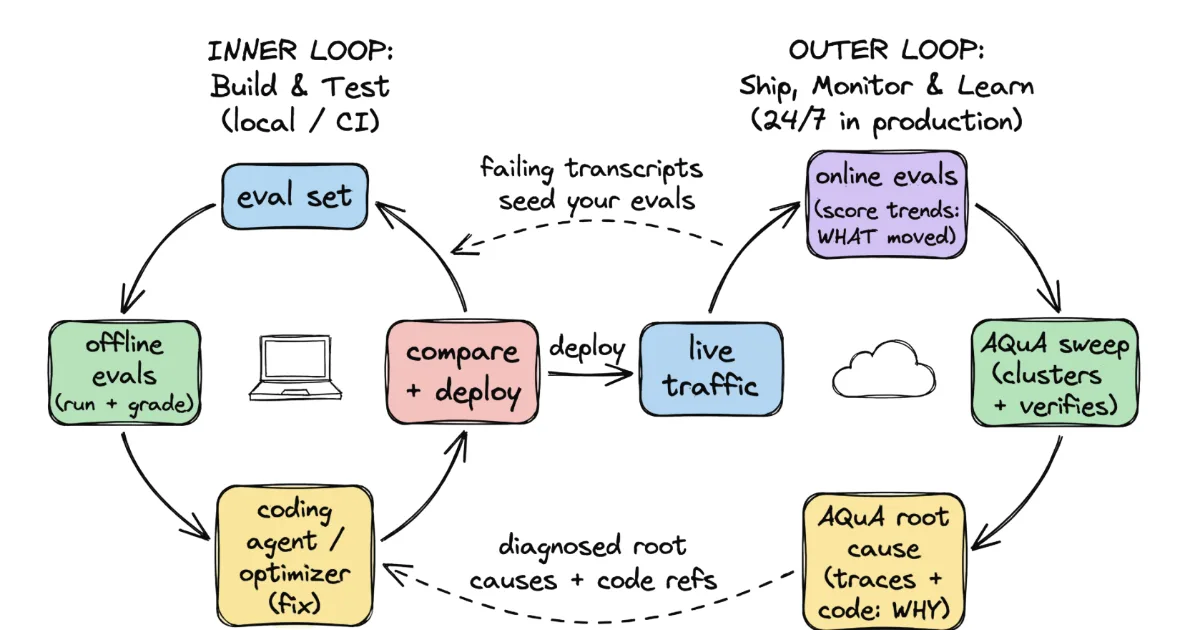
Figure: Editorial context image from the source page (preview only; rights remain with the publisher) · Credit / further reading: www.infoq.com
That single result explains why the release got attention: both failures are invisible to unit tests, throw no exceptions, and still produce confident, plausible-looking output. Here's a question-and-answer breakdown for teams evaluating it.
Q1. What exactly is AQuA?
AQuA is a reference implementation — not a hosted product — that analyzes recorded production AI agent sessions to find, confirm, and root-cause recurring failures.
Google describes it as an "ambient" agent: it works over the traffic your agent already generates rather than requiring new test suites. Its three core jobs are session analysis, recurring-pattern verification, and root-cause investigation against deployed source snapshots. Because it is a reference implementation, you adapt it to your own tracing, storage, and model stack.
Q2. Why is diagnosing production agent failures so hard?
Because agents fail behaviorally, not violently — they skip a required tool call or ignore a constraint and still return an answer that looks correct.
Classic APM tooling captures latency, error codes, and exceptions. It does not capture "the agent booked seat 14C when the user asked for an aisle seat." These failures are silent, intermittent, and often dependent on prompt phrasing, retrieved context, or tool-definition versions. By the time someone notices, the deploy that caused it is several releases behind you.
Q3. What does the AQuA workflow look like end to end?
Collect sessions → flag bad outcomes → cluster into candidate failure patterns → verify recurrence → root-cause against the deployed snapshot → re-run a replay to confirm the fix.
The critical ordering is that verification happens before root-cause analysis. Without that filter, an agent will happily generate a plausible-sounding root cause for any odd session you hand it, and you burn engineering time chasing one-off noise.
Q4. What is a "deployed source snapshot," and why does it matter?
It's a pinned record of the exact prompts, tool definitions, configuration, and code version that were live when a given session executed.
This solves the most common debugging trap in agent work: you investigate the failure against main, but the session ran three deploys ago, with a different system prompt and a tool schema that has since changed. Tying analysis to the snapshot is what makes the root-cause claim actionable rather than speculative.
Q5. What does "verifying recurring failure patterns" actually mean?
It means proving a defect is systematic — appearing across multiple sessions and genuinely violating intended behavior — before anyone changes code.
Verification separates three things that look identical in a single trace: a genuine defect, a user doing something unusual, and an acceptable variation in output. Only the first is worth a fix. This is also the step that makes the finding quotable in a postmortem.
Q6. What concrete results did Google report?
A 32-session replay: seat-selection bypasses dropped from 15 sessions to two, and dietary-preference omissions from seven to zero, after prompt changes.
Three things are worth noting. First, the fixes were prompt changes — no architectural rewrite. Second, the failures fell into two clean, measurable classes, which is what made them countable at all. Third, the bypasses went to two, not zero — a residual pattern the team can now chase with a precise starting point.
Q7. What do the two example failures have in common?
Both are constraint-adherence failures in a transactional agent: the agent completed the booking flow while silently dropping a user requirement.
Seat selection and dietary preferences are exactly the details a happy-path evaluation never exercises, and exactly the ones that generate customer complaints and refund requests. Neither throws an exception. Neither shows up in latency dashboards. This is the failure class AQuA was built for.
Q8. Is AQuA something I can just turn on?
No. It's a reference implementation you self-host and adapt — you supply the session storage, tracing, model access, and governance.
Expect integration work: mapping your trace format to what the analyzer expects, providing access to versioned prompts and tool definitions, and building a replay capability. Treat it as a blueprint for a quality pipeline, not a drop-in SaaS product.
Q9. How does AQuA differ from APM and from evaluation frameworks?
APM tells you what happened; evals tell you whether the agent passes before deploy; AQuA explains why a specific production behavior keeps recurring and which deployed artifact caused it.
The three are complementary layers. Evals are pre-deploy gates built from known cases. AQuA is the post-deploy discovery loop that finds cases your eval suite never imagined — and then hands you the test case to add.
Q10. What do I need in place before adopting it?
Five things: session logging with trace IDs, deploy versioning that pins prompts and tools, a labeled sample of bad outcomes, replay capability, and a privacy policy for logged conversations.
If you're missing session logging or version pinning, fix those first — AQuA has nothing to analyze without them. The labeled sample doesn't need to be large; a few dozen genuinely bad sessions is enough to seed pattern clustering.
Q11. What are the limitations and risks?
Analysis cost at volume, sampling bias, LLM-judge reliability, PII exposure in session logs, and the fact that AQuA diagnoses — it does not fix anything for you.
It also reflects Google's stack assumptions, so some adaptation friction is realistic. And a verified failure pattern is only as trustworthy as the labeling that fed it: if reviewers disagree about what "wrong" means, the verification step inherits that ambiguity.
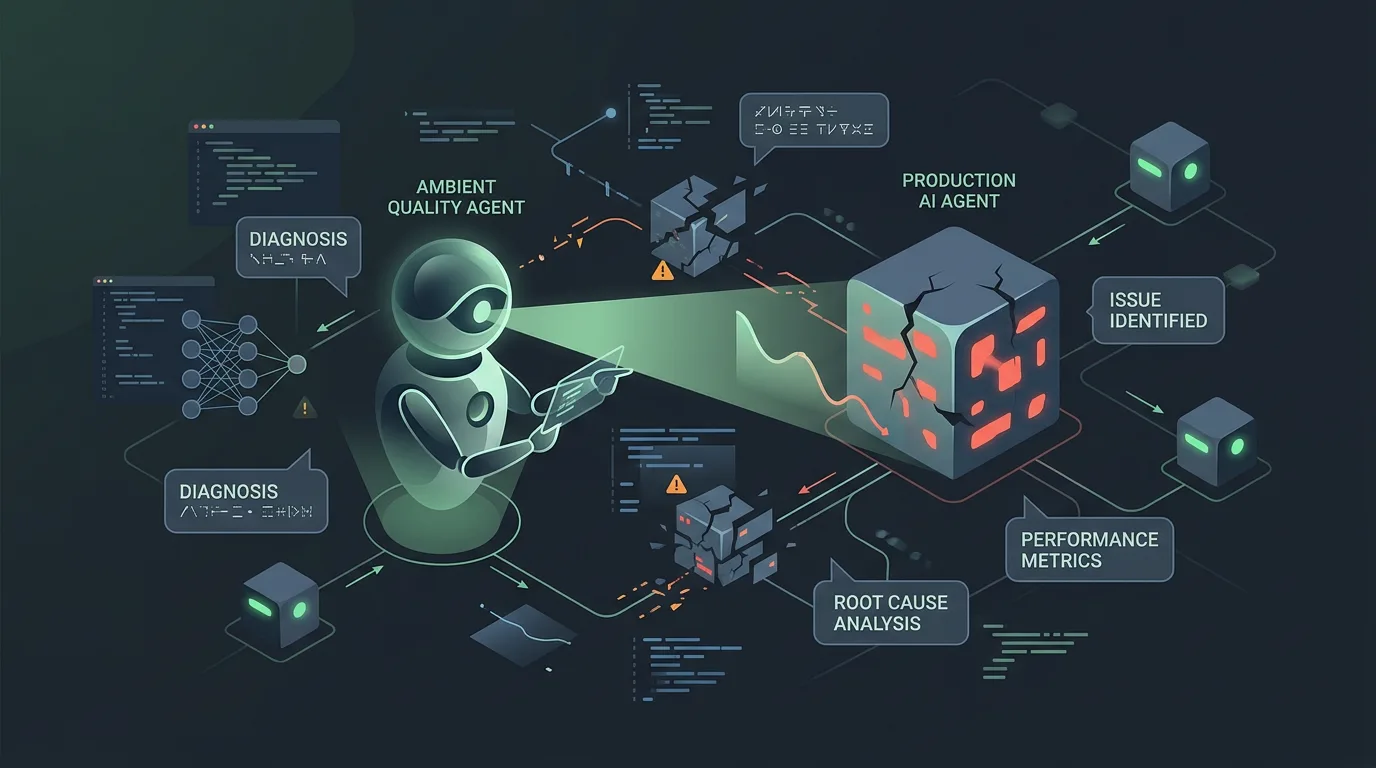
Figure: HEXOPS original illustration inspired by the topic (not a copy of the source article imagery) · Credit / further reading: www.infoq.com
Q12. What should a team do first?
Pick one high-value agent, pull one week of sessions, isolate one failure class, replay it, fix the prompt, and add the case to your eval suite.
Measure before and after the same way Google did — count sessions affected, not vibes. That single loop, run weekly, is the difference between an agent you ship and an agent you can operate.
Bottom line
AQuA's contribution isn't a new model. It's a discipline: treat production agent sessions as a data source, verify failures before chasing them, and always root-cause against the code that was actually live. The 15→2 and 7→0 numbers are small in absolute terms, but they came from a 32-session replay — which suggests the loop is cheap enough to run continuously.
Sources
- InfoQ, "Google Open Sources Ambient Quality Agent (AQuA) to Diagnose Production AI Agent Failures," by Leela Kumili — https://www.infoq.com/news/2026/11/google-ambient-agent-prod/
- Header image via InfoQ (
generatedHeaderImage-1792894383462.jpg), as included in the source feed item.