AI
Dropbox Buys Tigris Data for $350M: A Pass/Fail Checklist for Teams Betting on Agent Storage
On November 5, 2026, Dropbox acquired Tigris Data for $350M. The stated rationale, per reporting, is to support DBX Agent Cloud — a storage platform aimed at developers building AI models and agents.
Most coverage will treat this as an M&A story. For engineering and growth teams, it isn't. It's a forcing function: the object storage layer underneath AI agents is consolidating, and the vendor you pick this quarter may be a different company in eighteen months. That's a risk you can actually underwrite, if you ask the right questions.
This is a checklist. Every item has a pass condition and a fail condition. Count your passes at the end and use the scoring band to decide whether to act, hedge, or wait.

Figure: Editorial context image from the source page (preview only; rights remain with the publisher) · Credit / further reading: techcrunch.com
What the deal actually signals
Three things worth internalising before the checklist:
- Object storage is being repositioned as agent infrastructure. Not backup, not static assets — the substrate for per-agent state, session artefacts, and model inputs/outputs.
- $350M implies a bet on developer-facing storage economics, not on enterprise file sync. Dropbox is buying a wedge into the AI developer toolchain.
- Change-of-control risk is now a line item. Any team running on a startup object store needs a contractual answer to "what happens if you get acquired?"
Section A — Demand validation: do you actually need this?
Run this section before you evaluate any vendor. It kills more projects than procurement ever will.
A1. Can you name three workloads requiring per-agent or per-session storage isolation?
- Pass: You can list three concrete workloads (e.g. agent scratchpads, trace/artefact retention, per-tenant model output caches) with rough GB and request volumes.
- Fail: "Agents will probably need storage" is your answer. You have a hypothesis, not a requirement.
A2. Does your storage footprint scale with requests or tokens rather than with users?
- Pass: Storage growth tracks inference volume. Cost per query is a number you can compute.
- Fail: Storage grows with seats. You have a normal SaaS storage problem and agent-native vendors are overkill.
A3. Is your current object store measurably in the hot path?
- Pass: You have p50/p95 latency data showing storage round-trips inside your agent loop, with an estimate of user-visible impact.
- Fail: You suspect it's slow but haven't instrumented it. Instrument first; migrate second.
A4. Can you price the cost of a bad storage hop?
- Pass: You can express it in dollars per 1,000 requests or in a conversion metric (task abandonment, retry rate).
- Fail: You can't, so you can't justify the migration or measure its success.
A5. Do data residency or compliance rules force storage near inference?
- Pass: You have written requirements — region pinning, retention limits, deletion SLAs — and your current store fails at least one.
- Fail: No such constraint exists. Global object storage is already sufficient.
Section A threshold: 4 of 5 passes. Below that, stop here. You are shopping for a solution to a problem you have not confirmed.
Section B — Vendor diligence: choosing the platform
B1. S3 API compatibility is tested, not assumed.
- Pass: You ran your three heaviest operations against a sandbox and captured diffs in error codes, multipart semantics, and consistency behaviour.
- Fail: You read "S3-compatible" on a landing page and moved on. Compatibility claims are marketing until your SDK disagrees.
B2. Exit cost is measured in engineer-days.
- Pass: You have a number, and a named person owns it.
- Fail: "It's just object storage, it'll be easy." This is how teams end up with nine-figure data gravity bills and no leverage.
B3. Change-of-control clause reviewed by legal.
- Pass: Your contract specifies notice period, pricing protection, and migration assistance on acquisition. Directly relevant given this deal.
- Fail: You're on month-to-month terms with a startup and no protection. You are accepting acquisition risk for free.
B4. The roadmap dependency runs through someone else's M&A strategy.
- Pass: The features you need exist today, shippable without a vendor roadmap delivery.
- Fail: Your launch plan depends on a capability the acquirer hasn't committed to publicly.
B5. Support tier maps to your incident severity.
- Pass: Written response-time SLAs matched to your P1 definition, with a named escalation contact.
- Fail: Community Slack is the plan of record.
Section B threshold: 4 of 5.
Section C — Migration readiness
C1. Dual-write is technically feasible for your access pattern.
- Pass: You can write to both stores for a defined window and reconcile reads.
- Fail: Your workload is write-once, read-many with no reconciliation path. You'll need a cutover window instead — plan it explicitly.
C2. Cutover is bucket-by-bucket with a named rollback owner.
- Pass: Ordered list exists, each step has an owner and a rollback trigger.
- Fail: "Big bang, one weekend" — with no rollback owner, this is a hope, not a plan.
C3. Cost model is built before signature.
- Pass: You modelled egress, request pricing, and storage tiering against your real traffic for twelve months, including the migration month's double-spend.
- Fail: You're comparing headline $/GB figures. Headline storage price is the least predictive number in the deal.
C4. Data gravity audit complete.
- Pass: You know which buckets are hot, which are cold, and which should be deleted rather than migrated. Typically 20–40% of a mature estate is deletable.
- Fail: You're lifting everything. You'll pay migration costs on data you don't need.
Section C threshold: 3 of 4.
Section D — Growth team checks
D1. Storage cost is attributable per customer and per agent.
- Pass: Cost allocation tagging is in the schema, not the backlog. You can answer "what does this account cost us in storage?"
- Fail: Storage shows up as one line on the cloud bill. You cannot price or police your free tier.
D2. Your pricing model survives storage-heavy usage.
- Pass: You've modelled a worst-case power user and the gross margin holds.
- Fail: Free tier users can generate unbounded storage. Agents are very good at generating artefacts.
D3. You have a defensible narrative — moat or cost line, pick one.
- Pass: You can articulate why storage choices produce a customer-visible advantage (latency, residency, retention guarantees).
- Fail: It's an infrastructure swap. Ship it quietly and don't build a launch around it.
D4. A storage-adjacent feature can ship within one quarter.
- Pass: There's a scoped, user-facing improvement unlocked by the new platform.
- Fail: Migration is pure cost with no near-term revenue story. Sequence it behind features that have one.
Section D threshold: 3 of 4.
Scoring
Out of 18 checks:
| Passes | Verdict |
|---|---|
| 15–18 | Proceed. Run Sections C and D in parallel; sign nothing until B3 and C3 are closed. |
| 11–14 | Hedge. Stay on your current store, add a compatibility abstraction layer, and revisit in two quarters. |
| 0–10 | Do nothing. The deal is interesting; your migration isn't justified. Re-run Section A in 90 days. |
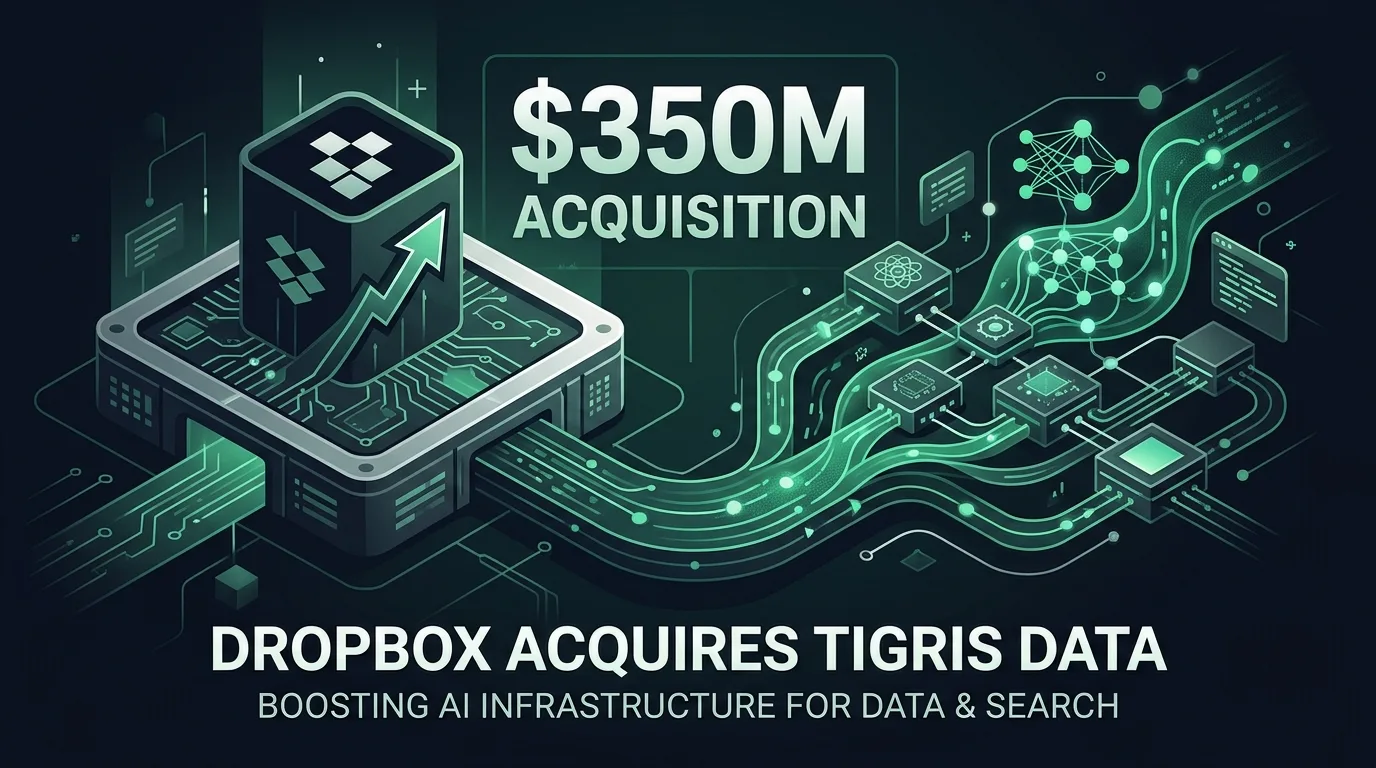
Figure: HEXOPS original illustration inspired by the topic (not a copy of the source article imagery) · Credit / further reading: techcrunch.com
What would change this assessment
- Dropbox publishes DBX Agent Cloud pricing and SLAs. Right now the platform is a stated intention, not a product you can diligence.
- Tigris customers get explicit migration commitments. Named public terms would materially reduce the change-of-control discount in B3.
- A credible second acquirer enters. One deal is an anecdote. Two is a category, and category consolidation changes how much optionality your abstraction layer buys.
- Your own instrumentation crosses a threshold. If storage round-trips exceed 10% of agent-loop latency, Section A's answer changes regardless of what Dropbox does.
The $350M headline is a distraction. The durable takeaway is simpler: object storage just became an M&A-relevant part of the AI stack, which means every storage contract you sign should now answer the question "what if they get acquired?" Dropbox just answered it for one vendor. Ask it of yours.
Sources
- TechCrunch — Dropbox acquires Tigris Data for $350M to bolster its AI infrastructure (November 5, 2026): https://techcrunch.com/2026/11/05/dropbox-acquires-tigris-data-for-350m-to-bolster-its-ai-iinfrastructure/
- Deal summary as reported: acquisition value $350M; stated purpose is to support development of DBX Agent Cloud, a storage platform for developers building AI models and agents.
Analysis, thresholds, and scoring bands in this article are the author's own framework and are not claims about Dropbox, Tigris Data, or their customers.