cybersecurity
Most teams do not have an agent problem. They have a containment problem. An agent that can do almost anything is impressive in a demo and exhausting in production, because nobody can say precisely what it was allowed to touch, what it actually did, or why.
The canvas model answers that. It is a design stance borrowed from product engineering: instead of maximizing what an agent can do, you define a bounded surface inside which it may act freely — and you instrument the edges of that surface so drift becomes visible early.
The Core Idea
Figure: Editorial context image from the source page (preview only; rights remain with the publisher) · Credit / further reading: www.infoq.com
1. What is a "canvas" for AI agents?
A canvas is an explicit, engineered boundary around an agent's work. It defines the scope of action (files, services, environments, tools), the intent it is executing against, the evidence it must leave behind, and the signals that indicate it has wandered outside the design.
The word matters: a canvas is not a cage. Inside the boundary the agent gets real freedom to plan, iterate, and choose its steps. The boundary is what makes that freedom safe enough to ship.
2. Why do agents need bounded autonomy?
Because unbounded autonomy converts every agent run into an unbounded risk review. Humans reviewing agent output need a finite surface to reason about — a known blast radius, a known toolset, a known intent. Once that surface exists, review becomes a check against a spec rather than an open-ended hunt for surprises.
Bounded autonomy also improves the agent's own performance. Narrower context and clearer constraints usually produce more consistent plans than a maximally permissive environment.
3. How is a canvas different from an agent harness?
A harness is the machinery that runs the loop: prompts, tool calls, retries, context assembly. A canvas is the contract that loop operates inside: scope, permissions, decision trail, and drift signals.
You can swap harnesses — different models, different orchestration frameworks — while the canvas stays stable. That separation is what lets an organization standardize agent behavior without freezing its tooling choices.
Making Autonomy Observable
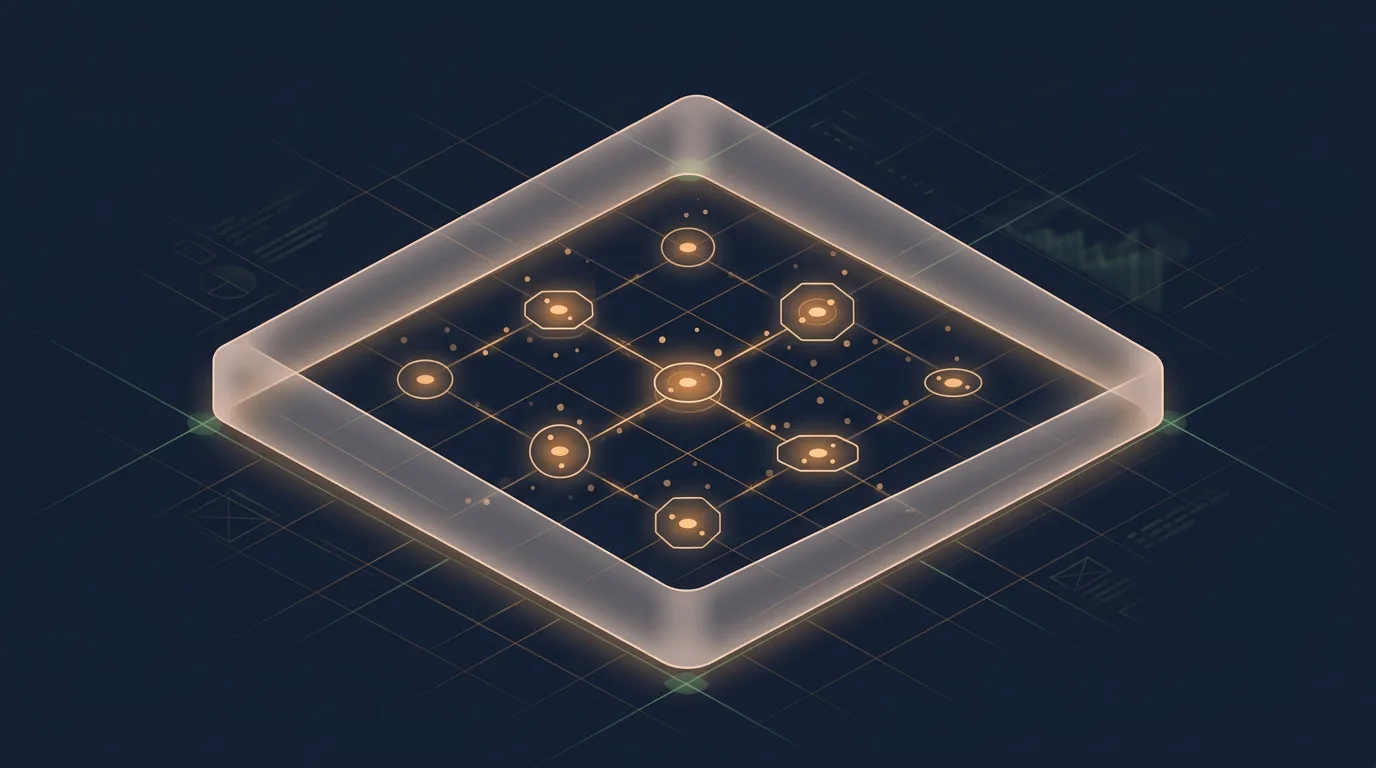
Figure: HEXOPS original illustration inspired by the topic (not a copy of the source article imagery) · Credit / further reading: www.infoq.com
4. What is drift detection for agents?
Drift detection is the practice of continuously comparing what an agent is doing against what the canvas says it should be doing. Concretely: touched paths outside scope, tool calls not on the allowlist, dependency changes nobody asked for, plans that no longer match the stated intent, or repeated retries signaling confusion rather than progress.
In engineering systems, drift usually means infrastructure diverging from declared state. For agents, drift is behavioral: the work quietly redefining itself. Detecting it early is cheaper than debugging it late.
5. What are decision records and why do agents need them?
A decision record is a short, durable note capturing what was chosen, what alternatives were rejected, and what evidence supported the choice. Agents need them because agent output is often plausible but unexplained — the diff arrives without the reasoning.
Recorded decisions turn an agent from a black box into a colleague with a paper trail. They also give future agents and future engineers the context that would otherwise be lost between sessions.
6. Which product-engineering principles actually transfer?
Four transfer cleanly. Scope definition — a written statement of what is in and out of bounds. Interface contracts — tools and APIs with explicit expectations rather than implicit assumptions. Observability by default — logs, traces, and artifacts designed in, not bolted on. Change review — a human checkpoint at the moments where reversibility drops.
None of these are novel. That is the point: agent systems fail in the same ways other systems fail, and the familiar disciplines still apply.
7. What does a canvas look like in practice?
Usually four artifacts. A scope document describing allowed repositories, environments, and tools. A permissions layer enforced in code, not in a prompt. An append-only decision log attached to each work item. A drift dashboard that surfaces anomalies for humans rather than silently auto-correcting them.
Teams often start with the permissions layer because it is the most concrete, then discover they need the decision log to explain why the permissions were hit.
8. What failure modes does a canvas prevent?
The common ones: scope creep inside a single task, agents editing infrastructure they were never asked to touch, silent dependency upgrades, repeated loops that burn budget without progress, and "works on my run" behavior that nobody can reproduce.
It does not prevent bad judgment. It prevents bad judgment from becoming unbounded damage — and it makes the bad judgment legible afterwards.
9. Does bounding autonomy reduce agent capability?
Less than teams expect, and usually in the right places. Agents rarely need the whole filesystem; they need the relevant slice, clearly described. Constraints that are documented and machine-enforced tend to improve output quality because the agent stops guessing about intent.
What you genuinely lose is accidental capability — the agent that solved a problem by wandering into an unrelated directory. That is a trade most production teams accept.
10. How do you measure whether the canvas works?
Track a small set of signals: percentage of runs with zero scope violations, time-to-explain for any given change, drift events caught before review versus after, and the share of agent work items that carry a complete decision record.
If time-to-explain is falling while delivery volume rises, the canvas is doing its job. If drift is only discovered in post-incident review, it is not.
11. What about multi-agent and cross-team setups?
Canvases compose, but they must be declared per boundary. When one agent hands work to another, the receiving agent inherits a scope and should not silently widen it. Cross-team, the canvas becomes an internal contract: platform teams define the surface, product teams operate inside it.
The failure pattern to watch for is boundary laundering — work passed between agents until no single agent's canvas explains the outcome.
12. How should a team start?
Pick one high-frequency, low-blast-radius workflow. Write down its scope in a page. Enforce three to five permissions in code. Require a decision record per work item. Instrument two or three drift signals and review them weekly for a month.
Resist the urge to build the universal canvas first. The constraints you actually need only become obvious once a real workflow has run against a narrow one.
Key takeaways
- A canvas is a bounded, instrumented surface for agent action — not a harness, and not a cage.
- Bounded autonomy makes human review finite and makes agent output explainable.
- Continuous drift detection catches behavioral divergence while it is still cheap to fix.
- Decision records convert plausible agent output into auditable reasoning.
- Familiar product-engineering disciplines — scope, contracts, observability, change review — transfer directly.
- Start narrow: one workflow, a few enforced permissions, a short decision log.
Next steps
Audit your most active agent workflow and write down its current scope in one page — most teams find they cannot. Then enforce the two permissions that matter most in code rather than in prompts, and add a decision record template to the work item. Once those exist, instrument a single drift signal and put it in front of a human every week. Expand the canvas only after the narrow version has survived a month of real use.
Sources
- InfoQ presentation, "Beyond the Harness: Canvas for AI Agents": https://www.infoq.com/presentations/canvas-ai-agents/