Comparison
Fable 5.2 vs Gemini 4 Carbon vs Decision Models: A Developer's Selection Guide (Nov 9–16, 2026)
Four days, four separate changes to the model layer, and at least one of them will touch code you already shipped. This guide is written for the person who has to choose something this sprint — not for the person who wants the announcement post read aloud. Every release, date and price band below traces back to a vendor blog, doc page or changelog checked on 16 November 2026; the Reddit threads we leaned on are linked in the source post.
Figure: Editorial context image from the source page (preview only; rights remain with the publisher) · Credit / further reading: dev.to
What actually shipped
- Fable 5.2 — the week's flagship text-and-code release. Incremental on the API surface, not incremental on output quality.
- Gemini 4 Carbon — Google's Gemini 4 family grows a second tier. We already covered the flagship path separately in the React chat migration post; Carbon is the sibling you reach for when Hydrogen's per-token cost stops making sense.
- Decision models — two vendors now sell models that answer closed questions. Yes/no, route A/B, pass/fail. No prose. This is a genuine new category, and it breaks any pipeline that assumes
response.textis a string with words in it. - DeepSeek turned its API into a full application stack — worth knowing because it changes the build-vs-buy math for small teams, not because you should migrate today.
- GitHub put a date on retiring six Copilot models. That's the only item on this list with a hard deadline attached to code you may not own.
The options, compared honestly
Fable 5.2 — the default, if you can pay for it
5.2 is the safest "just upgrade the model string" move this week. Tool-calling and long-context behaviour are consistent with 5.1, which means your prompt library and eval suite mostly carry over. The wins show up in multi-step agent loops, where the model holds a plan together for longer before it starts improvising.
The cost is the obvious catch: premium price band, and reasoning-style output means your completion-token bill grows faster than your request count. Teams that got comfortable with 5.1's spend should re-run their cost projection before flipping the default in production.
Pick it when output quality is the product, and a wrong answer costs more than a token.
Gemini 4 Carbon — the volume tier
Carbon is the tier you use when you've already proven the task and now need it to be cheap. It handles structured extraction, classification, summarisation and short-context chat at a price band that makes Hydrogen hard to justify for high-QPS workloads.
The tradeoff is at the edges. On long, ambiguous, multi-tool tasks Carbon drifts sooner — not catastrophically, but you'll see it in eval pass rates before you see it in user complaints. It's also a second model in the same family, which means Gemini 4's migration quirks now apply to two strings in your config instead of one.
Pick it when you have an eval harness and the task is well-specified.
Decision models — cheap, fast, and structurally different
This is the item most likely to be underestimated. A decision model doesn't return text, so it can be dramatically cheaper and faster per call — and it can't be dropped into a chat.completions shape without a translation layer. Where it shines: routing (which model handles this request), guardrails (does this input pass), and policy checks (does this action need approval).
Two vendors shipping this in the same week is a signal that the routing layer is becoming the product. If you're currently spending a frontier-model call to decide which frontier model to call, that's the line item to kill.
Pick it when your question has two answers and your current solution writes a paragraph to say "yes".
Staying put — still a defensible choice
Neither new frontier model forces a migration. If your current stack passes evals and your bill is stable, the correct action this week is to evaluate, not to ship. The only forced move is the Copilot retirement, and that has a date.
Criteria table
| Criterion | Fable 5.2 | Gemini 4 Carbon | Decision models | Your current stack |
|---|---|---|---|---|
| Output type | Free text + tool calls | Free text + tool calls | Closed answer only | Varies |
| Best at | Long agent loops, code | High-volume extraction, chat | Routing, guardrails, policy | Known quantity |
| Price band | Premium | Budget/mid | Lowest per call | Already budgeted |
| Latency profile | Slow, reasoning-heavy | Fast | Fastest | Known |
| Breaking-change risk | Low (incremental) | Medium (family quirks, two strings) | High (new response shape) | None |
| Eval effort to adopt | Low | Medium | High (new harness) | Zero |
| Migration urgency | Optional | Optional | Optional | Hard date if Copilot |
Read that table as effort-vs-payoff, not as a ranking. The two frontier models are upgrades. The decision models are an architecture change.
Recommendation by scenario
You run an agentic coding product. Fable 5.2, and only Fable 5.2. The long-horizon gains are the whole product. Budget for the token increase now rather than discovering it mid-quarter.
You run a high-QPS chat or extraction feature. Gemini 4 Carbon, with Hydrogen kept behind a flag for the 5% of requests that fail your eval. Route between them with a decision model instead of hardcoding thresholds.
You're paying a frontier model to classify things. This is the clearest win of the week. Replace it with a decision model, keep the frontier call for the actual work, and measure. Most teams will find 40–70% of their request volume was never generating text anyone read.
You're latency-bound (autocomplete, inline suggestions). Carbon, or a decision model for the routing layer. Fable 5.2's reasoning pass will show up in your p95 before it shows up anywhere else.
You're regulated, audited, or on-prem. Nothing here changes your constraints. The interesting question is whether a decision model's binary output makes your audit trail simpler or worse — a log line saying allowed: false with no rationale is cheaper and far less defensible than a paragraph.
You're a two-person team. DeepSeek's app-stack move is the relevant news; the frontier releases are not. Building your own orchestration layer got less attractive this week.
You're on a retiring Copilot model. Ignore all of the above until you've checked the deprecation table. That's the only clock actually ticking.
What breaks
The failure modes are boring and predictable, which is good news:
- Model strings. Six Copilot models have a retirement date. That's a config change with a deadline, and it's the one item here that can page you at 2 a.m.
- Response shape. Decision models don't return text. Any code doing
if "yes" in response.textwill silently returnFalseforever, which is worse than throwing. - Token accounting. Reasoning tokens bill differently. Dashboards that assume
prompt + completion = totalwill under-report, and your on-call engineer will blame the wrong service. - Tokenizer drift within the Gemini 4 family. Hydrogen-era token counts are not Carbon-era token counts. Context-window math that "worked" can now truncate.
- Tool-call schema strictness. Newer models are stricter about malformed arguments. Prompts that got away with sloppy JSON will start failing validation instead of quietly succeeding.
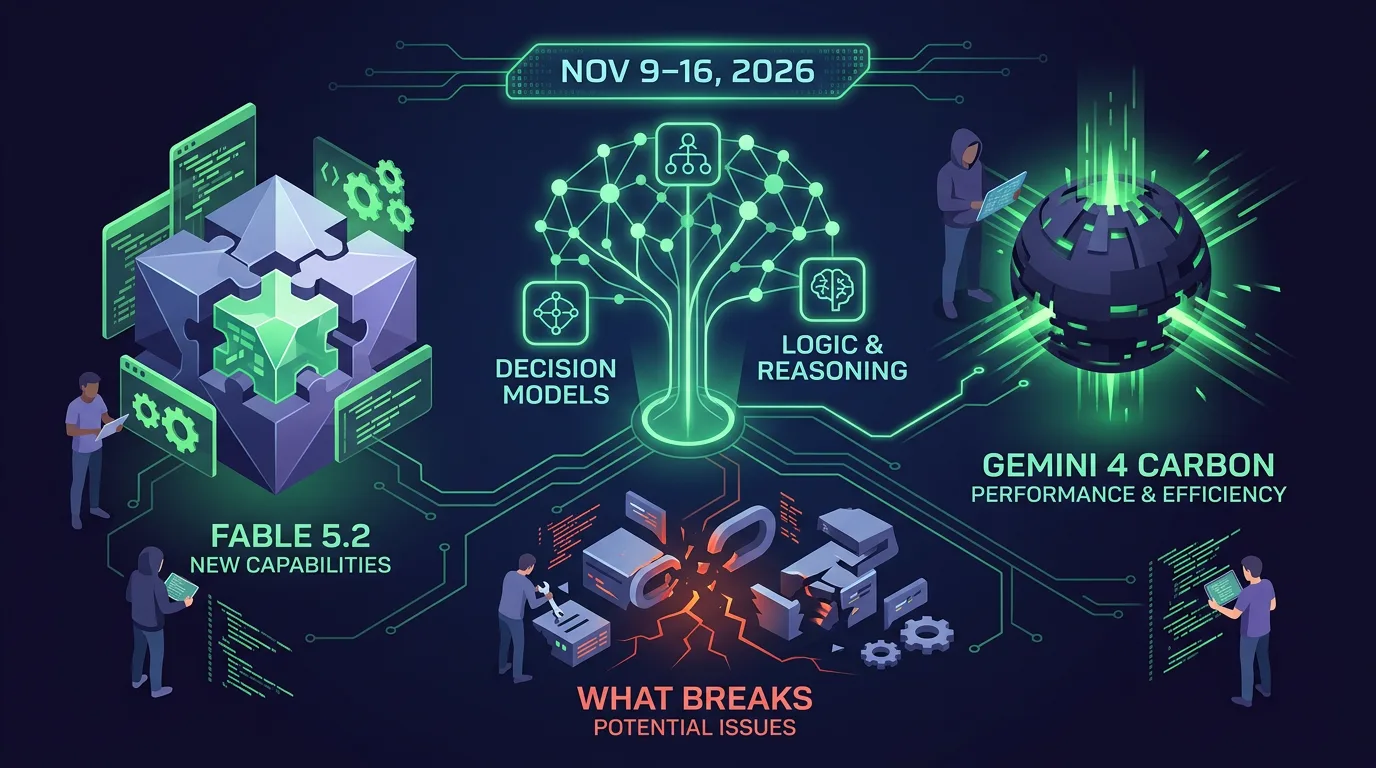
Figure: HEXOPS original illustration inspired by the topic (not a copy of the source article imagery) · Credit / further reading: dev.to
A 30-minute pre-flight check
Before you change a single model string:
- Grep for hardcoded model IDs and version suffixes.
- Find every place that reads
.textoff a response object. - Re-run your eval suite against the new model before changing the default — not after.
- Diff your cost-per-request projection, including reasoning tokens.
- Confirm your context-window assumptions with the new tokenizer, not the old one.
Verdict
Fable 5.2 is the upgrade you make because quality is the product. Gemini 4 Carbon is the upgrade you make because your bill is the product. Decision models are neither — they're the first credible answer to the question every team hit this year: why am I paying frontier prices to pick a route? Start there. It's the cheapest experiment on the list, and it's the one most likely to still matter in six months.
Sources
- Cuelark Team, "AI updates for developers, Nov 9–16 2026: Fable 5.2, Gemini 4 Carbon, decision models, and what breaks" — https://dev.to/cuelark/ai-updates-for-developers-nov-9-16-2026-fable-52-gemini-4-carbon-decision-models-and-what-14j1 (prices, dates and releases verified against vendor blogs, docs and changelogs on 16 November 2026; per-thread Reddit links in the original)
- Cuelark Team, "Gemini 4 Hydrogen in a React chat: the migration details that actually matter" — https://dev.to/cuelark/gemini-4-hydrogen-in-a-react-chat-the-migration-details-that-actually-matter-56lh
- Vendor release notes and changelogs for Fable 5.2, the Gemini 4 family, the two decision-model APIs, DeepSeek, and the GitHub Copilot model retirement table — consult these directly for exact pricing, context limits and deprecation dates before committing.