
How-to
Behind Booking.com's AI Evolution: A Practical Playbook for Cross-Border, SaaS, and Store Teams
Most AI platform talks are polished success stories. The Booking.com presentation by Jabez Eliezer Manuel is more useful than that: it's a 20-year account of scaling MySQL topologies, retiring Hadoop in favor of cloud-native architecture, and running a model-serving and feature-store stack that handles roughly 400 billion predictions per day — plus interleaved experimentation and a new agentic AI foundation.
You probably aren't Booking.com. But if you run a cross-border store, a SaaS product, or a multi-market commerce team, the underlying lessons apply directly: your data platform decisions compound, your feature store is the real moat, and experimentation discipline is what turns personalization from a demo into revenue.
Here's how to turn that story into an operating plan.
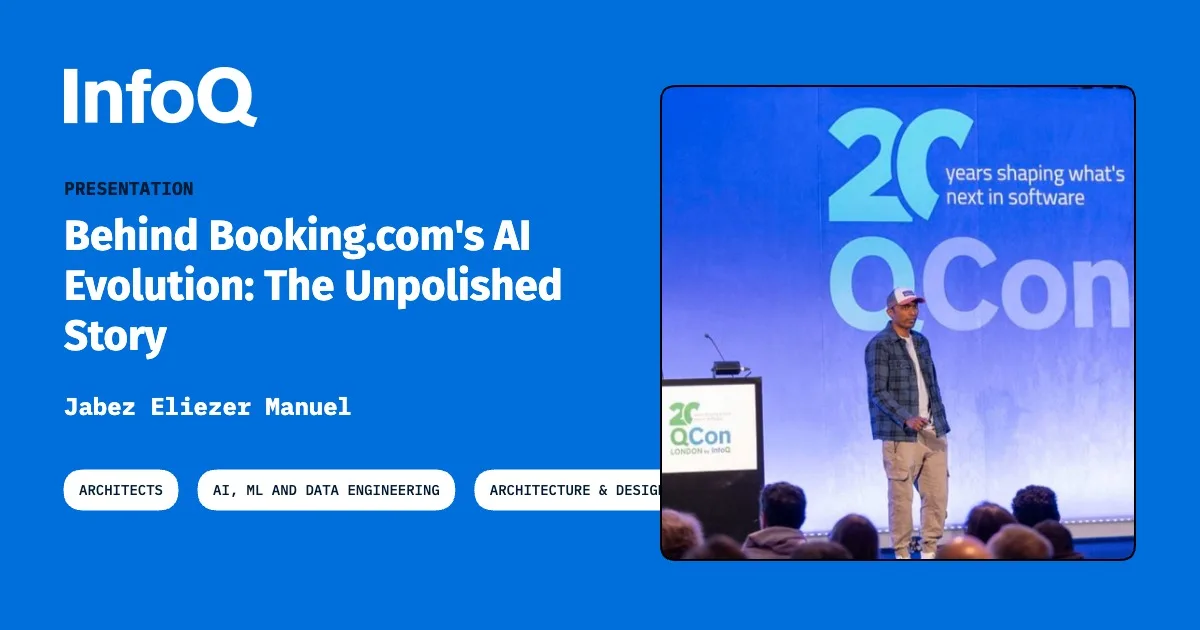
Figure: Editorial context image from the source page (preview only; rights remain with the publisher) · Credit / further reading: www.infoq.com
Step 1: Audit your platform in "eras," not tickets
Booking.com's stack didn't evolve in a straight line — it moved in eras: relational scale-out, then big data, then cloud-native serving. Each era solved a real problem and created new debt.
Do the same audit for your own stack. Write down:
- Era 1 (transactional): where your source-of-truth data lives (Postgres/MySQL, Shopify, Stripe, your ERP).
- Era 2 (analytics): warehouses, ETL jobs, dashboards, any legacy batch tooling nobody wants to touch.
- Era 3 (ML/serving): where predictions, rankings, recommendations, or fraud scores actually get computed today.
Then mark three things per era: cost, latency, and who owns it. Anything with unclear ownership becomes the bottleneck in 18 months. The Booking.com lesson isn't "copy their architecture" — it's that they knew when an era was over. Hadoop was retired because the cloud architecture made it redundant, not because it was fashionable.
Your action: book a half-day with one engineer, one analyst, and one product owner. Produce a one-page era map. If you can't name the owner of your feature pipeline, that's your first project.
Step 2: Build the feature store before the model
The most reusable idea in the talk is the feature store — a single place where training and serving read the same feature definitions. Teams that skip this end up with "train-serve skew": the model looks great offline and degrades in production because the pipeline that computes features for training is not the pipeline that computes them at request time.
For a cross-border or store team, this matters because your features are localized: price in local currency, shipping ETA by country, return rate by category, session behavior by device class.
Practical minimums:
- Define features once, in versioned code, with an owner per feature group.
- Serve and train from the same definition — no parallel SQL.
- Timestamp every feature so you can do point-in-time joins and avoid leakage.
- Track freshness SLAs (e.g., inventory features < 5 min, customer lifetime value < 24 h).
You don't need a vendor. A small team can start with a dbt project plus a low-latency key-value store (Redis, DynamoDB) and a strict convention. What you must not do is let every model team invent its own feature logic.
Step 3: Separate serving from training, and budget for throughput
400 billion predictions per day is an extraordinary number, but the design principle scales down: serving is a different system from training. Training is batch, forgiving of latency, and can be slow. Serving is real-time, latency-bound, and must degrade gracefully.
Design for throughput and failure explicitly:
- Set a p99 latency budget per prediction type (e.g., ranking ≤ 50 ms, recommendations ≤ 120 ms).
- Cache aggressively at the feature layer; recompute only what changed.
- Batch your model calls where the user experience allows it (cart recommendations, email personalization) and keep real-time paths lean.
- Define a fallback: a heuristic, cached result, or business rule when the model service times out.
This last point is where most store teams get burned. If your recommendation service is a hard dependency on the product page, a cold cache is a revenue incident. Booking.com-style scale forces these decisions early; you should make them deliberately.
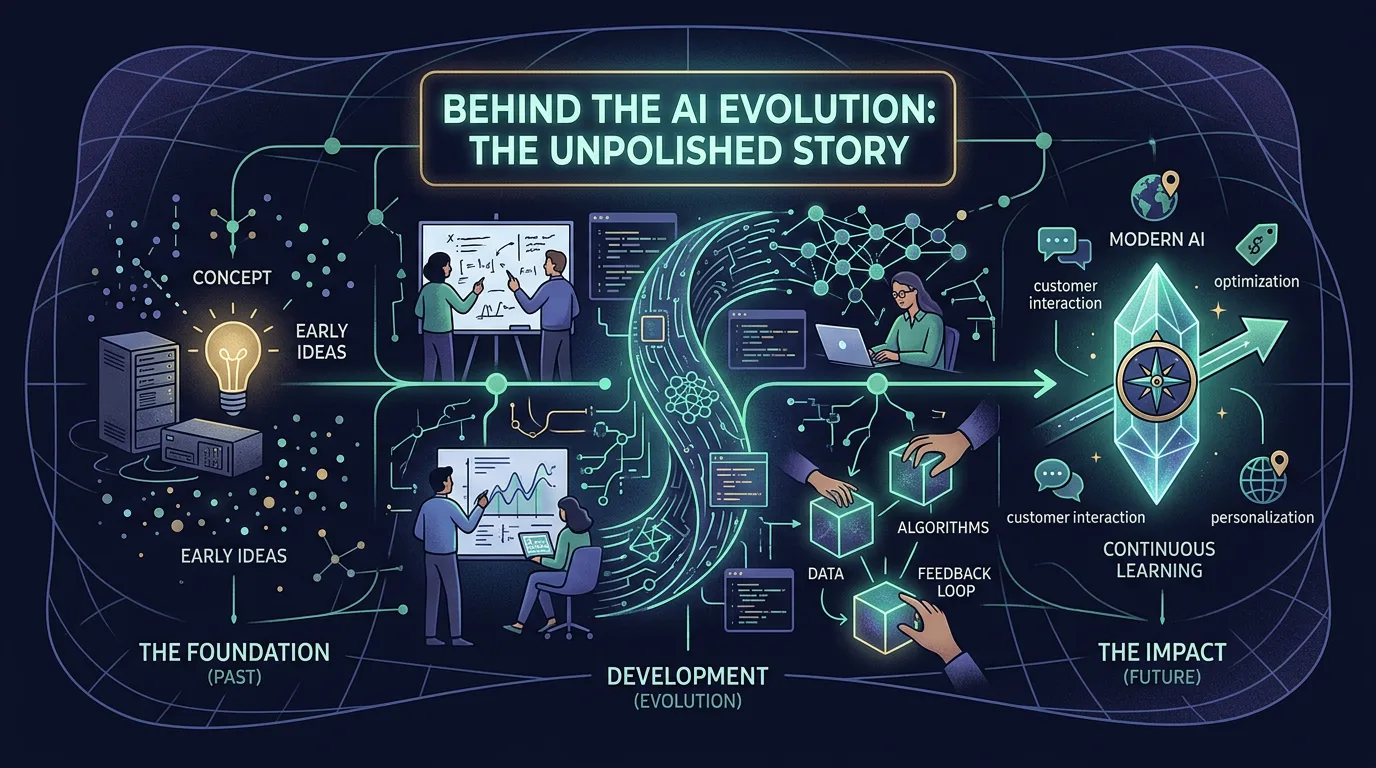
Figure: HEXOPS original illustration inspired by the topic (not a copy of the source article imagery) · Credit / further reading: www.infoq.com
Step 4: Treat experimentation as infrastructure, not a quarterly project
The presentation highlights interleaved experimentation — mixing results from two rankers in a single session and letting users' behavior decide which wins. It's a faster, lower-variance way to compare ranking systems than a classic A/B split, because it controls for session-to-session noise.
You don't need interleaving on day one, but you do need the following, in this order:
- A single assignment service that logs which variant a user saw, consistently across web and app.
- A metric registry with pre-agreed primary metrics (conversion, revenue per session, return rate, margin — not just clicks).
- Guardrail metrics so personalization doesn't quietly destroy margin or increase returns in a specific country.
- A kill switch per experiment, reachable by an on-call engineer without a deploy.
For cross-border teams, add a fifth: per-market analysis as the default. A test that wins in Germany and loses in Brazil is not a win — it's a segmentation discovery.
Step 5: Sunset legacy systems on a schedule, not on a crisis
Retiring Hadoop is unglamorous work with a long tail of angry dashboards. Booking.com did it anyway — and that's the transferable discipline.
Adopt a two-quarter sunset rule: any system with no new consumers and a declared replacement gets a deprecation date, a migration owner, and a public list of dependent jobs. Track it like a product launch. Freeze new work on the legacy path the day the date is announced.
Smaller teams can apply a lighter version: quarterly, list every data pipeline nobody has queried in 90 days. Kill or archive it. Your platform's cost and cognitive load are dominated by the long tail, not the core.
Step 6: Personalize with market-aware guardrails
Booking.com's personalization work runs at enormous volume, but the mechanics are familiar: user signals, contextual signals (device, destination, timing), and a ranking layer on top.
For a store or SaaS team, sequence it:
- Start with rules you can explain (recently viewed, local bestsellers, language-matched content).
- Add one model at a time, each with an offline eval and a live experiment.
- Handle cold start explicitly — new markets and new users get a market-level prior, not an empty state.
- Localize the objective, not just the language: price sensitivity, payment method, and delivery expectations differ by country, and a single global objective will optimize for your biggest market.
Step 7: Lay an agentic foundation without betting the roadmap
The talk closes with a new agentic AI foundation. That's a signal about direction, not a template. Before you build agents into customer flows, establish the boring prerequisites:
- Tool access with scoped permissions — an agent that can issue refunds needs the same audit trail as a human.
- Evaluation harness with a fixed set of real tasks and pass/fail criteria, rerun on every change.
- Human-in-the-loop for anything that touches money, inventory, or customer commitments.
- Observability: log every tool call, token spend, and outcome so you can debug and cost-control.
Start with internal, low-risk workflows (support triage, catalog enrichment, translation QA) before touching checkout or pricing.
The checklist
- One-page era map of your data platform, with an owner per era.
- Feature definitions versioned in code; training and serving share them.
- Point-in-time correctness verified on your top 10 features.
- p99 latency budget documented per prediction type.
- Explicit fallback for every real-time model dependency.
- Experiment assignment service logs variants across web and app.
- Primary + guardrail metrics pre-registered per test.
- Per-market breakdown is the default readout, not an afterthought.
- Kill switch tested in the last 30 days.
- Sunset date and owner assigned to at least one legacy system per quarter.
- Cold-start strategy defined for new users and new markets.
- Agent evaluation harness exists before any agent touches a customer flow.
Sources
- InfoQ presentation: Behind Booking.com's AI Evolution: The Unpolished Story — Jabez Eliezer Manuel. https://www.infoq.com/presentations/bookingcom-ml-data-platform-evolution/
Analysis and recommendations above are HEXOPS' own framing; specific figures (e.g., ~400B predictions/day) are as reported in the source presentation.