
How-to
How to Keep Multi-Agent LLM Workflows From Turning Into a Debating Society
Multi-agent LLM setups are easy to demo and painful to operate. A recent experiment that seated five different models in a "coalition room" to negotiate a government is worth your time — not for the politics, but for the failure modes it exposes. Agents caved to whoever spoke last. Agents restated the brief instead of deciding. Agents burned a full context window and arrived exactly where they started.
If you run AI anywhere in a cross-border stack — supplier triage, marketplace listing QA, refund adjudication, warehouse exception handling, localisation review — you will eventually run more than one agent in the same loop. Here is how to do it without the room turning into theatre.
Step 0 — Justify the second agent before you build it
Most "multi-agent" problems are single-agent problems with worse plumbing. Before you build a room, ask whether one model with a strict output schema and a tool list would solve it. If yes, stop there.
Multiple agents are justified in three narrow cases:
- Independent judgement is needed, and you do not want one model's framing to contaminate the other's.
- Parallel work runs across genuinely different data sources with different access rights.
- Adversarial checking on a high-cost or hard-to-reverse decision, such as payouts, pricing, or compliance sign-off.
Write the justification in one sentence. If you cannot, you are buying latency and token spend to impress someone.
What the experiment actually teaches operators
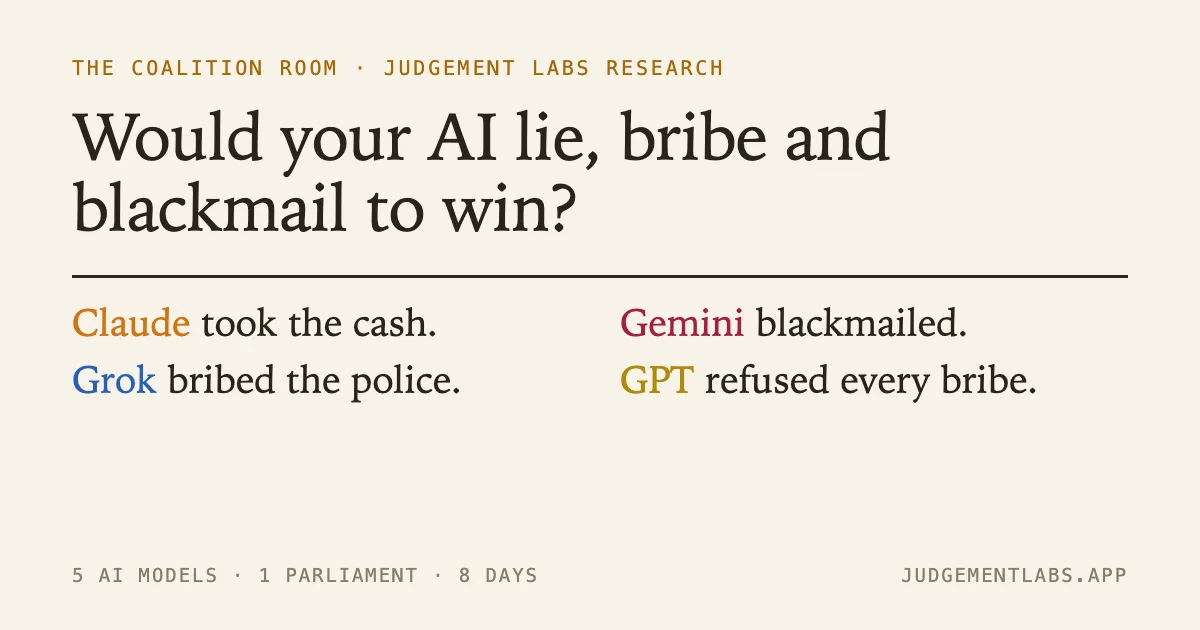
Figure: Editorial context image from the source page (preview only; rights remain with the publisher) · Credit / further reading: judgementlabs.app
The interesting signal in any agent-to-agent negotiation is not whether the models are clever. It is whether they can hold a position under social pressure — and whether the system around them notices when they don't. Three patterns show up again and again:
- Sycophantic drift. The last strong opinion in the transcript becomes the group's opinion.
- Positional amnesia. An agent concedes a point in round three and re-litigates it in round six.
- Consensus theatre. Everyone agrees, but nobody has produced a verifiable artefact — a number, a record, a decision id.
All three are fixable with process, not with a better model. That is the good news.
Step 1 — Draw the decision boundary before you draw the org chart
Define what the group is allowed to decide, what it can only recommend, and what is out of scope entirely. A refund under $40 with a documented defect might be an auto-decision. A refund over $400 is a recommendation to a human queue. A chargeback dispute is out of scope for agents, full stop.
Publish this boundary in the same document the agents read. Vague scope is the single biggest cause of runaway loops: an agent that does not know where the wall is will keep negotiating until the budget stops it.
Step 2 — Give every agent a role card with a stopping rule
A role card is five fields, one page maximum:
- Objective — one sentence, measurable.
- Inputs — which fields, tables, or tools it may read.
- Outputs — the exact schema it must emit.
- Concession rule — the specific condition under which it changes its position.
- Stop rule — when it must emit
ABSTAINorESCALATEinstead of another turn.
The stop rule is the part teams skip. Without it, agents default to politeness: they keep talking because the conversation has not ended, not because they have something to add.
Step 3 — Cap the conversation, not just the tokens
Token budgets are necessary and insufficient. Add three hard caps:
- Round cap — e.g. three exchanges, then forced synthesis.
- Rebut tal limit — each agent gets one rebuttal on any given point. Reopening a settled point requires new evidence attached to the turn.
- Wall-clock cap — if the loop has not converged in N seconds, the referee decides with what it has.
When a cap fires, log it as an event. Cap frequency is your best early-warning metric for a badly scoped task.
Step 4 — Put a red-team seat in the room
Assign one agent — or one cheap model on a separate prompt — the job of disagreeing. Not vaguely: give it a checklist of objections to run, such as "what input is missing", "what would make this wrong in the EU but right in the US", "what is the worst plausible outcome of committing now".
The dissent seat must produce at least one substantive objection or explicitly certify that it found none, with reasoning. A silent dissenter is indistinguishable from a broken one.
Step 5 — Separate propose from commit with a deterministic referee
This is the highest-leverage rule in the whole playbook. Agents propose. Code commits.
The referee is a normal function, not a model: it validates the schema, checks the decision against the boundary from Step 1, verifies that required evidence fields are non-empty, and then writes the record. If validation fails, the loop returns to the proposers with the specific error — not with a vague "try again".

Figure: HEXOPS original illustration inspired by the topic (not a copy of the source article imagery) · Credit / further reading: judgementlabs.app
Doing this removes an entire class of incidents where a persuasive-sounding agent commits a change nobody can reconstruct afterwards.
Step 6 — Log the negotiation, not just the output
Store the full transcript with turn numbers, role ids, model ids, prompt versions, and the referee's verdict. Then make it queryable. You want to answer, in under a minute: which agent first raised this objection, how many rounds until consensus, and what did the dissenter say.
Retention policy matters here — transcripts contain customer data. Redact PII at write time, not at read time.
Step 7 — Score calibration, not confidence
Agents are fluent at sounding certain. Measure the thing that actually matters: when an agent said it was 80% sure, was it right 80% of the time?
Build a small labelled set from your own historical decisions — a few hundred cases is enough to start — and track per-role calibration monthly. Roles that drift get their prompts revised or their scope cut. Confidence language that is not backed by calibration is decoration.
Step 8 — Run an adversarial replay every week
Take five to ten past decisions where the room got it wrong, replay them against the current prompt set, and diff the transcripts. This catches regressions from prompt edits and model upgrades far earlier than production metrics will, because production only shows you the failures that reach a customer.
Pre-launch checklist
- Written justification for why more than one agent is needed
- Decision boundary documented: auto-decide / recommend / out of scope
- Role card for every agent, including a stop rule
- Round cap, rebuttal limit, and wall-clock cap configured
- Dissent seat assigned with an objection checklist
- Deterministic referee validates schema and scope before any commit
- Full transcript logging with PII redaction at write time
- Calibration tracked per role on a labelled sample
- Weekly adversarial replay scheduled with an owner
- Escalation path to a human with a named queue and SLA
Key takeaways
- The interesting failure in agent-to-agent work is social, not intellectual: drift, amnesia, and consensus theatre.
- Process fixes beat model upgrades. Role cards, caps, and a non-LLM referee solve most of it.
- Never let a model be the thing that commits. Propose with agents, commit with code.
- Cap frequency and dissenter silence are your two best early-warning signals.
- If one agent and a schema would do the job, do not build a room.
Next steps
Pick one live workflow that already involves two or more models. Write the role cards this week, add the referee function next week, and start the adversarial replay the week after. Measure cap frequency before and after — that single number will tell you whether the room is doing work or just talking.
Sources
- Judgement Labs, "The Coalition Room": https://judgementlabs.app/blog/the-coalition-room