
AI
The AI Voice Product Description Checklist: A Pass/Fail Gate for E-Commerce Teams
Voice-enabled product descriptions are one of those features that demos beautifully and ships badly. The demo is a single product, a single voice, recorded in a quiet room. The production version is 40,000 SKUs, eleven locales, a CMS that emits HTML entities inside the copy, and a mobile user on a subway platform. This checklist exists to close that gap.
Use it as a gate, not a brainstorm. Every item is binary: PASS or FAIL. A single FAIL in a "blocking" section means you don't ship. Score honestly — the goal is to find the failure before your customers do.
Figure: Editorial context image from the source page (preview only; rights remain with the publisher) · Credit / further reading: dev.to
How to Score This Checklist
Three verdicts, applied at the end:
- SHIP — zero blocking FAILs, and at least 90% of non-blocking items PASS.
- SHIP WITH SCOPING — zero blocking FAILs, but non-blocking gaps exist. Restrict rollout to a subset of catalog or a single locale.
- NO-SHIP — any blocking FAIL. Fix it, re-run the gate.
Sections 1, 2, and 5 contain blocking items. Everything else is graded.
Section 1 — Script & Content Readiness (blocking)
Raw product copy is written for eyes, not ears. Decimal dimensions, slash-separated colorways, bullet fragments, and "SKU 4471-B" all read badly aloud.
- Narration scripts exist separately from display copy. FAIL if the TTS pipeline reads your HTML description field directly.
- Unit expansion is handled.
12.5"must become "twelve and a half inches." PASS only if you have a documented normalization layer with test coverage for currency, fractions, ranges, and abbreviations. - Every script passes a read-aloud test. Have a human read the script aloud. FAIL if any sentence requires re-reading to parse.
- Scripts have a length ceiling. Target 20–40 seconds of speech for a product blurb. FAIL if scripts routinely exceed 60 seconds — completion rates collapse.
- Brand and product names have pronunciation overrides. FAIL if your lexicon has no entry for your own brand name and top-50 SKU names.
Section 2 — Voice Selection & Brand Fit (blocking)
- Voice is chosen against a written brand brief. FAIL if the voice was picked because someone liked the demo.
- You have evaluated at least three candidate voices on five real SKUs — not on sample text from the TTS vendor's marketing page.
- Emotional range is validated. Test the same voice on a luxury item and a clearance item. FAIL if both sound identical in tone.
- Locale coverage matches your catalog. FAIL if you sell into a market where the voice only offers a generic accent that reads as wrong to native speakers.
- Cloned voices (if used) have documented consent. PASS only with a signed release on file for every source voice, plus a takedown process.
- Disclosure is present. Listeners should be able to tell the narration is synthetic, whether via a label, an intro tone, or a page annotation. FAIL if you're passing synthetic voice off as a human spokesperson in a way that a regulator would call deceptive.
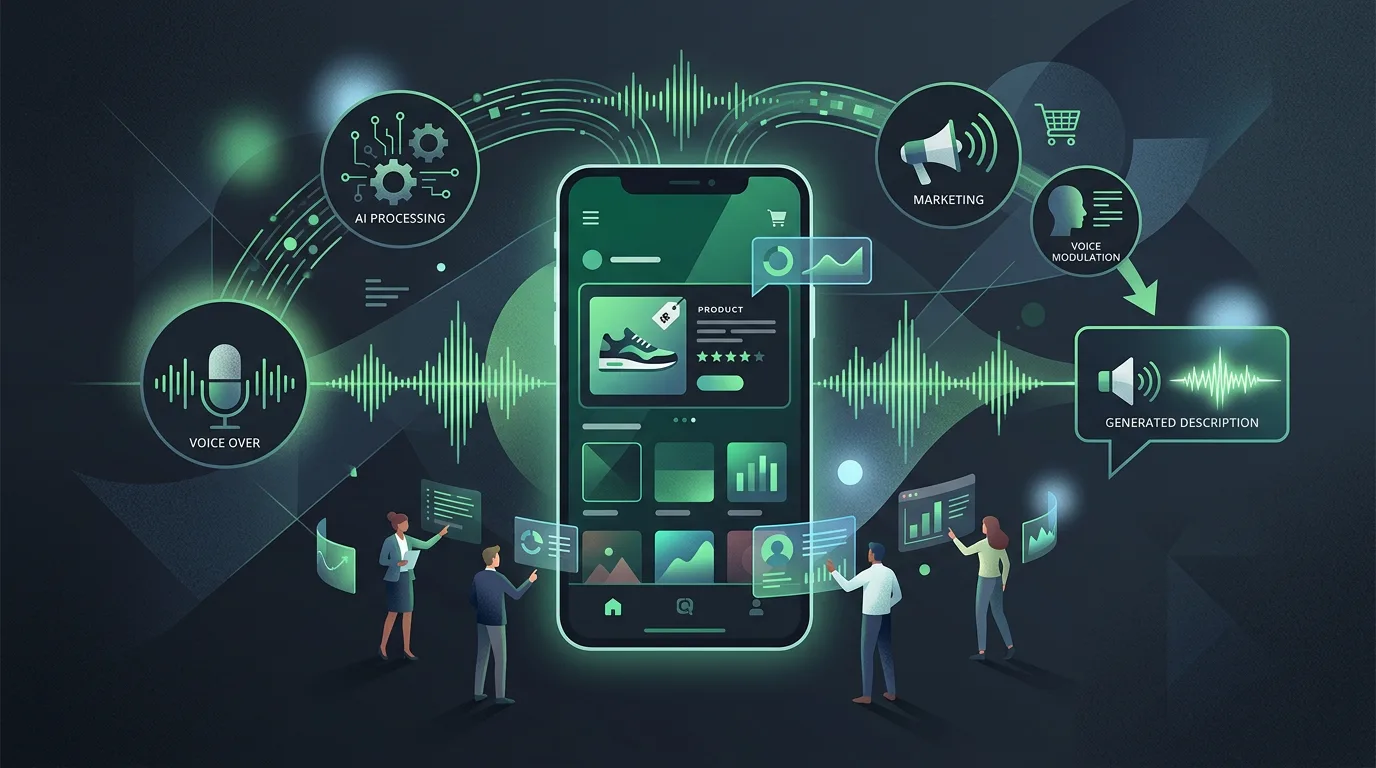
Figure: HEXOPS original illustration inspired by the topic (not a copy of the source article imagery) · Credit / further reading: dev.to
Section 3 — Generation Pipeline
- Generation is idempotent and cached. PASS if re-running the job for an unchanged script produces zero new API calls.
- Cache keys include script hash, voice ID, model version, and output format. FAIL if a voice model upgrade silently leaves stale audio in production.
- Batch jobs have per-item error isolation. One malformed script must not fail the whole run.
- There's a regeneration trigger on product update. FAIL if a price or spec change leaves outdated audio live for more than 24 hours.
- You retain the source scripts and generation parameters alongside the audio. Without them you cannot reproduce or audit an asset.
Section 4 — Delivery & Performance
- Audio is served as compressed, streamable files with
Content-Typeset correctly and byte-range support enabled. - Audio is on your CDN, not proxied live from the TTS provider. FAIL if a provider outage makes your product pages throw.
- Lazy loading is mandatory. Audio must not fetch until the user taps play. FAIL if page weight increases before interaction.
- There's a poster/decorative state before playback so no layout shift occurs on tap.
- You have a fallback. If audio 404s, the UI degrades to the text description without a broken player.
Section 5 — Accessibility & UX (blocking)
- The player is keyboard operable and screen-reader labeled. Button has an accessible name that changes with state ("Play product description" / "Pause").
- Audio never autoplays. FAIL for any autoplay, anywhere, ever.
- A transcript is available and linked. Voice supplements text; it never replaces it. FAIL if any product has audio as the only description.
- Playback state is announced via
aria-liveor equivalent. - Speed control and a visible scrubber exist. Listeners on mobile routinely use 1.25×–1.5×.
- The feature works with the screen reader's own TTS running. Test with VoiceOver and TalkBack active — the two audio streams must not fight.
Section 6 — Measurement
- You instrument play, 25/50/75/100% completion, and replay. FAIL if the only metric is "plays."
- Completion rate is tracked per voice and per category so you can spot a voice that's wrong for a segment.
- You have a holdout. A/B test pages with and without voice on conversion, add-to-cart, and return rate. FAIL if you shipped to 100% with no control group.
- Dwell time and bounce are segmented by device. Voice's lift is concentrated on mobile; blended numbers hide it.
- You've defined a kill criterion — e.g., "if completion drops below 40% for two consecutive weeks, we pull the feature for that category."
Section 7 — Cost & Governance
- Cost per 1,000 narrated SKUs is modeled and budgeted, including regeneration churn from catalog edits.
- You have a spend cap and alerting on the TTS account.
- Provider lock-in risk is assessed. PASS if your scripts and voice specs are stored provider-agnostically and a swap is a config change, not a rewrite.
- Data handling is reviewed. Confirm whether product scripts leave your jurisdiction and whether that matters for your catalog.
- An owner is named — a person, not a team, responsible for voice quality and regeneration.
The Ship Gate
You ship when: Sections 1, 2, and 5 are entirely PASS; you have a control group in Section 6; and Section 3's cache-key item passes. Everything else is a rollout-scoping decision, not a blocker.
The teams that get value from voice are the ones who treat it as an audio publishing pipeline with a content-normalization problem — because that's what it is. The teams that struggle shipped a demo and called it a product.
Sources
- Voice Developer, "Using AI Voice for E-Commerce Product Descriptions" — https://dev.to/voice_developer/using-ai-voice-for-e-commerce-product-descriptions-2dl7
- W3C, Web Content Accessibility Guidelines (WCAG) 2.2 — audio control, transcripts, and non-text content success criteria.
- W3C, Accessible Rich Internet Applications (ARIA) Authoring Practices — media player keyboard and state-announcement patterns.
- ElevenLabs documentation — voice cloning, model versioning, and pronunciation dictionaries.