
AI
Open-weight models have moved from hobbyist experiments to the shortlist for enterprise deployments. The pitch is familiar: lower cost, more control, and the freedom to fine-tune without renegotiating a vendor contract. But when the model itself is downloadable at no charge, the obvious question follows: who captures the value?
This FAQ breaks down the economics, the trade-offs, and the practical decisions teams face as open models, including capable Chinese releases, put pressure on pricing and product strategy.
What Is Driving the Open Source AI Boom?

Figure: Editorial context image from the source page (preview only; rights remain with the publisher) · Credit / further reading: techcrunch.com
What counts as open source AI?
Short answer: A model whose weights you can download and run, usually under a license that defines reuse.
Full open source in the software sense would also require open training data and training code, which is rare for frontier-scale models. Most so-called open models are open-weight: you get the parameters and often inference code, but not the full data recipe. The license matters as much as the download link, because it determines whether commercial use, redistribution, or derivative naming is allowed.
Why is adoption accelerating now?
Short answer: Cost control, data control, and customization.
Enterprises want to avoid per-token lock-in as usage scales. Governments and regulated industries want inference inside their own environments. Startups want to fine-tune on domain data without a lengthy procurement cycle. Capable open weights also let teams prototype on a laptop and deploy on rented GPUs, which shortens the path from experiment to production.
Who profits when the model itself is free?
Short answer: The layer around the model.
Cloud providers renting GPUs, inference hosts selling managed serving, systems integrators building vertical applications, and tooling vendors for evaluation, guardrails, and observability all capture revenue that is often more predictable than model licensing. The model author may earn less directly, but a widely used open model creates demand for the surrounding stack and for the author's own hosted or enterprise offerings.
How do model creators monetize open weights?
Short answer: Hosted inference, enterprise support, dual licensing, and ecosystem services.
The open release acts as distribution and credibility. Revenue comes from convenience and accountability: a managed endpoint with an SLA, a supported version with security patches, a commercial license for restricted use cases, or consulting for fine-tuning and deployment. The bet is that most users will pay for operational certainty rather than run everything themselves.
Why does Hugging Face matter in this economy?
Short answer: It sits at the discovery layer.
Hubs, model cards, datasets, and evaluation tooling reduce search costs. When hundreds of models compete, the ability to compare licenses, benchmarks, and community feedback becomes a marketplace function. That position lets the hub connect model authors with compute providers and service vendors, which is valuable even if the downloads are free. The source discussion is worth reading for context on how this ecosystem is evolving: TechCrunch.
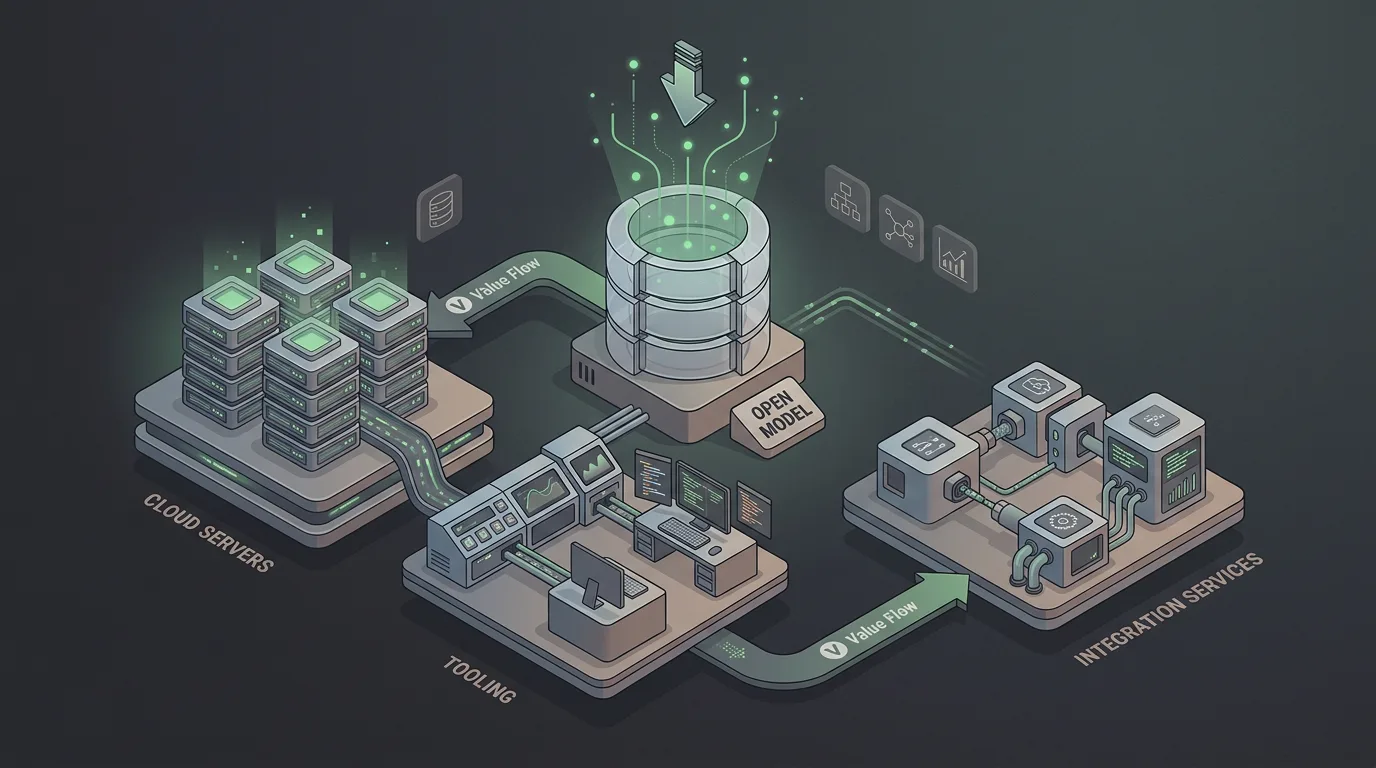
Figure: HEXOPS original illustration inspired by the topic (not a copy of the source article imagery) · Credit / further reading: techcrunch.com
Where do enterprises actually capture value?
Short answer: In proprietary data and workflows.
Open weights lower the cost of the model layer, which shifts advantage to what surrounds it: internal data, retrieval pipelines, domain evaluation sets, and integration into day-to-day operations. A generic model plus your proprietary workflow is often more defensible than a slightly better generic model alone. The winning teams treat the model as a component, not the product.
Are Chinese open models a competitive threat?
Short answer: They are a price anchor.
Widely available, capable weights put downward pressure on API pricing everywhere. That forces labs to differentiate on safety, tooling, enterprise trust, and vertical solutions rather than raw capability alone. For buyers, the practical effect is more choice and more negotiating leverage, provided the license and compliance review hold up.
What are the hidden costs of free models?
Short answer: GPUs, engineering, evaluation, security patching, and legal review.
A free download can cost more than a paid API once you staff inference, handle autoscaling, build monitoring, and track license obligations. Teams often underestimate the cost of evaluation: you need representative tasks and human review to know whether a smaller open model is good enough. Budget for the full stack, not just the weights.
How should teams choose between open and closed models?
Short answer: Start with the constraint, not the benchmark.
If data cannot leave your environment, open weights are often the only viable path. If you need frontier reasoning with minimal operations burden, a closed API may be cheaper in total cost of ownership. Many teams end up hybrid: closed models for hard reasoning tasks, open models for high-volume, privacy-sensitive, or latency-critical work.
What governance issues arise?
Short answer: License compliance, provenance, evaluation drift, and sector rules.
Keep an inventory of every model, version, license, and deployment location. Track changes when you update weights, because behavior can shift. Check export controls, procurement rules, and industry-specific obligations before production. Governance is less about banning tools and more about making the model supply chain visible.
What talent matters most?
Short answer: Evaluation and inference engineering.
The scarce skills are measuring model quality on your own tasks and serving models cheaply and reliably. Prompt engineering is useful, but the durable advantage comes from building evaluation sets, managing latency and cost, and knowing when a smaller model beats a larger one. Those skills transfer across vendors and model families.
What is the bottom line for operators?
Short answer: Treat models as commodities and your data as the asset.
Assume model quality will keep improving and prices will keep falling. Design your architecture so you can swap models without rewriting the product. Invest in proprietary data, evaluation, and integration. That is where the value is captured, whether the weights are free or not.
Key takeaways
- Open weights shift value from model licensing to cloud, tooling, integration, and support.
- Enterprises capture advantage through proprietary data, evaluation, and workflow integration.
- Chinese open models act as a price anchor, increasing buyer choice and leverage.
- Free downloads still carry real costs: GPUs, engineering, security, and legal review.
- Most organizations should plan for a hybrid model strategy and model-swappable architecture.
Next steps
- Inventory every model in use, including license, version, and deployment location.
- Build a small, representative evaluation set for your own tasks before choosing a model.
- Estimate total cost of ownership for open versus closed, including engineering time.
- Design an abstraction layer so models can be swapped without product rewrites.
- Review licensing, export, and sector compliance before any production rollout.