Tools
From CSV Chaos to Clean Data: An AI Janitor Tool Roundup
Every team has one: a folder of exports that nobody trusts. Order totals keyed in as text, tenure columns that go negative, dates in three regional formats, trailing whitespace on join keys. The work of fixing it is real engineering work, but it is rarely planned for — so it lands on whoever opens the file last.
A new crop of tools is attacking exactly that gap, framing itself as the janitor rather than the analyst. One recent open-source entry, SnoozeOps, pitches the idea bluntly: you sleep, the cleaning happens. That framing is catchy, but the category it belongs to is wider and more uneven than a single demo suggests. Below is a working roundup, organised by where your mess actually lives.
Why the AI data janitor category is suddenly crowded
Three things changed at once. First, LLMs got good enough to infer intent from column names and sample values, which means a tool can guess that a column of five-digit integers under a header like order_total_cents is probably money, not a count. Second, file-based data volume exploded — everyone exports to CSV because it always works, and nobody validates because nothing forces them to. Third, open-source maintainers discovered that data prep is a satisfying hackathon target: the scope is bounded, the before/after is visible, and the demo lands well.
The result is a category with very different maturity levels wearing the same label. Some of these are genuine engineering tools with test suites; others are a prompt wrapped around pandas. Knowing which is which is the difference between buying back hours and adding a new source of silent corruption.
Figure: Editorial context image from the source page (preview only; rights remain with the publisher) · Credit / further reading: dev.to
The roundup: pick by where the mess lives
1. SnoozeOps — open-source triage for ad-hoc file cleaning
The pitch is a scripted janitor that scans a spreadsheet or CSV and flags the usual suspects: broken formulas, decimal slips, impossible values, inconsistent categories. For a developer who receives a one-off export and needs a defensible first pass before loading it into a warehouse, that is genuinely useful.
Use it when your problem is intermittent and file-shaped — a monthly export, a vendor drop, a colleague's hand-edited sheet. Skip it when the data is already in a pipeline; you want validation enforced at ingestion, not a manual scan afterward. Pricing caveat: it is open source, so the licence is free, but the cost moves to maintenance — you own the rules, you own the false-positive tuning, and you own the upgrade path when your file schemas drift.
2. OpenRefine with an LLM extension
The veteran of the category, and still the strongest free option for messy categorical data. Clustering and faceting were doing fuzzy deduplication long before anyone said AI; bolting an LLM onto the reconciliation step makes the manual judgement calls faster.
Use it when you need an auditable, step-by-step record of every transformation — a real advantage over a chat window. Skip it when you need repeatable automation on a schedule; it is an interactive workbench, not a cron job. Pricing caveat: free, but it runs locally, so the hidden cost is the analyst's time and the fact that nothing is version-controlled unless you export the operation history yourself.
3. Mito and Rows — AI-native spreadsheet grids
These keep the grid but put an assistant in it, generating formulas and Python from plain-language instructions while showing the code it produced. For analysts who live in spreadsheets but want a scriptable escape hatch, the transparency matters more than the cleverness.
Use them when the deliverable is still a sheet and stakeholders expect to open it. Skip them when the task is one-off at scale or must run unattended. Pricing caveat: freemium with seat-based tiers and usage limits on AI actions. The trap is silent expansion — one power user on a paid tier is cheap, twenty occasional users each burning assistant credits is not. Audit seats quarterly.
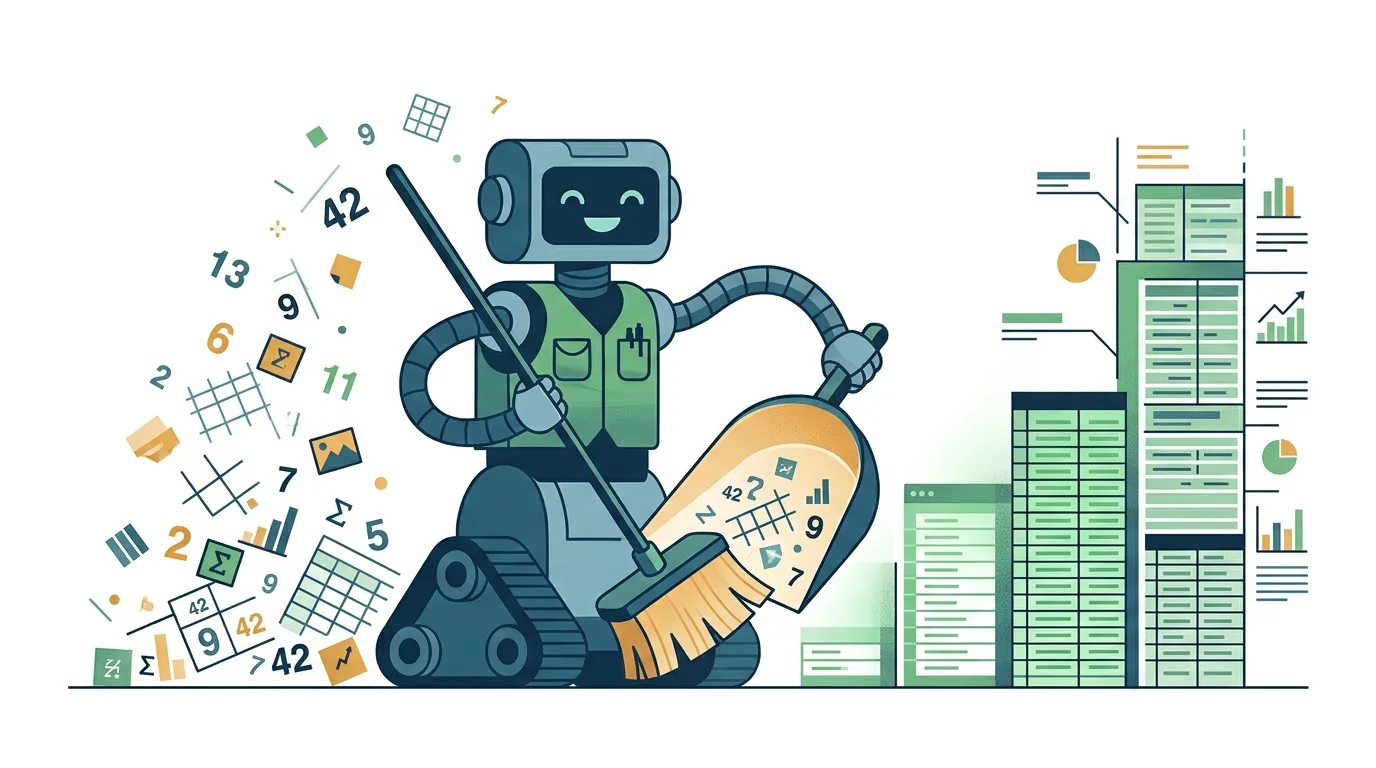
Figure: HEXOPS original illustration inspired by the topic (not a copy of the source article imagery) · Credit / further reading: dev.to
4. PandasAI and ydata-profiling — the developer-side stack
Profiling first, then targeted cleaning. ydata-profiling gives you a structured report on nulls, cardinality and distribution in seconds; PandasAI lets you query a dataframe in natural language. Combined, they cover most of what a janitor tool does, with the advantage of living in your own repo.
Use them when you have engineering capacity and want cleaning logic reviewable in a pull request. Skip them when the person with the messy file cannot write Python. Pricing caveat: libraries are free; the LLM calls are not. A natural-language layer over a large dataframe can burn tokens fast if prompts are not scoped to summaries rather than raw rows. Budget per-run, not per-month.
5. Great Expectations and Soda Core — validation as a contract
These do not clean; they refuse. You declare what correct looks like — no negative tenure, order totals within range, referential integrity on customer IDs — and the pipeline fails loudly when reality diverges.
Use them when data quality is a recurring production concern and you need alerts, not artisanal fixes. Skip them when you are still exploring and the schema is genuinely undefined; premature contracts generate noise. Pricing caveat: the cores are open source, while hosted dashboards and orchestration are commercial. The real cost is authoring and maintaining expectations — treat that as a standing task, or the suite rots into a wall of ignored warnings.
6. Cleanlab — when the data is training data
A different problem: label errors, outliers and confidently-wrong annotations in ML datasets. If your cleaning goal is model performance rather than reporting accuracy, generalist janitors will miss the point entirely.
Use it when you own a labelled dataset and suspect annotation noise. Skip it when your data is transactional and unlabelled. Pricing caveat: open-source core with commercial tiers for teams; check licensing terms before embedding it in a product, since the free tier is meant for evaluation and internal use.
7. Copilot and Gemini inside Excel and Sheets — the bundled tier
The path of least resistance, and often the correct first step. If your team already pays for a productivity suite, the assistant is effectively already purchased.
Use it when the work is light, interactive and stays inside the grid. Skip it when you need reproducibility — these tools rarely leave an auditable trail of what they changed. Pricing caveat: bundled, but that means it disappears when you switch suites, and admin controls over what data leaves the tenant are the real decision factor, not the price.
The cost traps nobody puts on the landing page
Token spend is the obvious one, but the sharper risk is trust without verification. An AI janitor that silently rewrites a column and reports success is worse than no janitor at all. Insist on diffs: what changed, in which rows, and why. If a tool cannot tell you that, it is a demo, not a tool.
The second trap is rule sprawl. Every ad-hoc cleaning script accumulates exceptions until nobody remembers which ones still matter. The third is seat creep — AI features are priced for enthusiasts and audited by nobody.
A short selection checklist
- Does the tool output a reviewable change log, or only a cleaned file?
- Can the cleaning logic run in CI, or only in a UI?
- What leaves your environment when the assistant is invoked?
- Who owns the rules when the schema drifts six months from now?
- Is the pricing per seat, per run, or per token — and which one scales with your worst month?
Key takeaways
- The AI data janitor label spans four distinct jobs: ad-hoc file triage, interactive reconciliation, scriptable profiling, and pipeline validation. Pick the job first.
- Open source removes the licence fee and installs a maintenance bill. Budget for rule ownership, not just adoption.
- Bundled assistants are the cheapest entry point and the weakest audit trail. Use them for exploration, not for anything downstream teams depend on.
- The non-negotiable feature is a diff. A cleaner that cannot show its work is a liability.
Next steps
Run a one-week trial on your worst real file, not a toy dataset. Instrument it with three questions: does it produce a reviewable diff, does it run unattended, and what does it cost at your busiest month's volume. Then decide between the open-source triage route and a validation-first pipeline — most teams eventually need both, and knowing which one you are buying prevents the expensive middle ground where neither is trusted.
Sources
- SnoozeOps announcement on Dev.to: https://dev.to/megh_shah_b6bd27d23860b05/i-built-snoozeops-an-open-source-ai-data-janitor-that-does-the-boring-spreadsheet-work-1i41